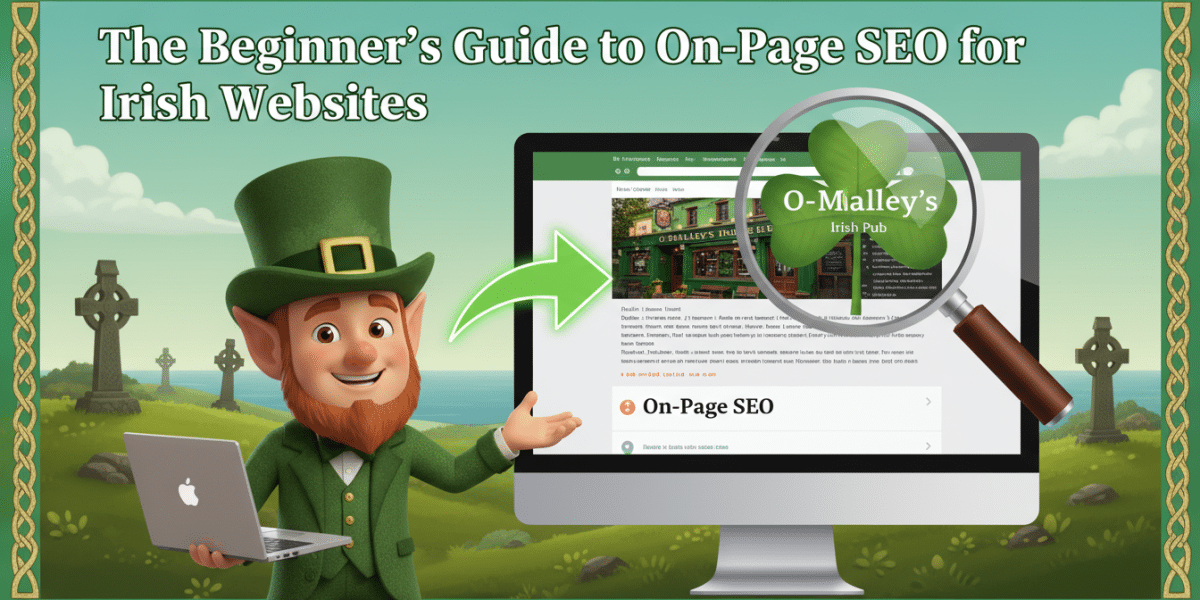
The Beginner’s Guide to On-Page SEO for Irish Websites: Your Roadmap to Digital Visibility
In today’s bustling digital marketplace, having a website is just the first step. To truly connect with your audience, whether they’re down the road in Cork or across the country in Donegal, your website needs to be found. That’s where search engine optimisation (SEO) comes in. Specifically, on-page SEO is your secret weapon for telling search engines exactly what your content is about, helping you rank higher and attract the right visitors.
This comprehensive article serves as The Beginner’s Guide to On-Page SEO for Irish Websites, designed to demystify the process and equip you with the practical knowledge to boost your online presence right here on the Emerald Isle. Forget confusing jargon; we’re going to break down the essentials into clear, actionable steps that anyone can follow.
What is On-Page SEO and Why Does it Matter for Ireland?
Think of on-page SEO as everything you can control on your website to improve its visibility in search engine results. It’s about optimising individual web pages to rank higher and earn more relevant traffic. This includes the content itself, the images you use, your site’s technical structure, and even how quickly your pages load.
For Irish websites, on-page SEO is particularly vital. The Irish market, while vibrant, is also competitive. Whether you’re a local artisan selling handmade crafts, a Dublin-based digital marketing agency, or a rural B&B, you’re competing for attention. By optimising your on-page elements, you can signal to Google that your content is the most relevant answer to a user’s query, especially when that query has local intent. This means more eyes on your business, more customers through your virtual (or physical) doors, and ultimately, greater success in the Irish digital landscape.
Keyword Research: Finding Your Irish Audience
Before you write a single word, you need to know what words your potential customers are actually typing into Google. This is the cornerstone of any effective on-page SEO strategy.
Understanding Local Search Intent
For Irish businesses, understanding local search intent is paramount. People searching for a “plumber” might just want any plumber, but someone searching for “emergency plumber Galway” has clear local intent. Your keyword research should reflect this. Think about:
- Geographic modifiers: “best coffee shop Dublin,” “accountant Limerick,” “hotel Dingle.”
- Specific products/services with local relevance: “Irish wool blankets online,” “trad music sessions Cork.”
- Local events or attractions: “things to do in Killarney,” “Puck Fair dates.”
Tools like Google Keyword Planner, SEMrush, or Ahrefs can help you find relevant keywords, but always filter your results for Ireland to get accurate search volumes and competition levels.
Embracing Long-Tail Keywords
While “shoes” is a broad term, “women’s comfortable walking shoes for Dublin city breaks” is a long-tail keyword. These longer, more specific phrases might have lower search volumes, but they often convert better because they indicate a user who knows exactly what they’re looking for.
For an Irish website, a long-tail keyword could be “gluten-free bakeries near me Sligo” or “sustainable Irish gifts for him.” Incorporating these naturally into your content can attract highly qualified leads.
Analysing Competitors
Take a look at what your Irish competitors are ranking for. What keywords are they targeting? What kind of content are they creating? This isn’t about copying, but about identifying gaps and opportunities. Perhaps they’re overlooking a specific long-tail keyword or a niche service that you offer.
Crafting Compelling Content: More Than Just Words
Once you have your keywords, it’s time to weave them into high-quality, engaging content that delights both your readers and search engines.
Optimising Title Tags & Meta Descriptions
These are your website’s shop window in the search results.
- Title Tag (H1): This is arguably the most important on-page element. It should contain your primary keyword, accurately describe the page’s content, and be compelling enough to encourage a click. Keep it under 60 characters to avoid truncation.
- Example for an Irish website: Instead of “Services,” try “Web Design Dublin | Creative Digital Solutions for Irish Businesses.
- Meta Description: While not a direct ranking factor, a well-written meta description significantly impacts click-through rates. It should summarise the page content, include your primary keyword, and offer a clear call to action. Keep it under 160 characters.
- Example: “Boost your online presence with our expert web design services in Dublin. Bespoke, responsive websites crafted for Irish SMEs. Get a free quote today!”
Strategic Use of Header Tags (H1, H2, H3)
Header tags (H1, H2, H3, etc.) provide structure to your content, making it easier for readers and search engines to understand the hierarchy of information.
- Use only one H1 tag per page – it’s your main title.
- Use H2s for main sections and H3s for subsections.
- Incorporate your keywords naturally into these headers where it makes sense, but never force them. The goal is readability and clarity first.
High-Quality, Relevant Content
This is where the “real readers” part comes in. Google prioritises content that provides genuine value. Your content should be:
- Comprehensive: Answer user questions thoroughly.
- Unique: Don’t just regurgitate what others have said.
- Engaging: Use storytelling, examples, and a friendly tone.
- Relevant: Directly address the intent behind your target keywords.
For an Irish website, this means creating content that resonates with local audiences. Share local stories, provide specific Irish examples, or discuss topics relevant to the local community (e.g., “Best Walks in the Burren,” “Supporting Irish Producers This Christmas”).
Image Optimisation (Alt Text)
Images make your content more appealing, but they also need to be optimised for SEO.
- File Names: Use descriptive, keyword-rich file names (e.g.,
galway-claddagh-ring.jpginstead ofIMG_001.jpg). - Alt Text: This describes the image for visually impaired users and search engines. Include relevant keywords where appropriate, but describe the image accurately.
- Example: For an image of a landmark:
alt="Cliffs of Moher at sunset in County Clare, Ireland". This helps Google understand the image’s context and can also help your images appear in image search results.
- Example: For an image of a landmark:
Technical On-Page Elements: The Nuts and Bolts
Beyond your content, several technical elements on your page influence your SEO performance.
SEO-Friendly URL Structure
Your URLs should be clean, concise, and descriptive. They should include your primary keyword and reflect the page hierarchy.
- Bad URL:
www.youririshsite.ie/p?id=123&cat=4 - Good URL:
www.youririshsite.ie/services/web-design-dublinorwww.youririshsite.ie/blog/beginner-seo-irish-websites
This makes it easy for both users and search engines to understand what the page is about before they even click.
Internal Linking
Internal links connect one page of your website to another. They are crucial for:
- Navigation: Helping users discover more of your content.
- SEO: Distributing “link equity” (ranking power) around your site.
- Relevance: Signalling to search engines which pages are important and what they are about.
Link relevant blog posts, service pages, and product pages together. For instance, an article on “Best Hiking Trails in Wicklow” could link to your “Accommodation in Wicklow” page. Always use descriptive anchor text (the clickable text) that includes relevant keywords.
External Linking (Outbound Links)
Linking out to authoritative, relevant external websites can add value for your users and demonstrate to Google that your content is well-researched and trustworthy. If you mention a statistic, link to the source. If you recommend a related non-competitor business (e.g., a local tourism board), link to them.
User Experience (UX) and Site Performance: Happy Visitors, Happy Google
Google increasingly prioritises user experience. A website that’s a joy to use will naturally perform better in search.
Mobile-Friendliness
Ireland is a nation of smartphone users. If your website isn’t responsive and doesn’t display perfectly on all devices, you’re losing potential customers. Google uses mobile-first indexing, meaning the mobile version of your site is the primary one used for ranking. Ensure your site loads quickly and is easy to navigate on phones and tablets.
Page Speed
Slow-loading pages are a user’s worst nightmare and a conversion killer. Google penalises slow websites. Optimise your images, minimise code, and consider using a reliable Irish hosting provider or a Content Delivery Network (CDN) to speed things up. Tools like Google’s PageSpeed Insights can help you identify and fix speed issues.
Readability and Engagement
Beyond just content, how readable is your content? Use:
- Short paragraphs: As you see in this article!
- Bullet points and numbered lists: Break up text.
- Subheadings: Guide the reader.
- Concise language: Get to the point.
An engaging layout keeps users on your page longer, which is another positive signal to search engines.
Local SEO Nuances for the Emerald Isle
For any Irish business with a physical location or a service area within Ireland, local SEO is non-negotiable.
Google Business Profile (GBP) Optimisation
This is your most powerful local SEO tool. Claim and fully optimise your Google Business Profile listing with accurate information:
- NAP Consistency: Ensure your Name, Address, and Phone number are identical across your website, GBP, and all online directories.
- Categories: Choose the most specific categories for your business.
- Photos: Upload high-quality photos of your business, products, and team.
- Reviews: Encourage customers to leave reviews and respond to them professionally.
- Posts: Use GBP posts to announce news, offers, or events.
This helps you appear in the “local pack” – the map results that show up for local searches like “restaurants near me Dublin.”
Local Citations and Directories
Beyond Google Business Profile, ensure your business is listed in relevant Irish online directories like Goldenpages.ie, Yelp, and industry-specific Irish directories. The more consistent citations (mentions of your NAP) you have across the web, the more trustworthy your business appears to search engines.
Putting It All Together: A Holistic Approach
The Beginner’s Guide to On-Page SEO for Irish Websites isn’t about applying one trick, but about integrating many small improvements into a cohesive strategy. Think of your website as a well-oiled machine, where every component plays a vital role.
Start small. Pick one page to optimise thoroughly. Conduct keyword research, refine your title and meta description, improve your content, add internal links, and ensure images are optimised. Then, move on to the next page. Consistency and patience are key. SEO isn’t an overnight fix; it’s a marathon, not a sprint. But with each step you take, you’re building a stronger, more visible online presence for your Irish business.
Conclusion: Your Journey to Digital Visibility Begins Now
Navigating the digital world can feel like a daunting task, but with a clear understanding of on-page SEO, Irish websites have a powerful tool at their disposal to stand out. From meticulous keyword research tailored to the local market to crafting engaging content and ensuring a seamless user experience, every element contributes to your search engine success.
By implementing the strategies outlined in this beginner’s guide, you’re not just optimising for search engines; you’re building a better, more accessible website for your Irish customers. So, take these insights, apply them to your digital presence, and watch as your website climbs the search rankings, bringing your unique offerings to a wider audience across Ireland and beyond. The craic is online, and now you have the map to find it!
Dublin's ROI-Driven Digital Marketing Agency Home
Related Posts
 What a Good Bounce Rate Looks Like for Irish Websites
 On Page SEO Optimization for Irish Business Websites
 The Ultimate Guide to Choosing a CMS for Irish Business Websites
 The Ultimate Guide to Winning Featured Snippets in Ireland
 Building DIY Websites for Dummies
 Delivery, Returns and Size Guide Pages: Hidden SEO Value
 SEO FAQs for Irish Businesses: What to Expect | Globe Boss
 Performance Max Campaigns: A Guide for Irish Advertisers