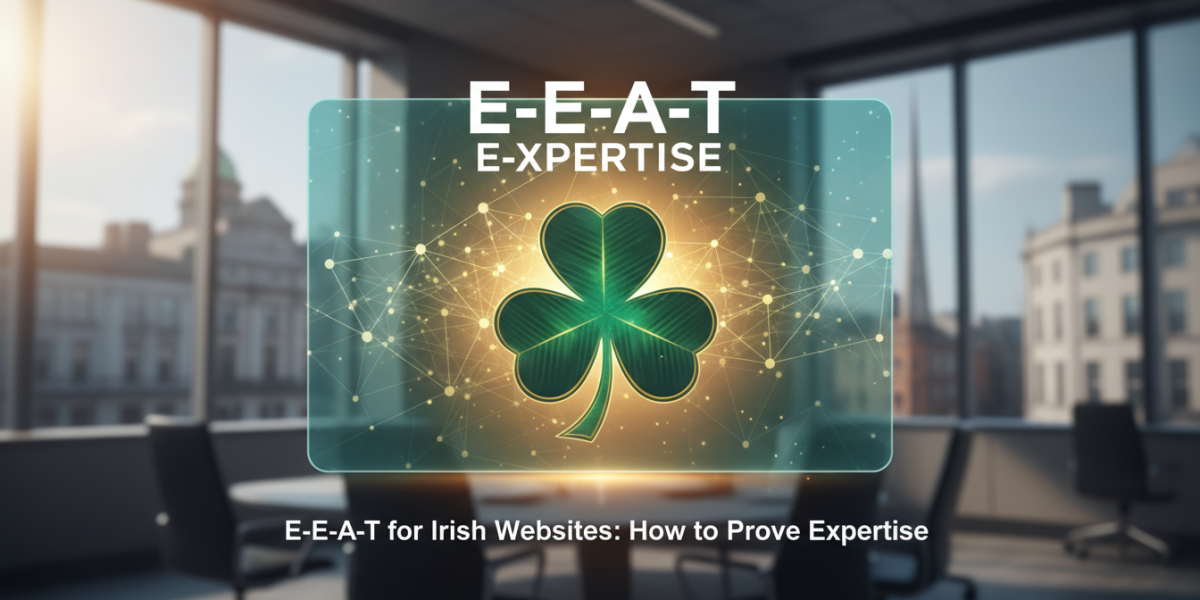
If you run a business website in Ireland, you’ve probably heard the term E-E-A-T floating around in SEO conversations. But what does it actually mean in practice, and why does it matter for Irish websites specifically? E-E-A-T — which stands for Experience, Expertise, Authoritativeness, and Trustworthiness — is Google’s framework for evaluating the quality and credibility of web content. It’s not a direct ranking factor in the traditional sense, but it heavily influences how Google’s quality raters assess your site, and that assessment shapes how well your pages perform in search.
For Irish businesses competing in both local and international markets, understanding and demonstrating E-E-A-T isn’t optional. It’s the difference between being seen as a credible source and being lost in a sea of generic, forgettable content.
What E-E-A-T Actually Means (And Why the Extra "E" Matters)
Google’s Search Quality Rater Guidelines have been around since 2014, but the framework was updated in late 2022 to add the extra "E" for Experience. That addition was significant.
Previously, you could demonstrate expertise through credentials and qualifications alone. Now, Google also wants to see that you have real, lived experience with the topic you’re writing about. A personal injury solicitor in Dublin writing about the claims process carries far more weight than a generic content writer recycling legal jargon. A Cork-based accountant sharing specific insights about Revenue.ie filings signals something a broad financial blog simply cannot.
Breaking Down Each Element
- Experience — Have you actually done the thing you’re describing? First-hand knowledge, case studies, and real-world examples all signal this.
- Expertise — Do you have the knowledge, training, or qualifications to be a credible voice on this subject?
- Authoritativeness — Are others in your industry recognising and referencing you? Backlinks, mentions, and reviews all contribute here.
- Trustworthiness — Is your site transparent, secure, and honest? This is arguably the most important of the four.
Each element reinforces the others. A Galway-based financial advisor who writes detailed, accurate content, earns references from reputable Irish finance publications, and displays their Central Bank of Ireland authorisation number on their website is ticking every box.
Why Irish Websites Face Unique Challenges
Ireland is a small market with a highly connected professional community. That can be both an advantage and a disadvantage when it comes to E-E-A-T.
On one hand, niche expertise is easier to establish. If you’re one of thirty certified structural engineers in Limerick, your authority in that geographic context is genuinely valuable. On the other hand, many Irish SMEs are competing with larger UK or US websites that have far greater content budgets, more established backlink profiles, and years of domain authority built up.
The Local Trust Gap
Irish consumers are also increasingly cautious online. According to research from the Competition and Consumer Protection Commission (CCPC), trust in online businesses has become a significant factor in purchasing decisions — particularly for services involving personal data, health, or finance. If your website doesn’t clearly signal who you are, where you’re based, and why you should be trusted, you’re leaving conversions on the table alongside search rankings.
Adding your Eircode, displaying your company registration number from the Companies Registration Office (CRO), and making your team visible are all small steps that carry real weight with both users and Google’s quality assessment systems.
How to Demonstrate Experience on Your Website
Experience is the newest addition to the framework, and it’s the one most Irish businesses are slowest to act on. Here’s how to show it effectively.
Use real case studies. Don’t just say you’ve worked with over 200 clients — show what that work looked like. A Waterford web agency might profile a project where they rebuilt a local retailer’s e-commerce site and increased monthly revenue by 34% within six months. Specific numbers. Specific outcomes. That’s experience made visible.
Write in the first person where appropriate. Blog posts and guides that include phrases like "in our experience working with Irish SMEs" or "when we were setting up our own practice in 2018" feel authentic because they are. Readers — and Google’s guidelines — respond to genuine voice.
Include photos and behind-the-scenes content. Images of your team at work, your office, your tools, or your events build a picture of a real, operating business. This is particularly impactful for trades, healthcare providers, and professional service firms.
Building Expertise Signals That Google Can Read
Expertise is about demonstrating depth, not just breadth. Here’s what that looks like in practice.
Author Bios That Actually Say Something
Every piece of content on your site should have a clearly identified author. Not just a name — a bio that explains why that person is qualified to write on the topic. A physiotherapist in Drogheda writing about rehabilitation after sports injury should have their CORU registration number, years of clinical experience, and any specialist training mentioned in their bio.
Google’s quality raters are specifically instructed to look for author credentials on YMYL (Your Money, Your Life) topics — anything touching health, finance, legal matters, or safety. In Ireland, this includes regulated professions like financial advisers (Central Bank), solicitors (Law Society of Ireland), and medical professionals (Medical Council of Ireland).
Content Depth Over Content Volume
Publishing fifty shallow blog posts won’t build expertise. Publishing ten genuinely thorough, well-researched articles will. Aim to cover topics with the kind of detail that answers the follow-up questions a reader might have, not just the surface-level query.
A good test: if someone read your article and didn’t need to Google anything else on that topic, you’ve probably achieved the right depth.
Authoritativeness: Getting Others to Vouch for You
You can’t manufacture authority — it has to be earned. But there are deliberate, ethical steps you can take to build it over time.
Earn backlinks from reputable Irish sources. Coverage or links from outlets like the Irish Times, Business Post, RTE.ie, or industry-specific publications like the Irish Medical Times carry significant weight. Local chamber of commerce listings, professional body directories (such as Engineers Ireland or the Irish Taxation Institute), and supplier directories all contribute too.
Get active in your professional community. Speaking at industry events, contributing to trade publications, or being quoted in news stories all create external signals of authority that no amount of on-site optimisation can replicate.
Encourage and respond to reviews. Google Reviews, Trustpilot, and industry-specific platforms all matter. A business with 80 genuine Google Reviews averaging 4.7 stars signals something fundamentally different to one with 3 reviews and no responses. And responding to reviews — even negative ones — demonstrates accountability, which feeds directly into trustworthiness.
Trustworthiness: The Foundation Everything Else Rests On
Of the four elements, Google has explicitly stated that trust is the most critical. A site can have demonstrable expertise and real experience, but if it doesn’t feel trustworthy, none of that matters.
Technical Trust Signals
Start with the basics. Your site should have:
- HTTPS (the padlock in the browser bar) — non-negotiable in 2024
- A clear, functional privacy policy compliant with GDPR (particularly important given Ireland’s role as the EU data regulator hub)
- Visible contact information including a physical address, phone number, and email
- An up-to-date About page that explains who you are and what you do
Transparency and Accuracy
Don’t make claims you can’t back up. If you say you’re "Ireland’s leading" anything, you need evidence for that. Vague superlatives damage trust with savvy readers and can attract scrutiny from the ASAI (Advertising Standards Authority for Ireland).
Being transparent about your pricing, your process, and your limitations builds more trust than polished marketing language ever will.
Practical E-E-A-T Audit: Five Things to Check on Your Site This Week
You don’t need to overhaul your entire website overnight. Start with these five checks:
- Do all your blog posts and articles have named authors with relevant credentials in their bio?
- Is your About page current, specific, and does it mention key team members by name?
- Do you display your company registration number, regulatory authorisation, or relevant professional membership?
- Is your contact information easy to find — ideally in the header or footer of every page?
- Do you have at least one real case study or client success story on your site?
If the answer to any of these is no, you’ve found a starting point.
Frequently Asked Questions
What is E-E-A-T and does it directly affect my Google rankings?
E-E-A-T stands for Experience, Expertise, Authoritativeness, and Trustworthiness. It’s not a standalone ranking factor with a measurable score, but it’s central to how Google’s quality raters evaluate websites — and those evaluations inform algorithm development. Sites that demonstrate strong E-E-A-T tend to rank better over time, particularly in competitive or sensitive niches.
How do I prove expertise if I’m a small Irish business without a big profile?
Start with what you have. Clear author bios, detailed and accurate content, visible qualifications or registrations, and genuine client testimonials all contribute. You don’t need national press coverage — local authority and niche depth are perfectly valid in Google’s eyes, especially for location-based searches.
Is E-E-A-T more important for some industries than others?
Yes. Google applies heightened scrutiny to YMYL (Your Money, Your Life) topics — health, finance, legal, and safety-related content. If your Irish business operates in any of these sectors, getting E-E-A-T right is especially critical. A financial planning firm in Dublin with no regulatory credentials displayed is at a significant disadvantage compared to one that clearly signals its Central Bank authorisation.
How long does it take to see results from improving E-E-A-T?
It’s not a quick fix. Building genuine authority and trust takes months, not days. However, addressing basic trust signals — HTTPS, contact information, author bios, and accurate content — can have a positive impact relatively quickly because they reduce friction for users and quality raters alike.
Can I outsource my content and still demonstrate E-E-A-T?
Yes, but it requires care. Content written by external writers should be reviewed and signed off by a qualified team member whose credentials are displayed. The author attribution should reflect someone with genuine expertise in the topic. Ghost-writing is common and accepted, but the named author needs to be real and credible.
Conclusion
E-E-A-T isn’t a technical checklist you run through once and forget. It’s a reflection of how your business presents itself online — and whether the signals you’re sending match the reality of who you are and what you know. For Irish websites, where trust in online businesses is hard-won and local credibility carries real weight, getting this right is one of the most valuable investments you can make in your digital presence.
The good news is that most of the improvements aren’t complicated. They’re about being transparent, being specific, and letting genuine expertise speak clearly rather than hiding behind generic marketing language. Start with the basics, build consistently, and the authority will follow.
Ready to strengthen your website’s credibility and improve your search performance? The team at GlobeBoss works with Irish businesses to build content strategies grounded in genuine expertise and sustainable SEO. Whether you want a full E-E-A-T audit, help developing authoritative content, or just want to talk through your options, we’re here to help. Email us at moc.ssobebolg@ofni or call +353 1 868 2345 — we’d be glad to have a conversation.
Related Posts
 Crawl Budget Optimisation for Large Irish Websites
 The Ultimate Guide to Choosing a CMS for Irish Business Websites
 The Generative Engine Optimisation Handbook for Irish Websites
 7 Ways to Prove Your Expertise to Google and Irish Customers
 Content Pruning: Why Less Is More for Irish Websites
 The Beginnerʼs Guide to On-Page SEO for Irish Websites
 What a Good Bounce Rate Looks Like for Irish Websites
 On Page SEO Optimization for Irish Business Websites