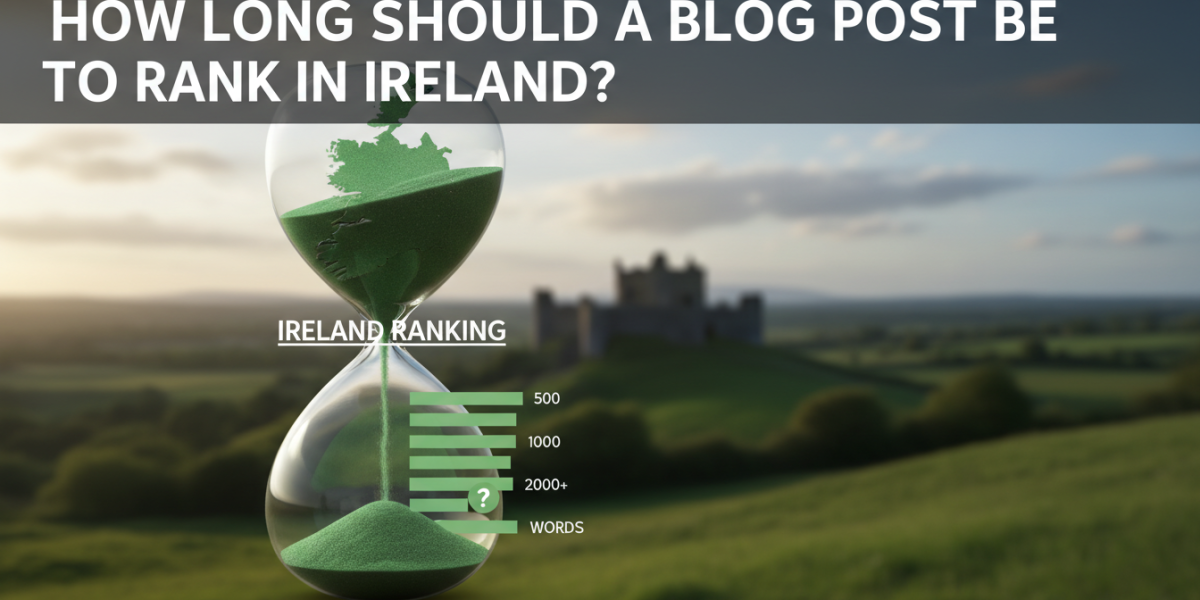
If you’ve ever stared at a finished blog post wondering whether it’s long enough to rank on Google, you’re not alone. It’s one of the most common questions Irish business owners and marketers ask when they start investing in content. The honest answer? There’s no single magic number — but there are clear patterns, and understanding them can genuinely transform your content strategy.
This guide breaks down what the research and real-world results tell us about blog post length, with specific attention to what works in the Irish market.
Why Word Count Still Matters for Blog Post Rankings
Let’s be clear from the start: Google doesn’t rank content based on word count alone. However, longer, well-structured posts tend to rank better — not because they’re long, but because length usually correlates with depth, detail, and usefulness.
A post that thoroughly answers a question will naturally be longer than one that skims the surface. That depth signals to search engines that the content is authoritative and worth showing to readers.
The Research Behind Word Count and SEO
Multiple studies over the years have pointed in a consistent direction. HubSpot has found that long-form content between 2,100 and 2,400 words tends to perform well in search. Backlinko’s analysis of over a million Google search results found that the average first-page result contains around 1,447 words.
These aren’t rules — they’re patterns. And patterns are worth paying attention to, especially when you’re building a content strategy from the ground up.
What "Ranking in Ireland" Actually Means
Here’s where local nuance matters. Ranking in Ireland is slightly different from ranking globally, and it’s worth understanding why.
When someone in Dublin, Cork, or Galway searches Google, they’re served results that Google considers most relevant to their location and search intent. For Irish businesses, this means competing against local competitors first, not necessarily against major international sites.
Lower Competition Can Work in Your Favour
For many Irish search terms — particularly those with geographic modifiers like "accountant in Limerick" or "plumber Dublin" — the competition is far lower than it would be in the UK or US. This means a well-written, moderately long post of 800–1,200 words might genuinely outrank thinner content from local competitors.
However, for broader topics without location modifiers, you’re competing in a wider pool. That’s when longer, more authoritative content becomes essential.
Local Intent Changes the Target Length
Consider the difference between these two searches:
- "How long should a blog post be" — broad, competitive, likely needs 1,500+ words
- "SEO blog writing service Ireland" — local, lower competition, could rank with 800–1,000 focused words
Matching your content length to the actual search intent is far more effective than chasing a word count target for its own sake.
A Practical Guide to Blog Post Length by Content Type
Different types of posts serve different purposes, and the ideal length shifts accordingly. Here’s a breakdown that works well for Irish content marketers.
Short-form posts (300–600 words)
These are rarely enough to rank for competitive terms, but they work well for news updates, announcements, and supporting pages. A local business announcing a new service opening in Waterford doesn’t need 2,000 words — it needs clarity and a strong call to action.
Mid-length posts (700–1,200 words)
This is the sweet spot for many Irish SMEs targeting local search terms. It’s enough space to provide real value, include some naturally placed keywords, and answer a reader’s question completely — without padding for padding’s sake.
Long-form posts (1,500–3,000+ words)
For competitive industries — legal services, financial advice, insurance, tech — long-form content gives you room to cover a topic thoroughly. These posts tend to earn more backlinks, get shared more often, and hold their rankings longer.
The Quality Trap: When More Words Actually Hurts
It needs to be said. Plenty of Irish websites publish 2,000-word blog posts that rank for nothing, get read by no one, and convert even fewer readers. Length without quality is just noise.
Padding a post with repetitive points, vague generalisations, or obvious filler will damage your credibility — both with readers and with Google’s quality algorithms. The Helpful Content Update, which Google has refined significantly since 2022, specifically targets content written to game search engines rather than genuinely help people.
Signs Your Post Is Too Long for the Wrong Reasons
- You’re repeating the same point in different words
- There’s a section that exists purely to hit a word count
- The post could answer the question in half the length and be more useful for it
Trim ruthlessly. A 900-word post that answers a question clearly will outperform a bloated 2,500-word post that buries the answer in fluff.
How to Find the Right Length for Your Specific Topic
Rather than guessing, there’s a reliable method worth using. Before you write a single word, search your target keyword in Google — ideally from an Irish IP address or with location set to Ireland — and look at the top five results.
Check the approximate word count of those pages using a browser extension like Word Counter Plus or simply by pasting the text into a document. This tells you what Google is already rewarding for that specific query.
If the top five results average 1,200 words, writing 600 words probably won’t cut it. If they average 800 words, there’s no value in writing 3,000 just to seem thorough.
This competitor-informed approach is one of the most practical and underused techniques in Irish SEO content planning.
Does Posting Frequency Affect Rankings?
Consistency matters, but not in the way most people think. Publishing 10 mediocre 400-word posts per month won’t outperform two well-researched, 1,500-word posts covering topics your audience actually searches for.
For small Irish businesses with limited time and resources, one high-quality post per week is far more effective than daily thin content. Search engines reward sites that demonstrate consistent expertise over time — and expertise is shown through depth, not volume.
Building Topical Authority Over Time
If you run an accounting firm in Cork, don’t just write one post about tax returns. Build a cluster of related content — VAT registration, self-assessment deadlines, PAYE for small employers, Revenue Online Service guides. Each post reinforces the others, and over time your site becomes a recognised authority on Irish accounting topics.
This topical authority strategy works particularly well in the Irish market because local industry niches are smaller and less saturated than in larger markets.
FAQs About Blog Post Length and Irish SEO
What is the minimum word count for a blog post to rank on Google in Ireland?
There’s no official minimum, but posts under 500 words rarely rank for anything competitive. For most Irish business blogs, aim for at least 800 words for any post you want to appear in search results. If you’re targeting a broad topic, 1,200–1,500 words gives you a much stronger foundation.
How do I know if my blog post is long enough?
The best benchmark is your competition. Search your target keyword on Google and check the length of the top-ranking results. If your post is significantly shorter without offering something uniquely valuable, it’s worth expanding.
Is it worth writing long blog posts for a small Irish business?
Absolutely — especially because the competition is often lower. A well-written 1,500-word post on a topic relevant to your local service area can consistently bring in organic traffic for months or years without any ongoing ad spend.
Does updating old blog posts help with rankings?
Yes, and it’s one of the most cost-effective SEO tactics available. Refreshing an older post with updated information, additional sections, or improved structure can give it a significant rankings boost — often faster than publishing brand new content.
Should I use the same word count strategy for every page on my site?
No. Service pages, about pages, and landing pages have different goals than blog posts. Blog content is where length matters most for organic ranking. Your service pages should be clear and conversion-focused rather than stretched for word count.
Conclusion
So, how long should a blog post be to rank in Ireland? The most useful answer is: as long as it needs to be to genuinely answer the question better than anyone else already has.
For most Irish businesses, that means somewhere between 800 and 2,000 words, depending on the topic, the competition, and the intent behind the search. Prioritise depth over length, local relevance over generic advice, and usefulness over keyword density. That approach consistently wins — in Ireland and everywhere else.
The businesses that get the most from content marketing are those who treat blog posts as genuine resources, not just SEO checkboxes. Build that habit, and the rankings tend to follow.
Ready to improve your content strategy or need help figuring out the right approach for your Irish business? Our team would be happy to help you plan and produce content that actually works. Get in touch at moc.ssobebolg@ofni or call us on +353 1 868 2345 — we’re here to answer your questions and help you find the right path forward.
Related Posts
 Why Most Dublin Blog Posts Never Rank (And How to Fix Yours)
 How to Write Blog Posts That Actually Rank on Google
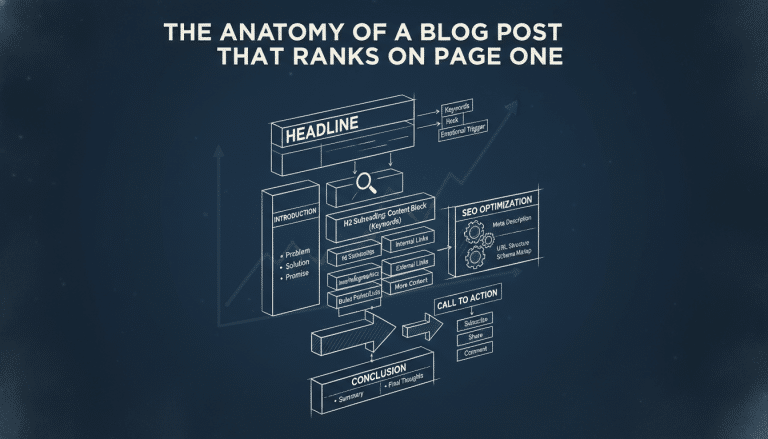 The Anatomy of a Blog Post That Ranks on Page One
 Dundrum Local SEO: Rank Beside Irelandʼs Biggest Shopping Centre
 How to Rank #1 for ʼNear Meʼ Searches in Dublin
 How to Rank in ChatGPT Search for Dublin Businesses
 How to Rank on Page One in Dublin Without Paying for Ads
 Why Some Dublin Businesses Rank for Years Without Trying