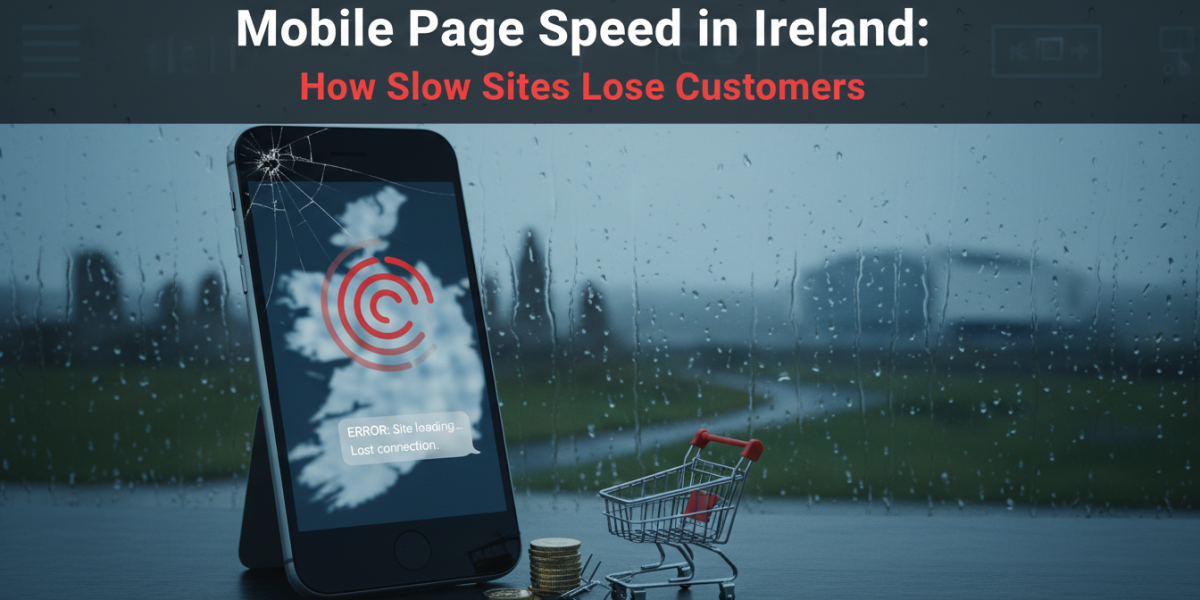
If you’ve ever tapped on a link on your phone and found yourself staring at a spinning loader for four or five seconds, you already understand the problem intuitively. Mobile page speed in Ireland is quietly costing businesses thousands of euro every month — not through any dramatic failure, but through the small, invisible friction of a site that loads just a little too slowly. Visitors don’t complain. They simply leave.
Why Mobile Speed Matters More Than Ever in Ireland
Ireland’s mobile internet usage has accelerated significantly over the past decade. According to data from the Central Statistics Office, the vast majority of Irish adults now access the internet via smartphones, and a growing proportion of online purchases, service enquiries, and local searches happen entirely on mobile devices.
This shift changes the rules of web performance. A site that feels acceptable on a desktop fibre connection can feel sluggish or broken on a mobile device navigating between 4G and 5G coverage — which still varies across counties, particularly in rural areas like Mayo, Roscommon, or parts of Donegal.
Speed isn’t just a technical concern. It’s a customer experience concern. And in a competitive market, experience is everything.
The Numbers Behind the Frustration
What Research Tells Us About Loading Times
Google’s own internal research has consistently found that as page load time increases from one second to three seconds, the probability of a mobile visitor bouncing increases by 32%. By the time you reach five seconds, that figure jumps to 90%.
Think about what that means practically. If your site takes five seconds to load on a mobile phone and you’re getting 1,000 visitors a month through mobile search, you could be losing 900 of them before they’ve read a single word about your business.
The Irish Consumer Mindset
Irish consumers are no different from the global norm here. In fact, anecdotal evidence from Irish e-commerce businesses suggests that cart abandonment spikes sharply on mobile, often tied directly to checkout page performance. A local clothing retailer in Dublin noticed a 28% improvement in mobile conversions after reducing their page load time from 6.2 seconds to under 2.5 seconds — simply by compressing images and switching to a faster hosting provider.
That’s not a marginal gain. That’s a fundamental change in business outcome.
What Actually Causes Slow Mobile Page Speed in Ireland?
There’s rarely one single villain when it comes to a slow site. Typically, it’s a combination of factors that accumulate quietly over time.
Unoptimised images are probably the most common culprit. A web designer uploads a 4MB hero image that looks great on a monitor, but every mobile visitor has to download that file before anything renders. Compress that image to 200KB using WebP format and the difference is immediate.
Render-blocking scripts are another major issue. When your site loads third-party tools — chat widgets, analytics platforms, marketing pixels — before it loads your actual content, the browser gets stuck in a queue. Visitors see a blank screen.
Poor hosting infrastructure also plays a role that’s often underestimated. Many smaller Irish businesses are still using shared hosting packages that made sense in 2012 but are completely inadequate for the expectations of 2024. Server response times above 600ms put you at a disadvantage before the page has even started to build.
Lack of browser caching and CDN usage rounds out the list. Content delivery networks (CDNs) distribute your site’s static assets across servers in multiple locations, so a user in Cork doesn’t have to wait for a response from a server in Frankfurt or New Jersey.
How Mobile Page Speed Affects Your Search Rankings
Google’s Core Web Vitals
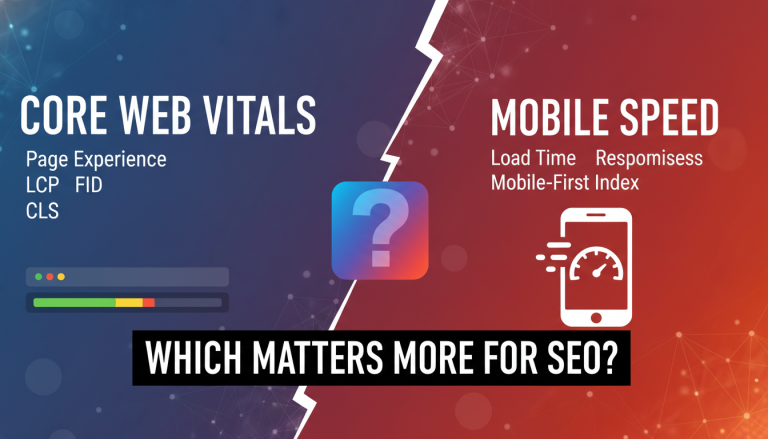
Since 2021, Google has used a set of measurements called Core Web Vitals as part of its ranking algorithm. These include:
- Largest Contentful Paint (LCP): How long it takes for the main content to appear. Google considers anything under 2.5 seconds "good."
- First Input Delay (FID) / Interaction to Next Paint (INP): How responsive the page is to user interaction.
- Cumulative Layout Shift (CLS): How much the layout jumps around as elements load.
If your mobile site performs poorly on these metrics, you’re likely losing ranking positions to competitors whose sites are better optimised — even if your content is stronger. It’s one of the frustrating realities of modern SEO.
Local Search and the Mobile Connection
Most local searches in Ireland happen on mobile. When someone in Galway searches "best accountant near me" or "emergency plumber Dublin," Google factors in page experience signals when deciding which results to show. A slow site doesn’t just lose customers directly — it loses visibility in the first place.
Testing Your Site: Where to Start
You don’t need to be a developer to get a clear picture of how your site performs. Several free tools give you actionable data within minutes.
Google PageSpeed Insights (pagespeed.web.dev) analyses your URL and scores it separately for mobile and desktop. It also gives specific recommendations in plain English — "eliminate render-blocking resources," "serve images in next-gen formats" — so you know exactly what to fix.
GTmetrix provides a waterfall chart of how each element on your page loads, which is useful for identifying the specific scripts or images causing delays.
Google Search Console includes a Core Web Vitals report that shows how your actual visitors are experiencing your site, segmented by mobile and desktop. This is real-world data, not just a lab simulation.
If your mobile score on PageSpeed Insights is below 50, you have a significant problem. A score between 50 and 89 means there’s meaningful room for improvement. The goal is to consistently land above 90 on mobile — not easy, but entirely achievable with the right approach.
Practical Steps to Improve Mobile Page Speed
Quick Wins You Can Act On Today
-
Compress and convert your images. Use tools like Squoosh or ShortPixel to reduce image file sizes. Aim for WebP format where possible, with JPEG as a fallback for older browsers.
-
Enable lazy loading. This tells the browser not to load images until they’re actually about to appear on screen. Most modern CMS platforms (WordPress, Shopify, Squarespace) support this natively or through plugins.
-
Audit your third-party scripts. List every external tool running on your site — Google Analytics, Facebook Pixel, Hotjar, Intercom, cookie banners. Decide which are essential and which can be delayed or removed entirely.
-
Switch to a faster host. Consider managed WordPress hosting providers like Kinsta or WP Engine, or explore cloud hosting options. For Irish businesses needing low latency, choosing a host with European data centres is important.
- Enable GZIP or Brotli compression on your server. This reduces the size of HTML, CSS, and JavaScript files before they’re sent to the browser — typically cutting file sizes by 60–80%.
Longer-Term Investments Worth Making
Moving to a static site architecture, implementing a CDN (Cloudflare has a generous free tier), and conducting regular performance audits as your site grows are all practices that pay consistent dividends over time.
Frequently Asked Questions
What is a good mobile page speed score for an Irish business website?
Google PageSpeed Insights scores your site from 0 to 100. A score above 90 is considered excellent, 50–89 is fair, and below 50 indicates serious issues. For competitive Irish markets, aiming for 80+ on mobile is a realistic and worthwhile target that meaningfully improves both user experience and search visibility.
How do I know if my slow site is actually costing me customers?
Check your mobile bounce rate in Google Analytics and compare it to your desktop bounce rate. A significantly higher mobile bounce rate — particularly on key landing pages or product pages — is a strong signal that load speed is causing visitors to leave. You can also check average session duration on mobile; if it’s very low, users aren’t sticking around long enough to engage.
Is mobile page speed more important than design or content?
Speed, design, and content are all interconnected, but speed acts as a gatekeeper. Even the most beautiful website with the most compelling copy will fail if users give up before it loads. Think of speed as the foundation — without it, everything built on top of it becomes irrelevant for the user who never waited.
Does slow page speed affect all types of Irish businesses equally?
E-commerce sites suffer most visibly because cart abandonment is measurable. But service businesses, restaurants, tradespeople, and local retailers all lose enquiries and footfall due to slow mobile sites — the impact is just harder to track directly. Any business relying on local search traffic has a direct stake in mobile performance.
How long does it take to improve a site’s mobile speed?
Basic improvements — image compression, script audits, caching — can often be implemented in a day or two and yield noticeable results almost immediately. More structural changes, like migrating to a better host or redesigning with performance in mind, might take a few weeks. Most businesses see measurable improvements within 30 days of focused optimisation work.
Conclusion
Mobile page speed in Ireland isn’t a technical niche issue reserved for developers and SEO specialists. It’s a direct line to customer behaviour — how long someone stays, whether they convert, and whether they ever find you in the first place. Every second of delay is a moment of doubt in the visitor’s mind, a reason to tap the back button and try the next result.
The good news is that this is a fixable problem. Unlike shifting market conditions or ad costs, page speed is something you have direct control over. Investing time and resources into optimising your mobile performance is one of the clearest, most measurable improvements an Irish business can make to its digital presence. Start with the tools available to you, understand where your site stands today, and begin making improvements — even small ones compound into significant gains over time.
Ready to improve your mobile performance or not sure where to start? Our team works with businesses across Ireland to diagnose speed issues and build faster, better-performing websites. Get in touch — email us at moc.ssobebolg@ofni or call +353 1 868 2345 and we’ll be happy to talk through your requirements and point you in the right direction.
Dublin's ROI-Driven Digital Marketing Agency Home
Related Posts
 Core Web Vitals vs Page Speed: What Dublin Sites Need to Know
 Why a Slow Website Is Killing Your Search Rankings
 Search engine optimisation ireland globe boss
 Page Speed Optimisation for Irish E-commerce Stores
 Hreflang Tags for Irish Businesses Targeting UK Customers
 The Beginnerʼs Guide to On-Page SEO for Irish Websites
 Core Web Vitals vs Mobile Speed: Which Matters More for SEO?
 National SEO Campaigns to Reach Customers Across Ireland