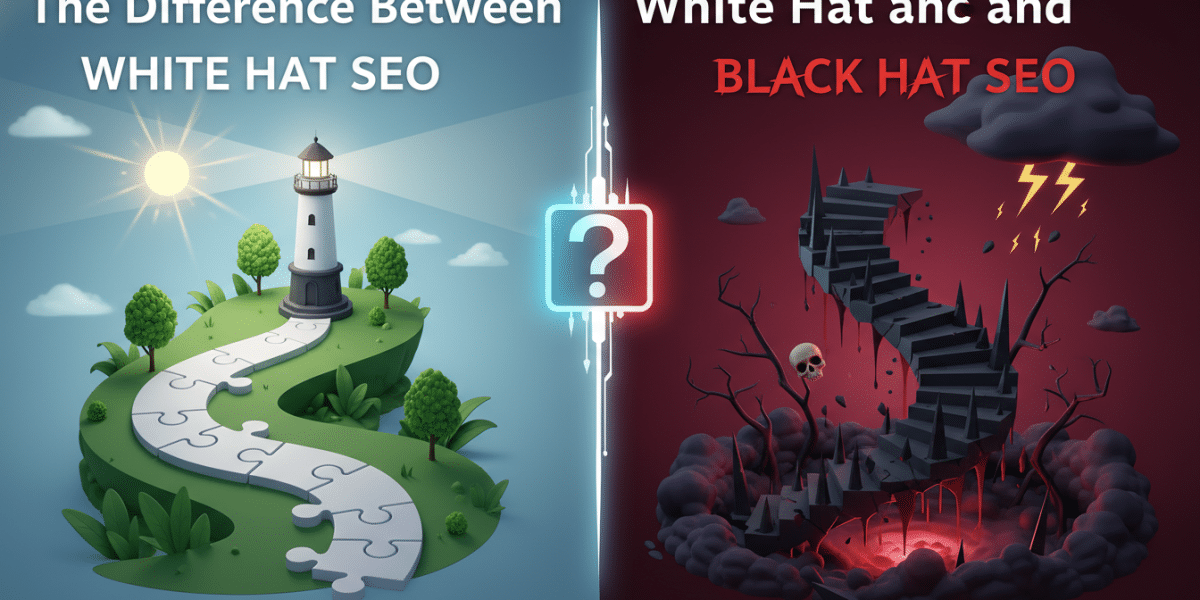
The Difference Between White Hat and Black Hat SEO: Building a Sustainable Online Presence
In the vast, ever-evolving landscape of the internet, search engine optimisation (SEO) is the compass that guides users to your digital doorstep. It’s the art and science of improving your website’s visibility in search engine results, making it easier for potential customers or readers to find you. But just like any powerful tool, SEO can be wielded for good or ill. This brings us to a crucial distinction that every website owner, marketer, and content creator needs to understand: the difference between White Hat and Black Hat SEO.
On one side, we have White Hat SEO, the ethical, long-term approach focused on providing genuine value. On the other, Black Hat SEO, a risky, manipulative strategy designed for quick, often fleeting, wins. Understanding these two philosophies isn’t just about adhering to rules; it’s about making a fundamental choice that will define your online future, impact your brand’s reputation, and ultimately determine your success. Let’s delve deep into what sets these two approaches apart, explore their tactics, and discover why one path consistently leads to sustainable growth while the other often ends in digital disaster.
What is White Hat SEO? The Ethical Path to Visibility
Think of White Hat SEO as building a magnificent, sturdy house on solid ground. It requires careful planning, adherence to architectural best practices, and a focus on creating something genuinely valuable and long-lasting. This approach strictly follows search engine guidelines, primarily Google’s Webmaster Guidelines, ensuring that your efforts contribute to a better internet experience for everyone.
The core philosophy of White Hat SEO revolves around providing value to the user. Its tactics are designed to genuinely improve a website’s quality, relevance, and authority, thereby naturally earning higher rankings.
User-Centric Content Creation
At the heart of White Hat SEO is high-quality, relevant, and engaging content. This isn’t just about stuffing keywords; it’s about addressing user intent, answering their questions, solving their problems, and entertaining them.
- In-depth Articles & Blog Posts: Creating well-researched, original content that provides comprehensive information on a topic. Instead of thin content with repetitive phrases, White Hat focuses on offering true value.
- Keyword Research for Intent: Understanding why users are searching for certain terms, not just what they’re searching for. This helps in crafting content that truly resonates and fulfills their needs. For example, if someone searches “how to fix a leaky faucet,” they’re looking for a step-by-step guide, not just a product page for new faucets.
- Optimized Multimedia: Using relevant images, videos, and infographics that enhance the user experience and are properly optimised with alt text and descriptions for accessibility and search engines.
- Clear Structure and Readability: Organizing content with headings, subheadings, bullet points, and short paragraphs to make it easy to scan and digest.
Technical SEO Best Practices
Beyond content, White Hat SEO pays meticulous attention to the technical aspects of a website, ensuring it’s accessible and understandable for both users and search engine crawlers.
- Website Speed Optimization: Ensuring pages load quickly, as slow load times frustrate users and can lead to higher bounce rates. This involves optimising images, leveraging browser caching, and using efficient hosting.
- Mobile-Friendliness: Designing websites that are responsive and provide a seamless experience across all devices, from desktops to smartphones. With mobile-first indexing, this is non-negotiable.
- Secure (HTTPS) Protocol: Implementing SSL certificates to encrypt data transferred between the user and the website, indicated by “HTTPS” in the URL. This builds trust and is a ranking factor.
- Clean Site Structure & Navigation: Creating a logical hierarchy of pages with clear internal linking, making it easy for users to find what they’re looking for and for search engines to crawl.
- XML Sitemaps & Robots.txt: Using these files to guide search engines on what to crawl and what to ignore, ensuring important pages are discovered and indexed.
Building Genuine Authority (Link Building)
In the White Hat world, backlinks (links from other websites to yours) are seen as “votes of confidence.” The goal is to earn these votes naturally because your content is so valuable and authoritative that others want to reference it.
- Content Promotion & Outreach: Actively promoting your high-quality content to relevant audiences and websites, hoping they’ll link to it because it genuinely adds value to their readers.
- Broken Link Building: Finding broken links on other authoritative websites and suggesting your relevant, intact content as a replacement.
- Guest Blogging (Strategic & Quality-Focused): Writing guest posts for reputable, industry-relevant websites, not just for the link, but to share expertise and expose your brand to a new audience. The link obtained is a natural byproduct of this value exchange.
- Building a Strong Brand Presence: Developing a reputation as a trusted source in your niche, leading to organic mentions and links over time.
Positive Long-Term Outcomes
The rewards of White Hat SEO are significant and enduring. It leads to sustainable rankings, consistent organic traffic, increased brand authority, and a loyal audience. While it often requires patience and consistent effort, its returns are robust and future-proof against most algorithm updates.
What is Black Hat SEO? The Risky Shortcut
Now, let’s explore Black Hat SEO. Imagine attempting to build that same house, but instead of solid foundations, you’re using cheap materials, cutting corners, and trying to trick the building inspector with clever disguises. Black Hat tactics aim to exploit loopholes in search engine algorithms to achieve rapid, but short-lived, ranking improvements. These methods explicitly violate search engine guidelines and are driven by a desire for quick profits, often at the expense of user experience and ethical standards.
The philosophy here is to manipulate, deceive, and shortcut the process, treating search engines as machines to be tricked rather than systems designed to serve users.
Manipulative Content Strategies
Black Hat approaches to content are typically focused on tricking algorithms into thinking content is relevant, even when it offers little to no value to a human reader.
- Keyword Stuffing: Overloading content with keywords in an unnatural and repetitive way, making it unreadable for humans but attempting to signal extreme relevance to search engines. For example, repeating “best SEO services, affordable SEO services, top SEO services” dozens of times in a paragraph.
- Cloaking: Presenting one version of content to search engine crawlers and a different version to human users. For instance, showing a keyword-rich, spammy page to Googlebot, but a sparse, low-quality page to a visitor.
- Hidden Text and Links: Placing text or links on a page that are invisible to the user (e.g., using white text on a white background, or text hidden behind an image) but detectable by search engines.
- Article Spinning: Taking existing content and using automated tools to rephrase it, creating numerous “unique” versions. The result is often grammatically awkward, illogical, and provides no original value.
- Doorway Pages: Creating multiple pages optimised for very specific keyword variations, all funneling traffic to a single main page. These pages offer no real value themselves and are designed purely to intercept search traffic.
Deceptive Technical Tactics
Black Hat extends its manipulative practices to the technical side, trying to trick search engines into seeing a website as more legitimate or authoritative than it is.
- Automated Content Generation: Using AI or other tools to mass-produce low-quality content that lacks coherence or accuracy, solely to fill pages with keywords.
- Private Blog Networks (PBNs): Creating a network of low-quality websites (often using expired domains with existing link equity) solely to link back to a “money site.” These are designed to artificially inflate a site’s backlink profile.
- Bait-and-Switch (Page Swapping): Ranking a page with high-quality content, and once it achieves good rankings, replacing that content with something completely different, usually commercial or low-quality, to leverage the acquired authority.
Artificial Link Schemes
Black Hat link building is all about acquiring as many links as possible, regardless of their relevance or quality, often through unethical or artificial means.
- Buying Links: Directly purchasing links from other websites, often in bulk, without disclosure.
- Link Farms: Participating in networks of websites that exist solely to link to each other, creating an artificial web of interconnectedness.
- Excessive Comment Spam: Posting irrelevant, keyword-rich comments on blogs and forums with links back to one’s own site.
- Negative SEO: Maliciously pointing spammy or low-quality links to a competitor’s website in an attempt to get them penalized by search engines.
Severe Risks and Penalties
The most significant consequence of Black Hat SEO is the very real risk of penalties from search engines. These penalties can range from a significant drop in rankings for specific pages or keywords to complete de-indexing of your entire website, making it virtually impossible for anyone to find you through search.
- Algorithmic Penalties: Automated systems detect suspicious patterns and demote your site.
- Manual Penalties: A human reviewer from Google (or another search engine) inspects your site, finds violations, and issues a manual action.
- Loss of Trust & Reputation: Beyond search engines, users quickly learn to distrust websites that employ spammy tactics, damaging your brand’s reputation irreparably.
- Short-Term Gains, Long-Term Failure: Any ranking improvements from Black Hat tactics are almost always temporary. Algorithms constantly evolve, and what works today will likely be detected and penalized tomorrow.
The Fundamental Difference: Values and Longevity
The core difference between White Hat and Black Hat SEO boils down to intent and philosophy.
- White Hat: Aims to serve the user and cooperate with search engines. It believes in earning authority through genuine value and sees SEO as a way to connect users with the best possible content. It’s a long-term investment, building a resilient online presence.
- Black Hat: Aims to manipulate search engines and exploit their algorithms, often at the expense of the user. It sees search engines as obstacles to circumvent and SEO as a trick to be played. It’s a short-term gamble, risking everything for a quick, unstable gain.
Why Algorithms Dislike Black Hat
Search engines, particularly Google, invest billions in refining their algorithms to deliver the best and most relevant results to their users. Black Hat tactics directly undermine this goal. They push low-quality, irrelevant, or deceptive content to the top, degrading the user experience. By penalizing Black Hat sites, search engines protect their integrity and their users.
The Cost of a “Quick Win”
While Black Hat SEO might offer a brief spike in traffic, the long-term costs far outweigh any temporary benefits. Recovering from a Google penalty is an arduous, often impossible, task. It can mean starting from scratch, losing years of potential brand building, and suffering significant financial losses.
The Value of Sustainable Growth
White Hat SEO, conversely, builds a valuable digital asset. It fosters user trust, generates high-quality leads, and adapts more easily to algorithm updates because its foundation is based on genuine value and best practices. It’s an investment that pays dividends for years to come.
Navigating the Grey Areas: A Quick Note on Grey Hat SEO
It’s worth briefly mentioning “Grey Hat SEO.” This term describes practices that aren’t strictly Black Hat but also push the boundaries of White Hat. They might not be explicitly forbidden by search engines but carry a higher risk than pure White Hat tactics. Examples might include aggressive guest posting campaigns purely for links, or buying expired domains with existing backlinks. While not as overtly malicious as Black Hat, Grey Hat still prioritizes link acquisition or ranking signals over pure user value, making it a riskier path than true White Hat. It exists in the murky waters where the line between acceptable and manipulative blurs, and carries a proportional level of risk.
Choosing Your Hat: Why White Hat Always Wins
In the end, the choice between White Hat and Black Hat SEO isn’t just a technical one; it’s a strategic business decision.
Building Trust and Reputation
White Hat SEO builds genuine trust with your audience and search engines alike. When users consistently find valuable, well-structured content on your site, they return, they share, and they become advocates. This is the bedrock of a strong brand and a loyal customer base.
Future-Proofing Your Website
Search engine algorithms are constantly evolving. White Hat strategies, being user-centric and aligned with search engine goals, are inherently more resilient to these updates. When Google updates its algorithm to better understand user intent or prioritize certain site qualities, White Hat sites often benefit or remain stable, while Black Hat sites crumble.
Achieving Real Business Goals
Ultimately, the goal of any website is to achieve business objectives – whether that’s sales, leads, subscriptions, or brand awareness. White Hat SEO delivers qualified traffic, engaged users, and sustainable growth, which directly translates into achieving these goals. Black Hat, while offering a mirage of traffic, rarely delivers genuinely interested users who convert into customers.
Conclusion
The difference between White Hat and Black Hat SEO is a chasm separating two fundamentally opposing philosophies. White Hat is about integrity, value, and long-term investment in your online presence. It builds authority by genuinely earning it, adheres to ethical standards, and places the user experience at its core. Black Hat, on the other hand, is about manipulation, shortcuts, and short-term gains, often resulting in severe penalties and reputational damage.
While the allure of quick results can be tempting, the internet is not a place where dishonesty thrives indefinitely. Search engines are constantly getting smarter, and their commitment to providing the best possible user experience means they will always seek out and punish those who try to game the system. By choosing White Hat SEO, you’re not just playing by the rules; you’re investing in a robust, future-proof, and respected online identity that will serve your business goals for years to come. In the world of SEO, the ethical path isn’t just the right path – it’s the only path to truly sustainable success.
Dublin's ROI-Driven Digital Marketing Agency Home
Related Posts
 Ethical White Hat SEO Services for Irish Businesses
 White Hat SEO Services Dublin
 What is the difference between a Dublin ʼfull-serviceʼ agency and a boutique firm?
 The 3 Pillars of a White Hat Link Building Strategy in Ireland
 What is the difference between SEO and PPC in Dublin?
 The dark side of link building how to avoid penalties
 Negative SEO
how black hat marketers abuse Googles rules vs toxic backlinks
Negative SEO
how black hat marketers abuse Googles rules vs toxic backlinks Does Globe Boss offer white-label SEO services?