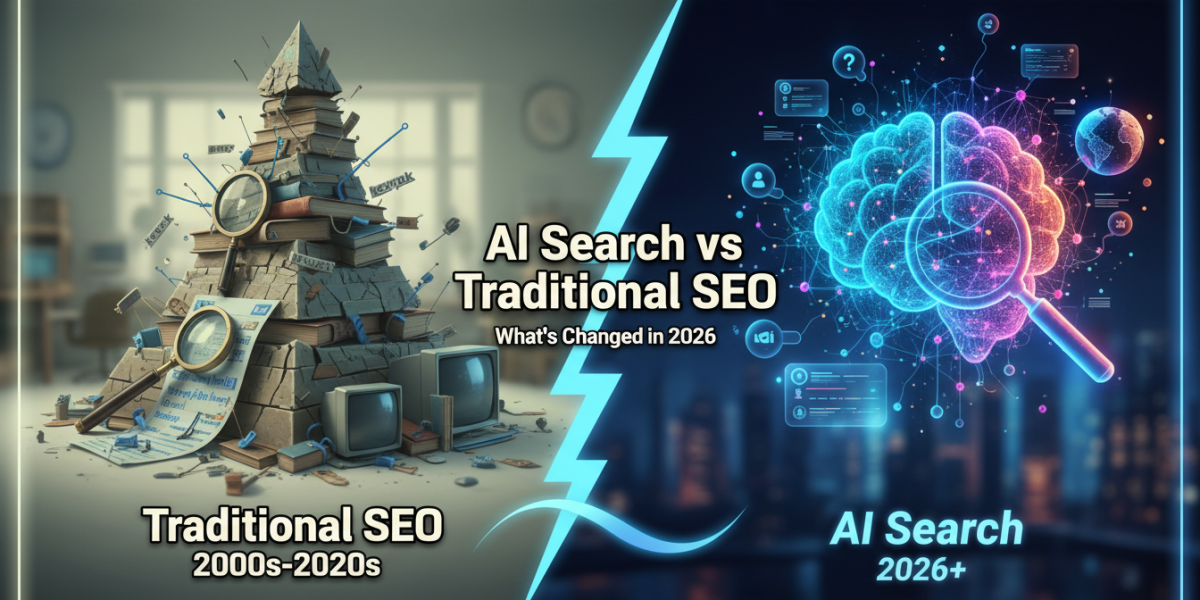
The way people find information online has shifted more dramatically in the past 18 months than in the previous decade combined. AI search vs traditional SEO isn’t just a trending debate — it’s a real strategic question that every business owner, marketer, and content creator needs to answer. If you’re still optimising purely for Google’s blue links, you may already be losing ground to competitors who’ve adapted to how search actually works today.
This article breaks down exactly what’s changed, what still matters, and how to position your website for visibility in a landscape where AI-generated answers are increasingly the first thing a user sees.
How AI Search Has Fundamentally Changed User Behaviour
The Rise of Zero-Click and Summarised Answers
In 2026, a significant portion of search queries never result in a click at all. AI Overviews — Google’s expanded AI-generated summaries that now appear at the top of results for a broad range of queries — have pushed traditional organic listings further down the page. Tools like Perplexity AI, ChatGPT Search, and Microsoft Copilot have trained users to expect direct, conversational answers rather than a list of links to explore.
Studies tracking click-through rates over the past two years show measurable declines in organic clicks for informational queries, particularly in categories like health, finance, how-to content, and local knowledge. For some high-volume question-based searches, AI summaries are capturing attention that once drove substantial traffic to well-ranked pages.
That doesn’t mean traditional SEO is dead. It means the game has changed — and the rules have become more nuanced.
What Users Actually Want Now
User intent has always mattered in SEO, but AI search has made it the central factor. AI systems are designed to interpret what someone means, not just what they type. A search for “best way to fix a leaking radiator” in 2024 returned a list of plumber directories and DIY guides. In 2026, it’s more likely to return a structured, step-by-step answer generated from multiple trusted sources — with those sources cited at the side.
This shift rewards content that genuinely answers a question clearly and completely, rather than content engineered around keyword density and backlink accumulation.
What Traditional SEO Still Gets Right
Technical Foundations Aren’t Going Anywhere
Crawlability, page speed, mobile responsiveness, structured data — none of these have become less important. If anything, AI systems rely more heavily on clean, well-structured HTML to parse and extract information accurately. A site that loads slowly, lacks schema markup, or blocks important crawl paths will struggle to be cited by AI engines just as it struggles to rank in conventional search.
Google’s core ranking systems still evaluate expertise, experience, authoritativeness, and trustworthiness (E-E-A-T). These criteria predate AI Overviews but have become even more central to how content is selected for AI-generated summaries.
Backlinks Still Signal Trust
Despite predictions to the contrary, backlinks remain a meaningful signal in 2026 — but their role has evolved. It’s less about volume and more about provenance. A link from a respected industry publication, a regional news outlet, or a government body carries genuine weight. A hundred links from low-quality directories contribute almost nothing.
AI search engines appear to weight topical authority — the depth and consistency of expertise demonstrated across an entire website — more heavily than isolated high-authority backlinks. A solicitor’s website that consistently publishes detailed, accurate legal commentary across a focused practice area will likely outperform a general content farm with a stronger raw backlink profile.
AI Search vs Traditional SEO: The Key Differences in Practice
The contrast isn’t always obvious from the outside, so it helps to look at concrete examples.
Traditional SEO scenario: A user searches “Irish VAT rates 2026.” A well-optimised accountancy firm’s blog post ranks on page one because it includes the exact keyword phrase, has strong internal linking, and has earned several backlinks from finance-adjacent sites.
AI search scenario: The same query now triggers an AI Overview that directly quotes the current VAT figures, cites Revenue.ie, and includes a brief explanation of recent changes. The accountancy firm’s post may be listed as a source — or it may not appear at all in the first visible result.
The opportunity here is to be the source that AI systems cite. That requires a different approach to content creation than traditional keyword targeting.
How to Optimise for AI Search Without Abandoning SEO Fundamentals
Prioritise Depth Over Density
The best-performing content in 2026 isn’t the content with the highest keyword frequency — it’s the content that covers a topic most completely. Think about what someone needs to know after their initial question is answered. What follow-up questions would they have? What nuances, exceptions, or regional variations apply?
A comprehensive guide to renting commercial property in Dublin, for example, should cover lease types, break clauses, rates obligations, planning considerations, and landlord-tenant protections under Irish law — not just a surface-level overview padded with keywords.
Use Structured Formats AI Can Parse
AI systems extract information more reliably from content that uses clear headers, numbered lists, definition-style explanations, and summary paragraphs. Writing an article where each section directly answers a specific sub-question makes it far easier for AI to pull that content into a summary and attribute it to your site.
Schema markup — particularly FAQ schema, HowTo schema, and Article schema — continues to signal structure and relevance to both traditional search crawlers and AI indexing systems.
Build Genuine Topical Authority
Pick your lanes and go deep. A small business website that tries to cover every possible topic will always lose out to focused sites that demonstrate real expertise in a defined area. This is especially true for locally operating businesses. A Galway-based physiotherapy clinic that consistently publishes detailed, clinically accurate content about musculoskeletal conditions, rehabilitation timelines, and physiotherapy approaches in Ireland will build the kind of topical credibility that AI systems reward.
Consistency matters too. Publishing one excellent article a year won’t achieve this. A regular cadence of quality content across a focused subject area — even six to twelve well-researched pieces annually — outperforms irregular publishing of broadly scattered topics.
Local SEO in the Age of AI Search
What’s Changed for Local Businesses
Local search has been disrupted in its own specific ways. AI-powered local results increasingly pull from Google Business Profile data, review aggregators, and structured citations to serve users answers like “best accountant near me in Cork” without displaying a traditional map pack or ranked list first.
For businesses operating in Ireland or the UK, this makes Google Business Profile hygiene more important than ever. Accurate categories, updated service descriptions, a consistent NAP (name, address, phone number) across all directories, and a healthy volume of genuine reviews all feed directly into how AI systems describe and recommend local businesses.
Reviews Are Now Content
User-generated reviews function as a form of topical content in 2026’s AI search environment. When a user asks for a recommendation, AI systems don’t just count stars — they scan review text for relevant terms, sentiment, and specificity. A landscaping company with 40 reviews that mention specific services like “garden design,” “patio installation,” and “lawn care” will likely appear in more relevant AI-surfaced recommendations than a competitor with 60 generic five-star ratings.
Encourage customers to leave detailed, service-specific reviews. Not by scripting them, but by following up after a completed job and making it easy to leave feedback.
Frequently Asked Questions
What is AI search and how is it different from traditional Google search?
AI search uses large language models to interpret queries and generate direct, conversational answers — often synthesising information from multiple sources rather than simply listing ranked web pages. Traditional search returns a list of links based on ranking signals like keywords, backlinks, and page authority. In 2026, most major search engines blend both approaches, but AI-generated summaries now appear prominently for a wide range of queries.
Is traditional SEO still worth investing in?
Absolutely. Technical SEO, quality content, backlink building, and on-page optimisation remain foundational. They’re also what makes your content eligible to be cited by AI systems. Think of AI search optimisation as an extension of good SEO practice, not a replacement for it.
How do I get my content cited in AI Overviews or AI search results?
Focus on writing authoritative, well-structured content that directly and completely answers real user questions. Use schema markup, maintain a consistent publishing cadence in your subject area, earn links from credible sources, and keep your site technically sound. There’s no guaranteed route, but these factors consistently correlate with AI citation.
Does AI search affect local businesses differently?
Yes, particularly for service-based businesses. Local AI results draw heavily from Google Business Profile data and review content. Keeping your GBP accurate and up to date, generating detailed reviews, and maintaining consistent citations across directories all have a direct impact on how your business appears in AI-powered local recommendations.
How quickly should I update my SEO strategy in response to these changes?
The core principles of good SEO haven’t changed overnight, but if your strategy still revolves primarily around keyword stuffing, thin content, or link schemes, those approaches are less effective now than they were two years ago and declining further. A phased shift toward authority-building, comprehensive content, and structured formatting is a practical and sustainable approach for most businesses.
Conclusion
The AI search vs traditional SEO debate isn’t a binary choice — it’s a spectrum that requires understanding both sides. The businesses that will perform best in 2026 and beyond are those that treat SEO fundamentals as the floor, not the ceiling, and build genuine expertise on top of them.
Visibility in AI-generated results isn’t awarded by algorithm alone. It’s earned through consistent, trustworthy, well-structured content that actually serves the reader. That’s always been what good SEO looked like. The difference now is that the machines have gotten better at telling the gap between content made for people and content made for rankings.
Ready to adapt your SEO strategy for the AI search era? Whether you want a full audit of your current setup, advice on content strategy, or a clear plan for improving your visibility in both traditional and AI search results, our team is here to help. Email us at moc.ssobebolg@ofni or call +353 1 868 2345 — we’re happy to talk through your requirements and point you in the right direction.
Dublin's ROI-Driven Digital Marketing Agency Home
Related Posts
 Limerick SEO: A Local Search Playbook for 2026
 How Dublin Solicitors Can Win Local Search in 2026
 2026 Zero Click Search Strategy Globe Boss Dublin
 How to Optimise Your Website for AI Search Results in 2026
 SEO Trends to Watch In 2026
 Is voice search optimisation necessary for Irish businesses in 2026?
 Galway SEO: Local Search Strategies for the West
 Dún Laoghaire SEO: Local Search for Coastal Businesses