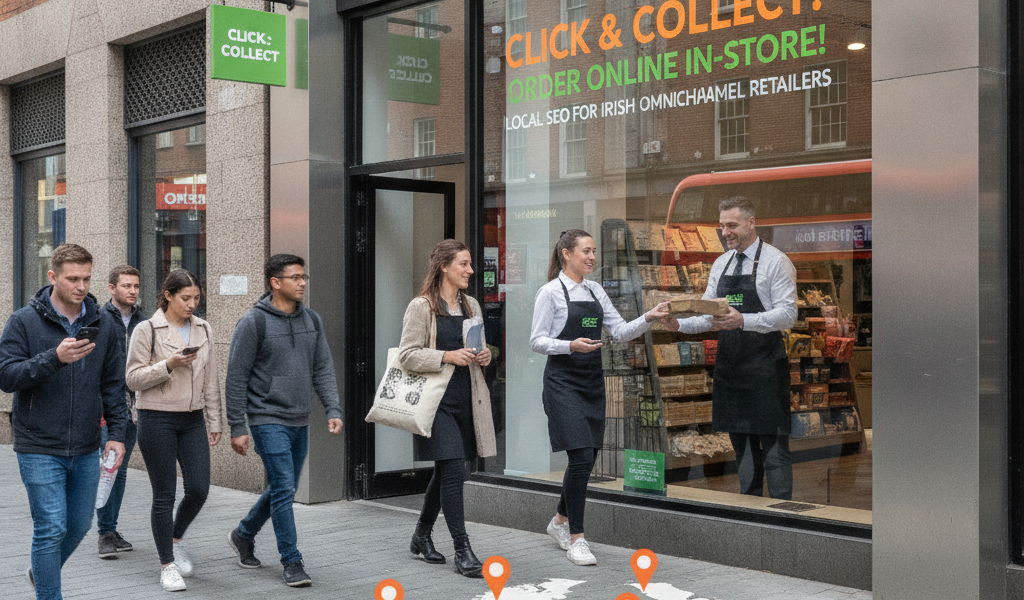
The way Irish shoppers buy has changed permanently. Click and collect — the practice of ordering online and picking up in-store — has moved from a pandemic-era workaround to a firmly established retail behaviour across Ireland. For omnichannel retailers trying to win local customers, that shift creates both a challenge and a significant opportunity. Getting your local SEO right for click and collect isn’t just about rankings; it’s about meeting real people at the exact moment they decide where to spend their money.
Why Click and Collect Demands Its Own Local SEO Strategy
Most retailers treat click and collect as a fulfilment option bolted onto their eCommerce setup. Few treat it as a distinct discovery moment — and that’s where the gap in local SEO performance opens up.
When someone in Galway searches “buy running shoes click and collect Galway” or “same day collection hardware store Dublin,” they’re not just browsing. They have intent, urgency, and a specific location in mind. If your store doesn’t appear in those results, a competitor will.
Local SEO for click and collect isn’t the same as standard product SEO. It requires you to think about physical proximity, store-level information, and the micro-moments that happen just before a customer decides to place an order.
The Numbers Behind the Behaviour
Research from Retail Ireland and broader European eCommerce data consistently shows that a large proportion of online shoppers who use click and collect were originally motivated by convenience and speed — not price. Many customers specifically choose retailers who offer same-day or next-day collection over those who offer cheaper delivery with longer lead times.
That means your local visibility is competing directly with convenience. If someone can’t find your store online when they’re searching with collection intent, they’ll find someone who has made that easier.
Google Business Profile: The Foundation for Collection Visibility
Your Google Business Profile (GBP) is the single most important tool for connecting click and collect searches to your physical stores. Think of it as your storefront on Google — not just for directions, but for communicating exactly what you offer.
Optimising Your Profile for Collection-Specific Searches
First, make sure your GBP is verified and fully completed. That sounds obvious, but a surprisingly high number of Irish retailers leave key fields blank or out of date.
Include your click and collect service explicitly in your business description. Don’t rely on Google to infer it. Use the “Services” or “Products” sections to add collection as a feature, and update your business attributes to reflect in-store pickup where that option exists.
Opening hours matter enormously here. If your collection window is different from your general store hours — say, collections are available until 6pm but browsing continues until 8pm — make that clear. Customers who show up at 7pm for a collection and find no staff to help them won’t be back.
Using Posts and Updates Strategically
Google Business Posts don’t get enough attention from Irish retailers. A short, timely post — “Order before 2pm for same-day collection at our Limerick store” — can appear in local search results and drive immediate action.
Posts expire after seven days by default, so set a recurring reminder to refresh them. Seasonal updates, new collection-friendly product categories, or changes to collection procedures are all worth posting about.
Location Pages That Actually Convert
If you operate multiple stores across Ireland — say, locations in Cork, Dublin, and Waterford — you need individual location pages, not a single generic “Find Us” page.
Each page should be built around that specific store’s context. Include the address with correct Eircode, opening hours, parking or public transport details, and a clear explanation of how click and collect works at that location specifically. Does the customer need an order confirmation email? Is there a dedicated collection desk? Can they collect on the same day if they order before noon?
These aren’t just UX details — they’re SEO signals. Search engines understand context, and a page that clearly describes the collection process at your Dundrum store will perform better for Dundrum-specific searches than a vague national page ever will.
Schema Markup for Local Retail
Adding structured data (schema markup) to your location pages tells Google explicitly what each page is about. For omnichannel retailers, the most relevant schema types include:
-
- LocalBusiness (with store-specific NAP: Name, Address, Phone)
-
- Store schema with
hasMapandopeningHoursSpecification
- Store schema with
-
- Offer or Product schema tied to in-store availability
If your development team hasn’t implemented this already, it’s worth raising. Google uses structured data to populate Knowledge Panels, local packs, and rich results — all prime real estate for collection-related searches.
Click and Collect Local SEO: Getting Stock Availability Right
One of the biggest friction points in the click and collect experience — and one that directly affects your local search performance — is stock availability visibility.
When customers search for a specific product available for collection nearby, Google’s local inventory ads and organic results increasingly surface product-level availability. Retailers who feed accurate, real-time inventory data into their Google Merchant Centre account have a significant advantage.
Connecting Inventory to Local Search
Google’s Local Inventory Ads (LIAs) allow you to show shoppers that a product is available for pickup at a specific store. This is particularly powerful for higher-consideration purchases — electronics, appliances, tools — where the customer wants certainty before they make the trip.
To make this work, you’ll need a verified Google Merchant Centre account, a store feed with correct store codes, and a product feed that reflects real-time or near-real-time inventory. It’s a technical lift, but the payoff in qualified local traffic is substantial.
Irish retailers in categories like DIY, baby products, and fashion have seen strong performance with LIAs because the purchase intent is high and the local search volume is consistent. If your competitors aren’t using this yet, the window to gain ground is still open.
Reviews, Reputation, and the Collection Experience
Local SEO isn’t just about what you say about yourself — it’s about what your customers say. For click and collect specifically, reviews are a trust signal that directly influences whether a new customer chooses you.
Encourage customers to leave reviews that mention the collection experience. A review that says “ordered online at 10am and had it in my hands by lunch — brilliant service” is doing SEO work that no meta description can replicate.
Respond to every review, positive or negative. A response to a negative collection experience — “We’re sorry the queue at collection was longer than expected on Saturday; we’ve since added a second counter” — shows prospective customers that you’re responsive and improving.
NAP Consistency Across Directories
Your Name, Address, and Phone number (NAP) must be consistent across every platform where your stores appear: Google, Bing, Yelp, Golden Pages, and any sector-specific directories relevant to your category. Even minor inconsistencies — an old phone number on one platform, a slightly different address format on another — can dilute your local authority and confuse customers.
Run a citation audit at least twice a year. Tools like BrightLocal or Whitespark can help identify inconsistencies at scale if you’re managing multiple Irish locations.
Mobile Search and the “Near Me” Moment
The majority of click and collect searches in Ireland happen on mobile devices. Someone is out, they need something, and they’re searching on their phone. That search might be “where to collect [product] near me” or simply “[product] + town name.”
Your website needs to load fast on mobile — Google’s Core Web Vitals are a ranking factor, and a site that takes four seconds to load on a 4G connection in rural Clare will lose that customer before they ever see your collection offer. Aim for a Largest Contentful Paint (LCP) under 2.5 seconds.
The click and collect flow itself should be mobile-friendly end to end: product selection, checkout, confirmation, and the collection confirmation email should all render cleanly on a phone screen.
Frequently Asked Questions
What makes local SEO for click and collect different from regular eCommerce SEO?
Regular eCommerce SEO focuses on national or international rankings for product pages. Local SEO for click and collect targets searches tied to physical proximity and collection intent — it involves your Google Business Profile, location-specific pages, and local inventory data rather than just product descriptions.
How do I optimise multiple store locations without creating duplicate content?
Each location page should contain genuinely unique information: the specific address and Eircode, local transport links, collection procedures at that branch, and any location-specific details. Don’t just copy the same template with a different town name — thin, duplicate content is a ranking risk.
Is it worth running Google Local Inventory Ads for a small Irish retailer?
It depends on your product category and margin. For retailers selling goods where customers value certainty of stock — tools, electronics, baby equipment — LIAs tend to deliver strong ROI because they capture high-intent searches. Smaller retailers with a focused product range often find it worthwhile even with modest ad budgets.
How quickly can local SEO improvements affect my rankings?
Google Business Profile changes (like updated hours or new posts) can be reflected within days. On-site changes such as location page improvements and schema markup typically show results over four to twelve weeks, depending on how frequently Google crawls your site. Local citation building is a longer-term investment — expect three to six months for meaningful impact.
Do customer reviews actually affect local search rankings?
Yes, review quantity, recency, and sentiment are all factors in Google’s local ranking algorithm. Reviews that mention specific products, locations, or services (like click and collect) are particularly valuable because they add relevant keyword context in a natural, credible way.
Conclusion
Click and collect isn’t a temporary trend — it’s now a core part of how Irish consumers shop, and it’s shaping how local search intent is expressed. For omnichannel retailers, the opportunity is clear: by aligning your local SEO strategy with the way customers actually search for collection options, you can capture high-intent traffic that your competitors may be leaving on the table.
The retailers who will win aren’t necessarily those with the biggest budgets — they’re the ones who have made their stores easy to find, easy to understand, and easy to trust at the exact moment a customer is ready to buy. That starts with a well-optimised Google Business Profile and runs all the way through to a seamless mobile experience and a collection counter that’s ready when your customer arrives.
Ready to Improve Your Click and Collect Visibility?
If you’d like to discuss how to strengthen your local SEO strategy for click and collect — whether you’re managing one store or a network of locations across Ireland — our team would be glad to help. Reach out whenever it suits you: email us at moc.ssobebolg@ofni or give us a call at +353 1 868 2345. We’re happy to answer questions, talk through your current setup, or put together a tailored plan for your business.
Dublin's ROI-Driven Digital Marketing Agency Home
Related Posts
 SEO FAQs for Irish Businesses: What to Expect | Globe Boss
 Local Citations for Irish Businesses: The 25 Best Directories
 Product Schema Markup: The Guide for Irish Retailers
 Shopify SEO Experts for Growth Minded Irish Retailers
 Building trust one click at a time in the Irish market
 How we turned a local legend into a global powerhouse
 Local SEO Checklist The 10 Must-Do Tasks for Irish SMEs
 Mastering Local Backlinks The Irish Strategy for Authority