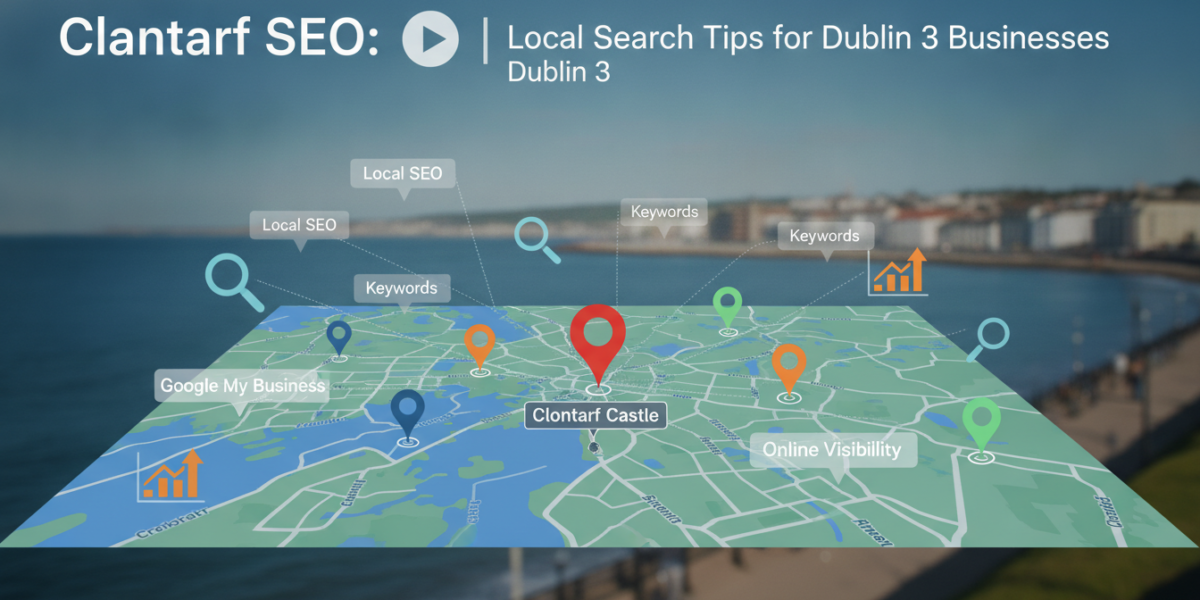
If you run a business in Clontarf or the wider Dublin 3 area, you’ve probably noticed how competitive the local landscape has become. Whether you’re a café on Vernon Avenue, a physio clinic near the seafront, or an independent retailer off Castle Avenue, getting found online by local customers is no longer optional — it’s essential. Clontarf SEO isn’t just about ranking on Google; it’s about connecting your business with the people who are already searching for what you offer, right on your doorstep.
This guide breaks down practical, actionable local search strategies tailored specifically for Dublin 3 businesses. No jargon, no fluff — just what actually works.
Why Local SEO Matters More Than Ever for Clontarf Businesses
The Way People Search Has Changed
Think about how you find a local business today. You probably open Google, type something like "best coffee near Clontarf" or "dentist Dublin 3", and click on one of the first few results. According to Google’s own data, nearly 46% of all searches have local intent — meaning people are actively looking for something nearby.
For businesses in Clontarf, this is both an opportunity and a challenge. The opportunity: local search levels the playing field. A small independent bookshop on Clontarf Road can outrank a national chain if its local SEO is done right. The challenge: if you’re not showing up in those results, a competitor almost certainly is.
What "Local SEO" Actually Means
Local SEO is the process of optimising your online presence so that your business appears prominently when people nearby search for relevant products or services. It covers everything from your Google Business Profile to the way your website mentions your location.
It’s distinct from general SEO in one important way: proximity and relevance to a specific area matter enormously. Google’s local algorithm weighs three factors — relevance, distance, and prominence. Understanding these three pillars is the starting point for any Clontarf business serious about local visibility.
Setting Up and Optimising Your Google Business Profile
This is the single most impactful thing you can do for local search visibility. Your Google Business Profile (formerly Google My Business) is what populates those prominent map listings and local "pack" results that appear at the top of Google searches.
Getting the Basics Right
Start with accuracy. Your business name, address, and phone number — often called NAP — must be consistent across every platform online. If your address appears differently on your website, your Facebook page, and your Google profile, this inconsistency confuses Google’s systems and can hurt your rankings.
For a Dublin 3 business, this means being precise. "Clontarf Road, Dublin 3" and "Clontarf Road, Dublin, D03" might seem interchangeable, but consistency matters. Choose one format and use it everywhere.
Going Beyond the Basics
Once the fundamentals are in place, the details make a real difference:
- Choose the right primary category. If you run a physiotherapy clinic, "Physiotherapist" should be your primary category, not "Health Clinic" — the more specific, the better.
- Upload real photos regularly. Businesses with photos receive 42% more requests for directions on Google Maps, according to Google’s own research. Use genuine images of your premises, your team, and your work.
- Use the Q&A and Posts features. These are underused by most local businesses. Regular posts about offers, events, or news signal to Google that your profile is active.
- Set your service area. If you serve all of Dublin 3 or beyond, make this explicit in your profile settings.
Building Local Relevance Through Your Website
Your Google Business Profile draws people in, but your website is what converts them. It also plays a significant role in how Google assesses your local authority.
On-Page Local SEO for Dublin 3
Every page of your website should make it clear where you’re based and who you serve. This doesn’t mean stuffing "Clontarf" into every paragraph — it means weaving your location into the content naturally.
Your homepage should mention Clontarf and Dublin 3 clearly, ideally in a heading or the first paragraph. Your contact page should include your full address in text (not just embedded in an image). If you serve specific areas — say, Clontarf, Raheny, Dollymount, and Fairview — consider mentioning these areas in your service descriptions.
Creating Content That Serves the Local Community
One of the most effective long-term SEO strategies is publishing content that’s genuinely useful to people in your area. A Clontarf estate agent might write a guide to "What to Know Before Buying Near Dublin 3’s Coastline." A personal trainer could publish "The Best Outdoor Workout Spots Along the Clontarf Promenade."
This kind of content earns organic links, builds topical authority, and keeps potential customers on your site longer — all signals that Google uses to assess quality. It also positions you as a local expert, not just another business with a website.
Technical Foundations That Can’t Be Ignored
No amount of great content will help if your site loads slowly or doesn’t work well on mobile. Google uses mobile-first indexing, which means it primarily looks at the mobile version of your website when deciding how to rank you.
Run your site through Google’s PageSpeed Insights tool (it’s free). Aim for a score above 70 on mobile. Fix broken links, ensure your site is served over HTTPS, and make sure your contact details are easy to find on every page.
Clontarf SEO and the Power of Online Reviews
Why Reviews Are a Ranking Signal
Online reviews aren’t just social proof for customers — they directly influence your local search rankings. Google’s algorithm treats review quantity, recency, and rating as indicators of a business’s prominence and trustworthiness.
A Clontarf restaurant with 200 Google reviews averaging 4.6 stars will almost always outperform a competitor with 30 reviews averaging 3.9, all else being equal. The gap compounds over time.
How to Generate Reviews Consistently
The biggest mistake businesses make is asking for reviews in a haphazard way. Build a simple, repeatable process:
- After a positive customer interaction, send a follow-up email or text with a direct link to your Google review page.
- Train staff to mention reviews as part of the natural customer journey.
- Include a review link in your email signature or on your receipts.
Never incentivise reviews with discounts or gifts — this violates Google’s policies and can result in your profile being penalised or suspended.
Responding to Every Review
Responding to reviews — positive and negative — is itself a ranking signal, and it demonstrates customer care. Keep responses personal, not templated. If someone leaves a glowing review of your Clontarf café, mention something specific. If someone leaves a critical review, acknowledge their experience professionally and offer to resolve it.
Local Link Building for Dublin 3 Businesses
Why Local Links Carry More Weight Than You’d Think
A backlink from a well-regarded Dublin-based website carries more local authority than a generic link from a distant directory. For Clontarf businesses, this means actively pursuing links from locally relevant sources.
Think about the Dublin 3 community more broadly. Are there local business associations? Clontarf GAA, local sports clubs, schools, community groups, or neighbourhood news sites? A mention or link from any of these carries real SEO value.
Practical Ways to Earn Local Links
- Sponsor or partner with a local event. The Clontarf Promenade area hosts seasonal events; being listed as a sponsor often includes a website mention.
- Get listed in local directories. Golden Pages, Yelp Ireland, Hotfrog, and local chamber of commerce directories all provide worthwhile citations.
- Collaborate with complementary local businesses. A Clontarf florist and a wedding photographer might cross-link to each other’s websites as recommended suppliers.
- Contribute to local media. Dublin-based publications like Dublin Gazette or community newsletters sometimes feature local business features, which can earn you coverage and links.
Tracking Your Local SEO Performance
You can’t improve what you don’t measure. Fortunately, the core tools are free.
Google Search Console shows you which search terms are driving traffic to your site, how often your pages appear in search results, and whether Google is encountering any technical issues with your site.
Google Analytics 4 tells you what happens after people arrive — which pages they visit, how long they stay, and whether they take action.
Google Business Profile Insights provides data specific to your local profile: how many people viewed it, how many clicked for directions, and how many called you directly.
Check these monthly at minimum. Look for trends rather than daily fluctuations. If a particular page is driving significant local traffic, consider expanding on that topic with additional content.
Frequently Asked Questions
How long does local SEO take to show results?
Most businesses start to see measurable improvements within three to six months of implementing consistent changes. That said, quicker wins — like optimising your Google Business Profile or fixing NAP inconsistencies — can have a visible impact within weeks. Local SEO is a long-term investment, not a quick fix.
Is it worth hiring an SEO professional for a small Clontarf business?
It depends on your budget and available time. Many of the fundamentals — setting up your Google Business Profile, gathering reviews, and optimising your website’s contact page — can be done in-house. But for more competitive niches or if you want to move faster, a professional with local SEO experience can significantly accelerate results and help you avoid common mistakes.
What’s the difference between local SEO and regular SEO?
Regular SEO focuses on ranking nationally or globally for broader keywords. Local SEO is specifically about appearing prominently in searches tied to a geographic area. For most Clontarf businesses, local SEO will deliver a much better return because it targets people who are physically nearby and likely to convert into real customers.
Do I need a separate page for each area I serve?
If you serve multiple distinct areas — for example, Clontarf, Raheny, and Fairview — dedicated location pages can help you rank for searches in each of those areas. However, these pages need to contain genuinely useful, distinct content. Thin "location pages" with minimal content can actually harm your rankings, so quality over quantity always applies.
How important are social media profiles for local SEO?
Social media itself isn’t a direct ranking factor for Google. However, having consistent business information across your Facebook, Instagram, and LinkedIn profiles supports your overall NAP consistency, and content shared on social media can earn links and engagement that indirectly benefit SEO.
Conclusion
Local search is one of the most cost-effective channels available to businesses in Dublin 3, and Clontarf SEO done well can deliver a steady stream of genuinely interested local customers. The fundamentals aren’t complicated: a well-maintained Google Business Profile, a website that clearly communicates where you are and who you serve, a consistent approach to gathering reviews, and content that genuinely serves your community.
The businesses that win at local search aren’t necessarily those with the biggest budgets — they’re the ones that show up consistently, treat their online presence with the same care as their physical premises, and keep improving over time. Start with one section from this guide, implement it properly, and build from there.
Ready to Improve Your Local Search Presence?
If you’d like to discuss your Dublin 3 business’s SEO needs or get a clearer picture of where you currently stand in local search, we’d be happy to help. Whether you have a specific question or want to explore a more comprehensive strategy, feel free to get in touch with our team — email us at moc.ssobebolg@ofni or call +353 1 868 2345 and we’ll talk through your options with no pressure and no obligation.
Related Posts
 SE0 strategies for Irish businesses in Dublin
 Dominate Dublin Searches with Powerful Local SEO Tactics
 How to get local backlinks for Dublin businesses?
 How to manage local citations for Dublin businesses?
 What is the best SEO strategy for Dublin businesses?
 SE0 consultants in Ireland for Dublin businesses globe boss
 Dublin SEO
agency for local rankings globe boss
Dublin SEO
agency for local rankings globe boss SEO strategies
for irish businesses in dublin
SEO strategies
for irish businesses in dublin