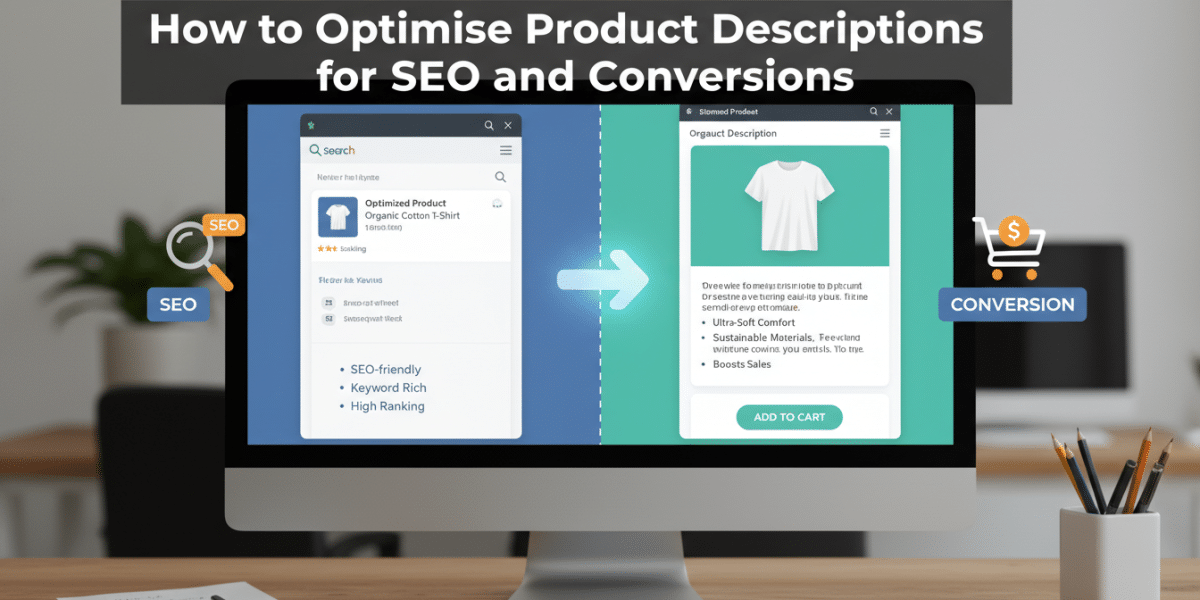
How to Optimise Product Descriptions for SEO and Conversions: Your Ultimate Guide
In the vast, bustling marketplace of the internet, your product descriptions are far more than just a list of features. They are your silent salespeople, your brand ambassadors, and a critical bridge connecting potential customers to your offerings. Yet, many businesses treat them as an afterthought, missing a massive opportunity to both capture organic search traffic and convert browsers into enthusiastic buyers.
If you’ve ever wondered why your amazing products aren’t getting the visibility or sales they deserve, it might be time to take a hard look at the words you’re using to describe them. This comprehensive guide will walk you through the essential strategies to optimise product descriptions for SEO and conversions, ensuring they work tirelessly for your business, day and night.
Why Your Product Descriptions Are Make-or-Break
Imagine walking into a physical store. What makes you pick up a product, examine it, and ultimately decide to buy it? It’s a combination of visual appeal, a compelling display, and often, a salesperson who can articulate its value. Online, your product description takes on many of these roles.
The Dual Powerhouse: SEO and Conversions
At their core, effective product descriptions serve two distinct, yet interconnected, masters:
- Search Engine Optimisation (SEO): This is about helping search engines like Google understand what your product is, who it’s for, and how it’s relevant to a user’s query. When optimised for SEO, your product descriptions can help your products rank higher in search results, driving free, qualified traffic to your store.
- Conversions: Once a user lands on your product page, the description must seal the deal. It needs to address their needs, highlight benefits, build trust, and ultimately persuade them to click that “Add to Cart” button.
Neglecting either of these aspects means leaving money on the table. A product description that ranks well but doesn’t convert is just a pretty billboard on a deserted highway. One that converts but can’t be found is like a brilliant hidden gem. The sweet spot lies in mastering both.
Beyond Features: Selling the Experience
Many product descriptions fall into the trap of simply listing specifications: “100% cotton,” “256GB storage,” “stainless steel.” While features are important, they rarely spark desire. People don’t buy products; they buy solutions to their problems, enhancements to their lives, or feelings of joy, convenience, or status. Your product descriptions need to transcend mere facts and paint a vivid picture of the experience of owning and using your product.
The SEO Angle: Getting Found in a Crowded Digital World
Before your product description can convert, it needs to be discovered. This is where strategic SEO comes into play.
Keyword Research: Your North Star
The foundation of any good SEO strategy is thorough keyword research. You need to understand what words and phrases your target audience uses when searching for products like yours.
- Brainstorm Seed Keywords: Start with broad terms related to your product (e.g., “women’s running shoes,” “organic coffee beans”).
- Utilise Keyword Tools: Tools like Google Keyword Planner, Ahrefs, SEMrush, or even Google’s “People also ask” and “Related searches” can help you uncover long-tail keywords (more specific phrases, e.g., “lightweight running shoes for women with arch support”) which often have less competition and higher conversion rates.
- Competitor Analysis: See what keywords your competitors are ranking for. This can give you ideas for terms you might have missed.
- Consider User Intent: Are people looking for information, comparison, or are they ready to buy? Tailor your keywords to match buying intent.
Strategic Keyword Placement: Natural, Not Naughty
Once you have your keywords, the goal isn’t to stuff them everywhere. Instead, integrate them naturally and strategically.
- Product Title: Include your primary keyword here. It’s often the first thing search engines (and users) see.
- First Paragraph: Weave your main keyword and a few secondary keywords into the opening sentences. This signals relevance to search engines right away.
- Headings (H1, H2, H3): Use keywords in your subheadings to break up text and further signal content relevance.
- Body Text: Distribute keywords throughout the description, using variations and synonyms to keep it natural and readable.
- Bullet Points: Bulleted lists are great for both readability and keyword inclusion (e.g., listing key features with relevant terms).
- Meta Description: While not a direct ranking factor, a compelling meta description (which should include keywords) significantly impacts click-through rates from search results.
- Image Alt Text: Describe your product images using relevant keywords. This helps search engines understand the image content and can improve image search rankings.
Technical SEO Basics: Don’t Forget the Backend
Beyond the words themselves, a few technical SEO elements play a role in your product description’s visibility.
- Unique Content: Every product description should be unique. Copying manufacturer descriptions or duplicating content across your own site can harm your SEO.
- Schema Markup: Implement product schema (structured data) to tell search engines specific details about your product (price, availability, reviews, rating). This can lead to rich snippets in search results, making your listings stand out.
- Page Speed: Ensure your product pages load quickly. Slow pages frustrate users and negatively impact search rankings.
The Conversion Angle: Turning Browsers into Buyers
Once a potential customer lands on your page, your product description needs to act like a master salesperson, guiding them towards a purchase.
Know Your Audience: Speak Their Language
Before you write a single word, think deeply about who you’re talking to.
- Create Buyer Personas: Who is your ideal customer? What are their demographics, psychographics, pain points, and aspirations?
- Understand Their Motivations: Why are they looking for a product like yours? What problem does it solve for them? What desires does it fulfill?
- Use Their Language: Do they use jargon or prefer simple terms? Are they looking for luxury, budget-friendliness, sustainability, or cutting-edge tech? Tailor your tone and vocabulary accordingly.
Crafting Compelling Headlines and Opening Hooks
Your first few sentences are crucial. They need to grab attention and make the reader want to learn more.
- Lead with a Benefit or Problem Solved: Instead of “Introducing the new XYZ widget,” try “Tired of tangled cables? Revolutionise your workspace with the XYZ Cable Organiser.”
- Use Intrigue or a Question: “What if you could enjoy barista-quality coffee at home every morning?”
- Inject Urgency or Exclusivity: “Limited edition: Experience unparalleled comfort with our hand-stitched leather chair.”
Features vs. Benefits: Always Lead with “What’s In It For Me?”
This is perhaps the most important conversion-focused aspect. Features are facts; benefits are what those facts do for the customer.
- Feature: “Our blender has a 1200-watt motor.”
- Benefit: “With a powerful 1200-watt motor, our blender effortlessly crushes ice and frozen fruits, making silky-smooth smoothies in seconds.”
Always translate features into benefits. Ask yourself, “So what?” after every feature.
- “Made from durable, recycled plastic.” (Feature) -> “Sustainable and built to last, you’re investing in a product that’s good for the planet and your wallet.” (Benefit)
- “Lightweight design.” (Feature) -> “Carry it all day without strain, making your commute or travels a breeze.” (Benefit)
Storytelling: Weaving a Narrative
People connect with stories. A good story can differentiate your product and make it memorable.
- Product Origin Story: How was it conceived? What problem inspired its creation?
- Use Cases: Describe a scenario where the product shines. “Imagine cozying up with a good book on a chilly evening, wrapped in the unparalleled softness of our cashmere throw.”
- Customer Transformation: How will the product change the customer’s life? “From chaotic mornings to serene starts, our smart coffee maker ensures your perfect brew is waiting when you wake.”
Sensory Language: Engage All Five Senses (Where Applicable)
Help your customer visualise, hear, feel, smell, and even taste your product through evocative language.
- Sight: “Vibrant ruby red,” “sleek matte finish,” “sparkling clarity.”
- Touch: “Velvety smooth,” “crisp linen,” “plush softness,” “rugged texture.”
- Sound: “Whisper-quiet operation,” “satisfying click,” “gentle rustle.”
- Smell/Taste: “Aromatic cedar,” “zesty citrus,” “rich, earthy notes.”
Social Proof and Urgency: Building Trust and Driving Action
Integrate elements that build trust and encourage immediate action.
- Testimonials/Reviews: Weave snippets of positive customer feedback directly into the description.
- “As Seen On”: If your product has been featured, mention it.
- Numbers & Stats: “Trusted by 10,000+ happy customers,” “98% satisfaction rate.”
- Limited Stock/Offer: “Only 5 left in stock!”, “Special introductory price ends Friday!”
Formatting for Readability: Make it Scannable
Even the most brilliant copy won’t convert if it’s a dense wall of text. People scan online.
- Short Paragraphs: Break up your text into bite-sized chunks, typically no more than 2-4 sentences.
- Bullet Points: Excellent for listing features, benefits, or specifications in an easy-to-digest format.
- Bold Text: Highlight key benefits, keywords, or important phrases.
- White Space: Give your text room to breathe. Don’t cram too much onto the page.
- Vary Sentence Length: Mix short, punchy sentences with longer, more descriptive ones to maintain rhythm.
Putting It All Together: A Step-by-Step Approach
Ready to overhaul your product descriptions? Here’s a quick workflow:
- Research Deeply: Conduct thorough keyword research and define your target audience’s needs and desires.
- Draft with Benefits First: Start writing, focusing on how your product solves problems and improves lives. Integrate storytelling and sensory language.
- Optimise for SEO: Naturally weave in your researched keywords into titles, headings, the first paragraph, and throughout the body. Don’t forget image alt text and meta descriptions.
- Refine for Readability & Call to Action: Format for easy scanning (short paragraphs, bullet points, bolding). Ensure a clear, compelling call to action is present, even if it’s just implied by the urgency and benefits.
- Test and Iterate: Don’t just set it and forget it. A/B test different headlines, opening lines, and calls to action. Monitor analytics (conversion rates, time on page) and continuously refine your descriptions based on data.
Conclusion
Optimising your product descriptions for both SEO and conversions is not a one-time task; it’s an ongoing process of refinement and understanding your customers better. By approaching them strategically, focusing on both discoverability and desirability, you transform simple text into a powerful tool that drives traffic, builds connection, and ultimately, grows your sales. Stop treating your product descriptions as a chore and start viewing them as one of your most valuable marketing assets. Invest the time and effort, and watch your products move from overlooked to irresistible.
Dublin's ROI-Driven Digital Marketing Agency Home
Related Posts
 How to Write Meta Descriptions That Get More Clicks
 How to optimise landing pages for conversions in PPC?
 Optimise product pages
 How to optimise your product pages for black friday
 Smart Bidding Compared: tCPA, tROAS and Max Conversions
 Out-of-Stock Product Pages: Delete, Redirect or Keep?
 How to Write Meta Descriptions That Get Clicks
 Product Schema Markup: The Guide for Irish Retailers