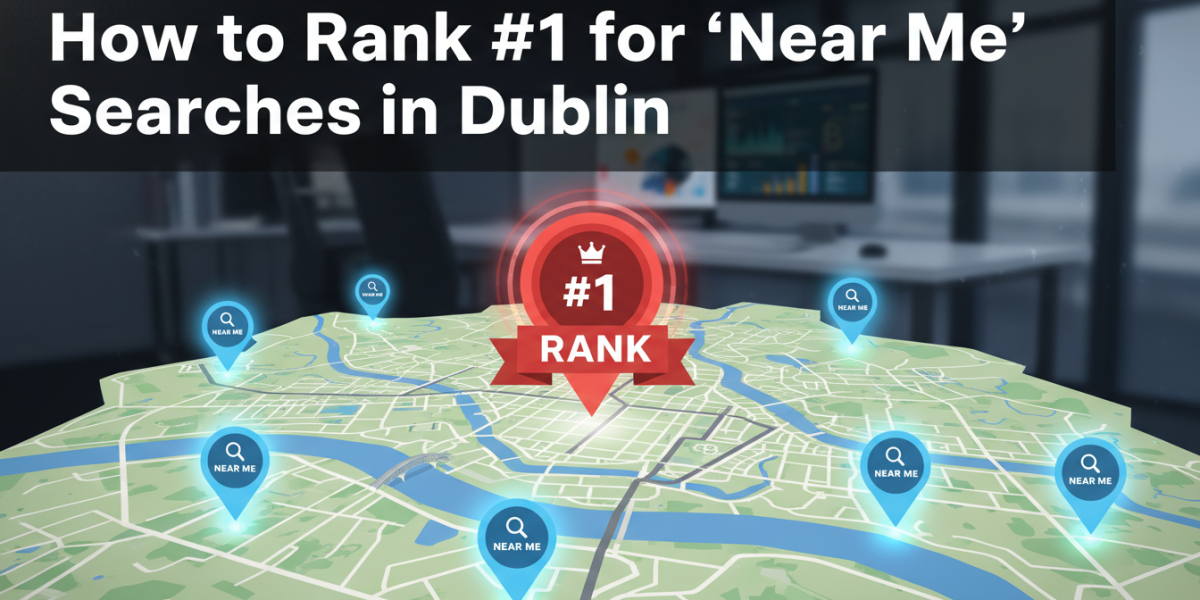
If you run a local business in Dublin, ranking for ‘near me’ searches could be one of the most valuable things you do this year. These searches — "plumber near me," "best coffee shop near me," "accountant near me" — are made by people who are ready to act. They’re not browsing. They’re buying. And in a city as competitive as Dublin, showing up at the top of those results can mean the difference between a fully booked calendar and an empty phone.
This guide breaks down exactly how to get there.
Why ‘Near Me’ Searches Matter More Than Ever in Dublin
Google data has shown that "near me" searches have grown by over 500% in the past several years, with the majority happening on mobile devices. In an urban environment like Dublin, where people are constantly on the move between Ranelagh, Rathmines, Smithfield, and Sandyford, this kind of micro-intent searching is happening hundreds of times a day across almost every industry.
What makes these searches so valuable isn’t just volume — it’s intent. Someone searching "emergency electrician near me" in Dublin at 7pm on a Thursday isn’t doing research. They need someone now. Ranking in that moment means you get the call.
How Google Decides Who Ranks for ‘Near Me’ Queries
Google uses three main factors to determine local search rankings: relevance, distance, and prominence. Relevance is how well your business profile matches what someone is searching for. Distance is straightforward — how close you are to the user’s location. Prominence refers to how well-known and trusted your business appears across the web.
You can’t control distance, but you can significantly influence relevance and prominence — and that’s where most Dublin businesses either win or fall behind.
Step 1: Claim and Fully Optimise Your Google Business Profile
This is the single most important step for ranking in ‘near me’ searches. Your Google Business Profile (GBP) is the foundation of local SEO. Without it, you’re invisible in the local pack — those three map listings that appear at the top of local search results.
Getting the Basics Right
Start by making sure your business is verified. Then fill out every field Google provides: business name, address, phone number, website, hours (including holiday hours), and business category. The category you choose matters enormously — selecting "Electrical Contractor" instead of just "Contractor" gives Google a much clearer signal about what you do.
Use your primary and secondary categories carefully. If you’re a café in Dublin that also does evening wine events, you might list "Café" as your primary category and "Wine Bar" as a secondary. This broadens your relevance without confusing Google.
Keep Your Profile Active
Businesses that post updates to their GBP regularly tend to rank better than those that don’t. This doesn’t need to be daily — even weekly posts about offers, events, or useful tips signal to Google that your profile is active and maintained. Think of it like a social feed for your local presence.
Add photos regularly too. According to Google’s own research, businesses with photos receive 42% more requests for directions and 35% more clicks through to their website than those without. For a Dublin restaurant or retail shop, this is low-hanging fruit.
Step 2: Build Consistent NAP Citations Across the Web
NAP stands for Name, Address, and Phone Number. Consistency of this information across every directory, listing, and website where your business appears is a critical trust signal for Google.
If your business is listed as "Murphy’s Plumbing Ltd" on Google but "Murphy Plumbing" on Golden Pages, and your phone number has changed since your Yelp listing was created, these inconsistencies quietly undermine your local rankings. Google struggles to confirm that all these mentions refer to the same business — and when it can’t confirm, it’s less likely to rank you confidently.
Where to Build Citations in Dublin
The most important directories for Irish businesses include:
- Google Business Profile (essential)
- Bing Places
- Apple Maps
- Golden Pages (goldenpages.ie)
- Yelp Ireland
- Hotfrog Ireland
- Local.ie
- LinkedIn Company Page
- Your local county or Dublin City Council business directory, if available
Go through each one and make sure your details are identical. Even small things like "Street" versus "St." can create noise in the data.
Step 3: Generate and Respond to Reviews — Consistently
Reviews are one of the most powerful ranking factors for local SEO, and they’re particularly influential for ‘near me’ searches. Google gives significant weight to businesses that have a high volume of recent, positive reviews with genuine written feedback.
In Dublin’s competitive market, this is often where businesses separate themselves. A plumber with 12 reviews and a 4.2-star average will almost always outrank one with 3 reviews and a 5-star average — because volume and recency matter alongside rating.
How to Get More Reviews Without Awkwardness
The most effective method is simply to ask — right after a job is done or a service is completed. A short follow-up text or email with a direct link to your Google review page removes all friction. You can generate this link directly from your Google Business Profile dashboard.
Don’t incentivise reviews (Google prohibits this), but do make it easy. A QR code on a receipt, a card left with a delivery, or a simple email follow-up all work well.
Always respond to reviews — both positive and negative. Responding to a negative review professionally often impresses potential customers more than having no negative reviews at all. It shows you’re real, accountable, and engaged.
Step 4: Optimise Your Website for Local Search Signals
Your GBP and citations are essential, but your website still plays an important supporting role. Google looks at your site for additional relevance signals when deciding whether to rank you for local queries.
On-Page Local SEO for Dublin Businesses
Every page on your website should have a clear, location-aware title tag and meta description. If you’re a solicitor based in Dublin 2, your homepage title might read: "Family Law Solicitor Dublin | [Firm Name]" rather than just "[Firm Name] | Solicitors."
Include your full address and phone number in the footer of every page — and make sure it matches your GBP exactly.
Create Location-Specific Content
If you serve multiple Dublin areas — say, Dublin 1, Dublin 4, and Dublin 8 — consider building dedicated service area pages for each. These don’t need to be lengthy, but they should be genuinely useful: mentioning the specific areas you cover, any local context, and services offered there.
Thin, copied pages that just swap suburb names will hurt rather than help. Write each page as if you’re speaking directly to someone in that neighbourhood.
Step 5: Earn Local Backlinks That Signal Dublin Relevance
Backlinks remain one of Google’s most trusted ranking signals — and for local SEO, local backlinks carry particular weight. A link from a Dublin business association, a mention in the Dublin Inquirer, or a feature in a local industry blog sends a strong geographic relevance signal to Google.
Getting these links takes time but isn’t as difficult as it sounds:
- Join the Dublin Chamber of Commerce — membership often comes with a directory listing and backlink
- Sponsor local events — many event websites link to sponsors
- Write guest articles for local business blogs or industry publications
- Partner with complementary local businesses and exchange mentions where appropriate
- Get listed by your trade association — many Irish trade bodies have member directories with do-follow links
Even five or six strong, locally relevant backlinks can meaningfully boost your local rankings over time.
Step 6: Make Sure Your Website Is Mobile-First and Fast
Given that ‘near me’ searches are dominated by mobile users, your website’s mobile experience is non-negotiable. Google now uses mobile-first indexing, meaning it evaluates the mobile version of your site when determining rankings — not the desktop version.
Run your site through Google’s PageSpeed Insights (free tool) and aim for a score above 70 on mobile. Key things to fix:
- Compress images before uploading
- Remove unnecessary plugins or scripts that slow load time
- Use a mobile-responsive design (most modern WordPress themes do this automatically)
- Make your phone number clickable on mobile (a tap-to-call link)
A site that loads in under 3 seconds on a mobile connection will consistently outperform a slow competitor — even if that competitor has more content.
Frequently Asked Questions
How long does it take to rank for ‘near me’ searches in Dublin?
It depends on the competitiveness of your industry and how optimised your current presence is. For less competitive niches, you might see movement within 4–8 weeks. For competitive sectors like legal services or trades in central Dublin, allow 3–6 months of consistent effort. Local SEO is a compounding strategy — early work builds on itself.
Do I need a physical Dublin address to rank for local searches?
Yes. Google requires a verifiable business address to appear in the local pack for ‘near me’ searches. Service-area businesses (like mobile tradespeople) can hide their address publicly but must provide one to Google during verification. Without this, you won’t appear in map-based results.
Is it worth paying someone to manage my local SEO?
If local customers are a meaningful part of your revenue, the answer is almost always yes — provided you work with someone who understands the Irish market and can show you transparent progress. The ROI from ranking at the top of ‘near me’ searches in Dublin can be substantial, particularly in high-value service industries.
What’s the difference between a Google Business Profile and a regular Google account?
Your regular Google account is your personal login. A Google Business Profile is a separate, free tool that lets you manage how your business appears in Google Search and Maps. Every local business should have one — it’s independent of whether you have a website.
Can I rank without a website?
Technically, yes — some businesses rank in the local pack using only a Google Business Profile. But having a well-optimised website significantly strengthens your local authority and improves your chances of ranking consistently. It also gives you a destination to send potential customers with full service information, testimonials, and contact options.
Conclusion
Ranking #1 for ‘near me’ searches in Dublin isn’t about one magic fix — it’s about building a consistent, credible local presence across multiple channels. A fully optimised Google Business Profile, accurate citations, genuine reviews, local backlinks, and a fast mobile-friendly website all work together to signal to Google that your business is the most relevant and trustworthy option in your area.
The businesses that win these searches aren’t necessarily the biggest or the oldest — they’re the ones that have done the groundwork. Start with the foundations, be consistent, and the rankings follow.
Ready to grow your local presence in Dublin? Whether you want to discuss your current Google rankings, get a local SEO audit, or find out what it would take to reach the top of ‘near me’ searches in your area, our team is here to help. Email us at moc.ssobebolg@ofni or call +353 1 868 2345 — we’re happy to talk through your options and point you in the right direction.
Dublin's ROI-Driven Digital Marketing Agency Home
Related Posts
 How do I optimise my website for ʼnear meʼ searches in Dublin?
 How do I rank my business on Google Maps for ʼDublin 2ʼ or ʼDublin 4ʼ?
 Drumcondra Local SEO: How to Rank in Dublin 9
 SEO FAQs for Small Businesses: How to Rank Higher on Google in Dublin
 How to Rank in ChatGPT Search for Dublin Businesses
 Why Most Dublin Blog Posts Never Rank (And How to Fix Yours)
 How to Dominate Near Me Searches in Dublin
 How to Rank on Page One in Dublin Without Paying for Ads