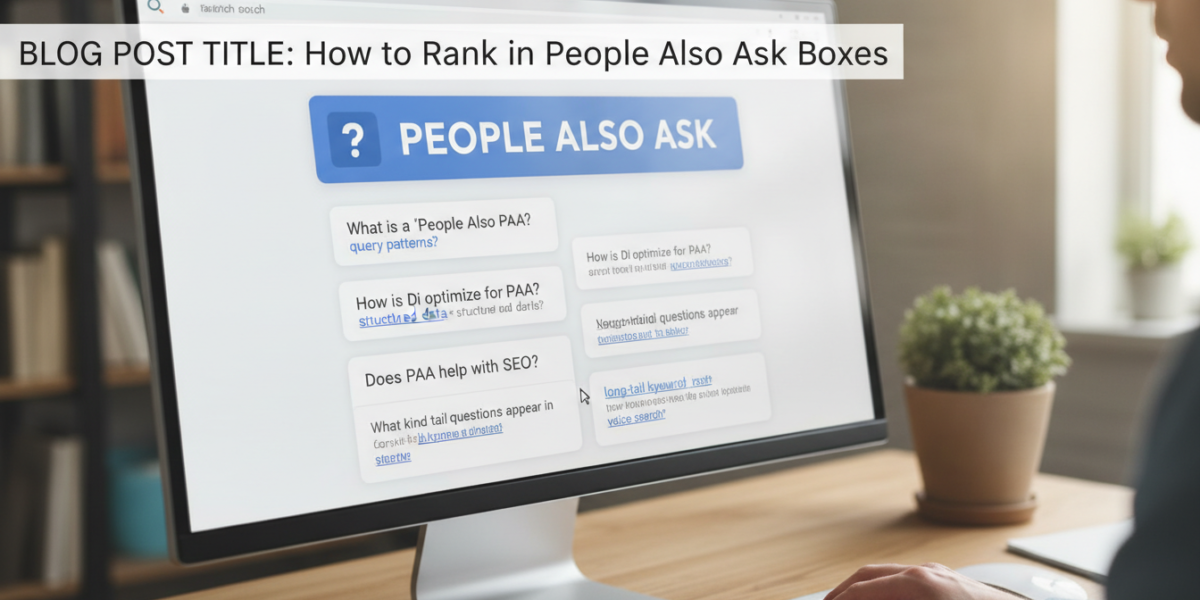
If you’ve searched anything on Google recently, you’ve almost certainly noticed those expandable question boxes sitting partway down the search results page. They appear for hundreds of millions of queries every day. Known as People Also Ask boxes — or PAA boxes — they represent one of the most accessible and underutilised opportunities in modern SEO. Ranking in People Also Ask boxes doesn’t require a massive domain authority or a huge content budget. It requires the right approach, the right content structure, and a clear understanding of what Google is actually trying to do when it surfaces these results.
This guide breaks down exactly how to get there.
What Are People Also Ask Boxes and Why Do They Matter?
People Also Ask boxes are dynamic SERP features that display a set of related questions alongside brief answers pulled from across the web. Each answer links back to the source page, and when you click to expand one question, Google typically loads two or three more. The list is effectively infinite — which means the opportunity is too.
From a traffic perspective, PAA placements are genuinely valuable. Research from SEMrush and Ahrefs has consistently shown that PAA boxes appear in roughly 40–50% of all search results in competitive markets. For informational and commercial-investigation queries, that figure climbs even higher.
The Difference Between Featured Snippets and PAA Boxes
People often confuse the two, but they’re distinct. A featured snippet sits at position zero — one answer, one source, right at the top. PAA boxes appear further down and contain multiple answers from multiple sources, often all on the same page at once.
The good news? The same page can appear in both a featured snippet and multiple PAA results simultaneously. That kind of SERP real estate is worth competing for.
How Google Selects PAA Answers
Understanding the selection logic is half the battle. Google pulls PAA answers from pages it considers authoritative, well-structured, and directly responsive to a specific question. It’s not simply rewarding the highest-authority domains. A smaller site with a tightly focused, clearly formatted answer can absolutely outrank a major publisher if the content serves the user’s intent more precisely.
Google looks at several signals when choosing which content to feature:
- Direct question matching: Does your page actually address the question as asked?
- Answer clarity: Is the answer concise and readable within the first 2–3 sentences below a relevant heading?
- Page structure: Are questions and answers clearly delineated using headings and logical formatting?
- Topical relevance: Does the surrounding content reinforce the page’s authority on the subject?
The Role of Schema Markup
FAQ schema and Q&A schema don’t guarantee a PAA placement, but they do signal to Google that your page contains structured question-and-answer content. Implementing FAQ schema on relevant pages makes it easier for Google’s crawlers to identify, extract, and evaluate your answers. It’s a low-effort, high-upside technical step that many sites still overlook.
How to Rank in People Also Ask Boxes: The Core Strategy
Winning PAA placements isn’t a single tactic. It’s a combination of content strategy, formatting discipline, and smart keyword research working together. Here’s how to approach it methodically.
Step 1: Find the Right Questions to Target
Start by researching what questions people are actually asking around your topic. Tools like Ahrefs, SEMrush, Moz, and free options like AnswerThePublic give you direct visibility into question-based search queries. But don’t stop there — manually search your core keywords in Google and note the exact PAA questions that appear. These are the real targets.
Look for questions that:
- Have clear, factual answers (not purely subjective)
- Align with topics you can genuinely write about with authority
- Match the intent of pages you already have or plan to create
Step 2: Write Answers That Match the Format Google Favours
Google tends to extract PAA answers that are 40–60 words long, directly follow a heading that mirrors the question, and avoid unnecessary padding. This is not the place for a rambling introduction. Get to the point.
Here’s a practical example. If you’re targeting the question "How long does SEO take to work?", your answer block should look something like this:
Heading: How long does SEO take to work?
Answer paragraph: SEO typically takes 3 to 6 months to show meaningful results, though this varies by industry, competition, and how established your site already is. New websites may take longer, while sites with existing authority can see movement faster. Consistent effort over time is far more effective than short bursts of activity.
That’s it. Clear, direct, structured. That’s what Google wants.
Step 3: Use Question-Based H2 and H3 Headings
One of the most impactful structural changes you can make is converting some of your headings into actual questions. Instead of a heading that reads "Benefits of Email Marketing," try "What Are the Main Benefits of Email Marketing?" The question format signals to Google that you’re directly addressing an informational query — exactly the kind of content PAA boxes are built to surface.
This approach works best on:
- FAQ pages
- How-to guides
- Glossary or definition pages
- Long-form blog posts covering broad topics
Step 4: Build Dedicated FAQ Sections on Key Pages
Adding a well-crafted FAQ section to your top-performing pages is one of the fastest ways to create PAA-eligible content at scale. Each FAQ answer gives Google another candidate snippet to evaluate. Over time, a page with eight well-structured FAQ questions has eight separate opportunities to appear in a PAA box — for eight different queries, potentially from eight different searches.
Combine this with FAQ schema markup and you’re giving Google both the content and the structural metadata it needs to make a confident selection.
Optimising Existing Content for PAA Rankings
You don’t always need to create new content from scratch. Some of your best PAA opportunities are already sitting in pages you’ve already published.
Auditing Your Current Pages
Do a content audit with a specific PAA lens. For each page, ask: what questions does this content answer? Are those questions explicitly stated as headings? Are the answers immediate and clear? Often, pages that rank well organically are just a few formatting tweaks away from PAA eligibility.
Use Google Search Console to identify which queries are already bringing people to your pages. If users are arriving via question-based queries and your page doesn’t have a direct, structured answer to those questions, you’re leaving PAA placements on the table.
Refreshing and Restructuring
Updating older content to include question-format headings, concise answer paragraphs, and FAQ schema can produce results within a few weeks — especially on pages that Google is already crawling regularly. This kind of content refresh is often more time-efficient than creating entirely new pages, and it signals freshness to Google at the same time.
Common Mistakes That Cost You PAA Rankings
Even well-intentioned optimisation efforts can miss the mark. A few patterns come up repeatedly.
Burying the answer: If your answer appears three paragraphs into a section, after a long preamble, Google may not extract it cleanly. The answer must follow the question heading immediately.
Being too vague: Generic answers like "it depends on many factors" don’t win PAA placements. Specific, useful, contextually grounded answers do.
Ignoring mobile formatting: PAA boxes are heavily used on mobile. Pages that render poorly on mobile — slow-loading, hard to read, with awkward formatting — are less likely to be selected, even if the content is good.
Over-optimising for one keyword: PAA questions often use natural language that doesn’t match your primary keyword exactly. Target the question as people actually phrase it, not just how you’d like them to phrase it.
Frequently Asked Questions
What types of content rank best in People Also Ask boxes?
Informational content performs best — how-to guides, definitions, comparison articles, and FAQ pages. Google favours concise, direct answers that appear immediately below a relevant heading, ideally between 40 and 60 words long.
How long does it take to rank in a PAA box?
There’s no fixed timeframe, but pages that are already indexed and ranking on page one tend to get PAA placements faster — sometimes within days of a content update. For new pages, allow 4–12 weeks for Google to crawl, evaluate, and potentially feature your answers.
Is FAQ schema required to appear in PAA boxes?
No, it’s not required — but it helps. FAQ schema makes it easier for Google to identify and extract your Q&A content. Pages without schema can still earn PAA placements, but adding schema removes ambiguity and can speed up the process.
Can a small or new website rank in PAA boxes?
Yes, and this is one of the most encouraging aspects of PAA optimisation. Google prioritises answer quality and structure over raw domain authority for these features. A well-structured answer on a niche site can outrank a major publication if it’s clearer and more directly useful.
Should I target every PAA question I find in my research?
Not necessarily. Focus on questions that align with your existing content topics and genuine areas of expertise. Relevance and authenticity matter — creating thin content just to chase PAA boxes can do more harm than good in the long run.
Conclusion
Ranking in People Also Ask boxes is one of the most achievable goals in modern SEO when approached with the right strategy. It rewards content that is clear, specific, and genuinely useful — not necessarily content that comes from the biggest or most authoritative domains. By identifying the right questions, formatting your answers precisely, using structured markup, and auditing your existing content for hidden opportunities, you can steadily build a PAA presence that drives real, consistent traffic.
The key takeaway is this: Google is looking for the best answer to a specific question. Your job is to make sure your page is unmistakably that answer. Structure, clarity, and relevance will get you further than any technical shortcut.
Want help putting this into practice? Whether you’re looking to audit your existing content, build a PAA-focused strategy from the ground up, or simply talk through your options, our team is happy to help. Reach out at moc.ssobebolg@ofni or give us a call on +353 1 868 2345 — we’ll point you in the right direction.
Related Posts
 SERP Features How to Capture Featured Snippets in the Irish SERP
 SERP Features Ireland: Optimizing for featured snippets
 Google updates review snippet structured data
 Google updates article structured data guidance
 Dog Trainer SEO: Rank for Puppy Class Searches
 YouTube Shopping Features: Opportunities For Irish E-Retailers
 Cork SEO Guide: How Leeside Businesses Rank in 2026
 Dundrum Local SEO: Rank Beside Irelandʼs Biggest Shopping Centre