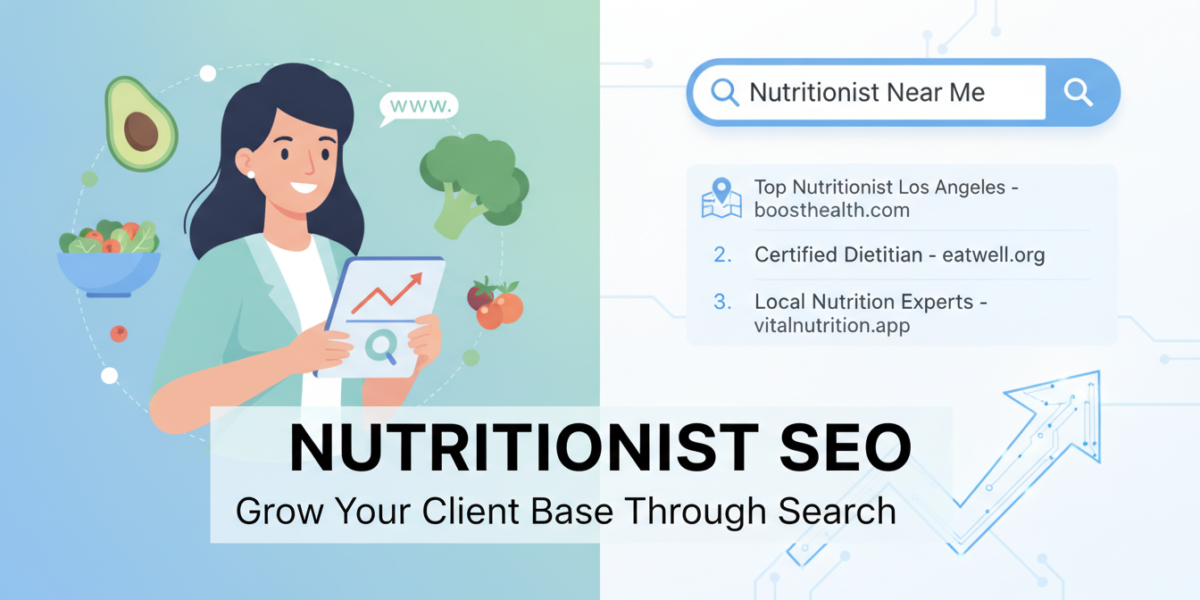
If you’re a nutritionist trying to build a steady stream of clients, you’ve probably already tried word-of-mouth, social media, and maybe even a flyer or two. But there’s one channel that consistently delivers long-term, compounding results that most nutrition professionals underutilise: search engine optimisation. Nutritionist SEO isn’t about gaming algorithms or stuffing your website with keywords — it’s about making sure that when someone in your area types "nutritionist near me" or "help with gut health diet," your name is the one they find.
The good news is that SEO for nutritionists doesn’t require a computer science degree. It requires strategy, consistency, and a genuine understanding of what your potential clients are actually searching for.
Why SEO Matters More Than Ever for Nutritionists
The Way People Find Health Professionals Has Changed
Think about how you found your last service provider — a plumber, a dentist, a solicitor. Chances are, you searched for them online. Health and wellness is no different. According to Google Health, health-related searches account for roughly 5% of all Google queries globally, and that number continues to climb.
People aren’t just searching for "nutritionist." They’re searching for "nutritionist for PCOS in Dublin," "best diet plan for marathon training," or "how to stop bloating with food." If your website doesn’t surface during these searches, you’re invisible to a large segment of your potential clients — even if you’re the most qualified person in your area.
Organic Search vs Paid Ads: A Long-Term Investment
Paid ads can get you immediate visibility, but the moment you stop paying, the traffic stops. Organic SEO, on the other hand, builds over time. A well-optimised blog post about gut health could drive consistent traffic for three to five years with minimal ongoing effort. For a solo nutritionist or small practice managing costs carefully, that kind of return matters.
The Foundation: Getting Your Website Right
Before you think about ranking, your website needs to be technically sound and user-friendly. Search engines reward sites that load quickly, display correctly on mobile devices, and offer a clear, logical structure.
A few non-negotiables:
- Page speed: Google’s Core Web Vitals framework measures loading performance, interactivity, and visual stability. A slow site loses both rankings and potential clients.
- Mobile optimisation: Over 60% of searches now happen on mobile. If your site looks broken on a phone, visitors leave within seconds.
- Clear navigation: Can a visitor find your services, contact details, and qualifications within two clicks? If not, fix it.
On-Page SEO: The Details That Add Up
On-page SEO refers to the elements on each page of your site that signal relevance to search engines. This includes your page titles, meta descriptions, header tags, and the language you use throughout your content.
For example, your homepage title shouldn’t just say "Welcome to Sarah’s Nutrition." It should say something like "Registered Nutritionist in Cork | Weight Management & Gut Health." This tells both Google and your visitor exactly what you do and where you do it.
Use your service pages to go deep on specific topics — one page for weight management, another for sports nutrition, another for digestive health. This creates what SEO professionals call "topical authority," signalling to search engines that your site is a credible resource in your field.
Nutritionist SEO and Local Search: Winning in Your Area
For most nutritionists, the majority of clients come from a defined geographic area. This is where local SEO becomes your most powerful tool.
Google Business Profile: Don’t Skip This Step
Your Google Business Profile (formerly Google My Business) is often the first thing a potential client sees when they search for a nutritionist locally. It displays your name, address, phone number, opening hours, reviews, and photos — all before they even click through to your website.
Claim and verify your profile if you haven’t already. Fill in every section completely. Upload professional photos. Actively encourage satisfied clients to leave reviews, because Google’s local ranking algorithm weighs review quantity and quality heavily. A profile with 40 genuine five-star reviews will consistently outperform a competitor with none.
Location-Specific Pages and Content
If you serve multiple areas — for example, you’re based in Galway but also see clients in Tuam and Athenry — create individual location pages for each. These pages should be genuinely informative, not carbon copies of each other with only the town name swapped out.
Mention local context where relevant: nearby gyms, community health programmes, or regional dietary trends. This kind of specificity builds trust and improves your chances of ranking for location-based searches.
Content Marketing: Answering Questions Before They’re Asked
One of the most effective nutritionist SEO strategies is creating content that answers the questions your ideal clients are already typing into Google. This isn’t about writing for algorithms — it’s about being genuinely helpful.
Think about the consultations you have every week. What are the most common questions your clients ask? Some examples might be:
- "Is it safe to do intermittent fasting with thyroid issues?"
- "What should I eat before a morning workout?"
- "How long does it take to see results from an anti-inflammatory diet?"
Each of those questions is a potential blog post. Each blog post is a potential doorway into your website.
A Simple Content Strategy That Works
You don’t need to publish daily to see results. A realistic and effective approach looks like this:
- Research your keywords using free tools like Google’s "People Also Ask" feature, AnswerThePublic, or Ubersuggest.
- Write one quality post per week — aim for 800 to 1,500 words, focused on a single question or topic.
- Internally link your posts to your service pages wherever it makes natural sense.
- Promote each post once via your social channels to generate initial traffic and signals.
Over six to twelve months, this approach builds a content library that consistently draws in new visitors — many of whom become paying clients.
Building Authority Through Backlinks and Credentials
Search engines don’t just look at your website in isolation. They look at how other websites reference and link to you. These inbound links — called backlinks — act like votes of confidence for your content.
For nutritionists, there are natural and ethical ways to build these links:
- Guest posts on health and wellness blogs or local lifestyle publications
- Local directory listings on sites like Yelp, Healthgrades, or national nutrition body directories
- Press mentions from local newspapers covering health topics
- Collaboration content with complementary professionals like personal trainers or GPs
Your professional credentials also matter here. Being registered with a recognised body — such as the Irish Nutrition and Dietetic Institute (INDI) or the Association for Nutrition (AfN) in the UK — adds authority signals that both Google and your potential clients respect. Include your registration details prominently on your website.
Tracking What’s Working
SEO without measurement is guesswork. Set up Google Analytics 4 (GA4) and Google Search Console on your website — both are free. These tools show you which pages attract the most visitors, which search terms lead people to your site, and where people drop off.
Check your data monthly at minimum. If a particular blog post is generating consistent traffic, consider expanding it or creating related content. If a service page has high traffic but few enquiries, revisit the copy and call-to-action.
FAQ: Nutritionist SEO Questions Answered
How long does SEO take to show results for a nutritionist?
Most nutritionists start seeing meaningful movement in rankings within three to six months of consistent effort. Building significant organic traffic typically takes nine to twelve months, depending on competition in your area. SEO is a long-term investment, but the results compound over time in ways paid ads don’t.
Is it worth hiring an SEO agency as a nutritionist?
It can be, especially if you’re short on time or unsure where to start. A good agency will conduct keyword research specific to your niche and location, optimise your site technically, and develop a content strategy tailored to your services. Look for agencies with experience in health and wellness or professional services sectors.
What keywords should a nutritionist target?
Start with a mix of service-based keywords ("nutritionist Dublin," "sports nutrition consultant") and question-based keywords ("what to eat with IBS," "best diet for hormone balance"). Long-tail, specific phrases often have lower competition and attract more qualified visitors.
Do I need to blog regularly to rank on Google?
Not necessarily daily, but consistent publishing helps. One well-researched, genuinely useful post per week is more effective than five thin posts. Quality always outperforms quantity in modern SEO.
Can social media help my SEO?
Social media doesn’t directly influence your rankings, but it drives traffic to your website, increases your content’s visibility, and can lead to backlinks if your posts are shared by other sites. It’s a useful supporting channel, not a replacement for solid on-page and technical SEO.
Conclusion
Nutritionist SEO is one of the most reliable and cost-effective ways to grow your client base over time. By building a technically sound website, optimising for local search, creating genuinely useful content, and establishing your credentials online, you position yourself as the go-to nutritionist in your area — not just for today, but for years to come.
The most important thing is to start. You don’t need a perfect strategy on day one. You need consistent, informed action. Whether you’re a solo practitioner just starting out or an established clinic looking to scale, search is the channel that keeps working even when you’re not.
Ready to get your nutrition practice found online? Whether you have questions about where to start, want a site audit, or are looking for a tailored SEO strategy for your practice, our team is happy to help. Reach out at moc.ssobebolg@ofni or give us a call at +353 1 868 2345 — we’ll talk through your goals and point you in the right direction.