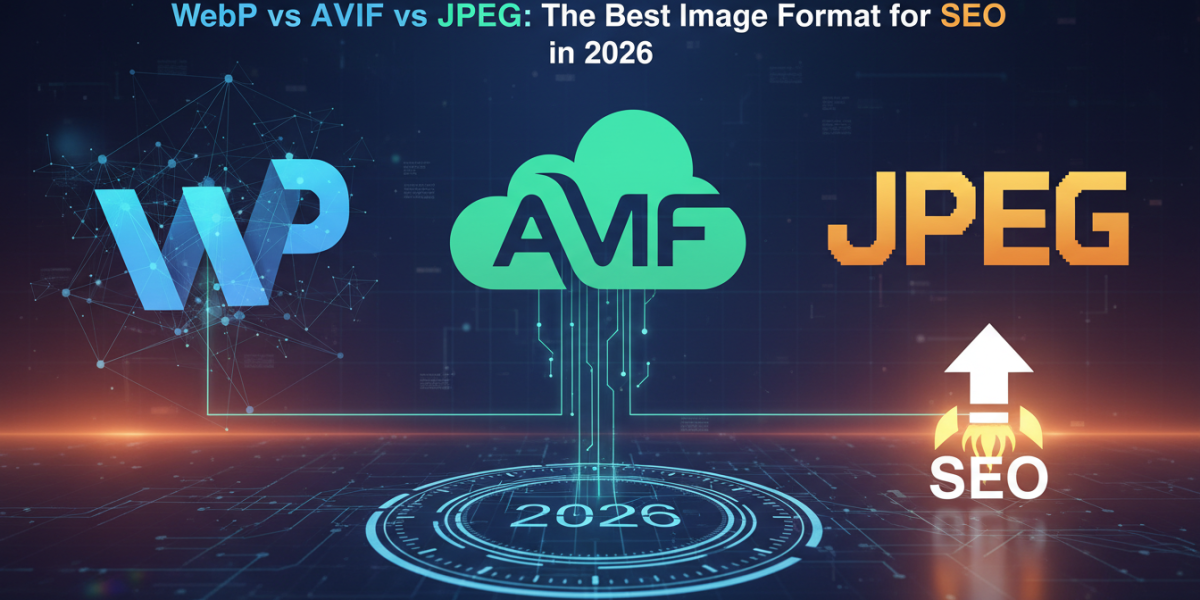
Images make up a significant chunk of most websites’ total page weight. Choose the wrong format, and you’re quietly sabotaging your load times, your Core Web Vitals scores, and ultimately your search rankings. In 2026, the conversation around WebP vs AVIF vs JPEG has moved well beyond "which one looks nicer" — it’s now a genuine SEO decision with measurable consequences.
This guide breaks down exactly what each format offers, where each one falls short, and how to make the right call for your specific situation.
Why Image Format Choice Actually Matters for SEO
Google has been transparent about the role of page speed in rankings since its 2010 announcement, and that signal has only grown stronger with the rollout of Core Web Vitals. Largest Contentful Paint (LCP) — one of the three core metrics — is directly affected by how quickly your images load.
A poorly optimised image can push your LCP score from "Good" into "Needs Improvement" territory overnight. That’s not a hypothetical. A 2MB hero image in an uncompressed JPEG format on a mobile connection can delay LCP by several seconds, enough to hurt both rankings and bounce rate.
Format choice is one lever you can pull without touching a single line of your CMS or redesigning anything. It’s low-hanging fruit with genuine impact.
JPEG: The Old Reliable That’s Starting to Show Its Age
JPEG has been the web’s default image format since the mid-1990s. That’s an extraordinary run, and it hasn’t survived this long without reason. The format is universally supported across every browser, every device, and every content management system on the planet.
For photography-heavy websites — think travel blogs, eCommerce product pages, or news outlets — JPEG still does a decent job. A well-optimised JPEG at 75–85% quality can look sharp and sit under 100KB without too much trouble.
Where JPEG Falls Short
The fundamental problem is that JPEG uses lossy compression that was designed for hardware and bandwidth constraints that no longer exist. As you compress a JPEG harder to hit smaller file sizes, you get visible artefacts, colour banding, and a general muddiness around edges and text.
JPEG also doesn’t support transparency. If you’re working with logos, product cutouts, or UI elements, you’ve historically had to switch to PNG — which tends to produce even larger files. Neither option is ideal for performance-focused development.
WebP: The Format That Changed Everything (and Is Now the Baseline)
Google introduced WebP back in 2010, but widespread browser support took nearly a decade to materialize. By 2020, all major browsers — Chrome, Firefox, Safari, and Edge — had adopted it. In 2026, WebP is effectively the new baseline for web image delivery.
The headline benefit is compression efficiency. WebP typically achieves 25–35% smaller file sizes compared to JPEG at equivalent visual quality. It also supports transparency (replacing the need for PNG in many cases), animation (a lightweight alternative to GIF), and both lossy and lossless modes.
Real-World WebP Performance
To put numbers to this: a product image that comes in at 180KB as a JPEG might weigh just 115KB as a WebP at comparable quality. Multiply that across a category page displaying 40 products, and you’ve saved roughly 2.6MB per page load — without any visible quality difference to the user.
Most modern CMSs, including WordPress (since version 5.8), Shopify, and Squarespace, either convert images to WebP automatically or support it natively. If you’re still serving JPEGs in 2026 without a conversion pipeline, you’re leaving performance on the table.
AVIF: The New Challenger With Serious Compression Credentials
AVIF (AV1 Image File Format) is derived from the AV1 video codec and represents a generational leap in image compression. It was standardised by the Alliance for Open Media — a group that includes Google, Apple, Netflix, and Mozilla — and has been gaining browser support steadily since 2021.
By 2026, AVIF enjoys broad support across Chrome, Firefox, Edge, and Safari (which added support in version 16.4). The only significant holdout is older mobile devices and legacy browsers, which remain a consideration depending on your audience.
How Does AVIF Compare to WebP?
The compression gains are genuinely impressive. Independent benchmarks from organisations like Cloudinary and Squoosh regularly show AVIF achieving 40–55% smaller file sizes than JPEG and 20–30% smaller than WebP — often with better retention of fine detail and colour accuracy.
AVIF also handles high dynamic range (HDR) images and wide colour gamuts better than either JPEG or WebP. For publishers working with professional photography or video thumbnails, that matters.
The Catch with AVIF
Encoding speed is the main practical drawback. AVIF images take significantly longer to compress at the server level — sometimes 5–10 times longer than WebP encoding. For large catalogues being processed in real time, that overhead adds up.
Decoding on older or lower-powered devices can also be slightly slower. In testing on mid-range Android phones from 2020–2021, AVIF decode times were occasionally noticeable compared to WebP. In most real-world scenarios this is negligible, but it’s worth monitoring if your audience skews toward older hardware.
WebP vs AVIF vs JPEG: A Direct Comparison for SEO Decisions
Rather than treating this as a three-way competition with one clear winner, it’s more useful to think about each format as suited to different contexts.
| Format | File Size | Browser Support | Transparency | Encoding Speed | Best For |
|---|---|---|---|---|---|
| JPEG | Baseline | Universal | No | Fast | Legacy support, simple pipelines |
| WebP | 25–35% smaller | Near-universal | Yes | Fast | General web use, eCommerce, blogs |
| AVIF | 40–55% smaller | Broad (2026) | Yes | Slow | High-quality photography, performance-critical pages |
The practical recommendation for most websites in 2026 is to serve AVIF where supported and fall back to WebP — using the HTML <picture> element to handle both gracefully, with JPEG as a final fallback for truly legacy environments.
How to Implement Modern Image Formats Without Breaking Your Site
The <picture> element is your best tool here. Here’s a basic implementation:

The browser reads these sources in order and uses the first one it supports. This means AVIF-capable browsers get the smallest file, WebP-capable browsers get the next best option, and everyone else gets the JPEG fallback. No user is left with a broken image.
Tools and Platforms to Streamline Conversion
You don’t need to manually convert every image. Several tools handle this automatically:
- Cloudflare Images and Cloudflare Polish automatically serve AVIF or WebP based on browser support
- Cloudinary and ImageKit offer on-the-fly format conversion via URL parameters
- WordPress plugins like ShortPixel, Imagify, and Smush convert and serve modern formats automatically
- Shopify has been serving WebP natively for years and is progressively rolling out AVIF support
For developers using static site generators or custom build pipelines, tools like Sharp (Node.js) or libvips can automate bulk conversion as part of your build process.
Regional and Industry Considerations
Your audience’s location and typical device profile should influence your format strategy. Markets with strong 4G and 5G infrastructure — such as Western Europe, South Korea, Japan, and North America — will see the most measurable benefit from AVIF, where bandwidth savings translate directly into faster perceived load times.
In regions where older devices or slower mobile connections are more common — parts of Southeast Asia, Sub-Saharan Africa, or rural areas in any market — WebP often represents a more pragmatic choice. The encoding overhead of AVIF is less justifiable if a significant portion of your users can’t fully benefit from it.
For Irish businesses targeting domestic audiences, modern devices and strong broadband infrastructure mean AVIF adoption makes clear sense for high-traffic, performance-critical pages. Google’s Irish data centre infrastructure also means that server-side rendering and image processing pipelines can handle AVIF encoding without meaningful latency for end users.
Frequently Asked Questions
What is the best image format for SEO in 2026?
For most websites, serving AVIF to supported browsers with a WebP fallback offers the best balance of file size, quality, and compatibility. If you can only implement one format, WebP remains an excellent choice with near-universal support and meaningful file size savings over JPEG.
Is JPEG still worth using at all?
JPEG still has a place as a fallback format in <picture> elements, ensuring compatibility with legacy browsers and older devices. For anything beyond that safety net, you’re better off with WebP or AVIF in terms of both performance and quality.
How do I know if my site is already serving WebP or AVIF?
Open Chrome DevTools, go to the Network tab, filter by "Img," and reload your page. Look at the "Type" column — it’ll show whether images are being served as webp, avif, or jpeg. Google PageSpeed Insights and GTmetrix will also flag "Serve images in next-gen formats" as an opportunity if you’re still on JPEG.
Will switching image formats affect my visual quality?
Done properly, the transition should be completely transparent to users. The goal is to match or exceed the visual quality of your existing JPEGs while reducing file size. Tools like Squoosh (Google’s free image comparison tool) let you preview the output before committing to a conversion pipeline.
Is AVIF support good enough to rely on in 2026?
Yes, for most audiences. By 2026, AVIF is supported by Chrome, Firefox, Edge, and Safari, covering well over 90% of global browser usage. The <picture> element fallback approach means the remaining users still get a perfectly functional WebP or JPEG — so there’s no risk in adopting AVIF now.
Conclusion
The WebP vs AVIF vs JPEG debate doesn’t have to be complicated. JPEG served the web well for thirty years, but in 2026 it’s a fallback format, not a first choice. WebP is the safe, practical upgrade most sites should have made yesterday. AVIF is where the real performance gains live — and with broad browser support now in place, there’s little reason not to start serving it.
The smart approach isn’t picking one winner and going all-in. It’s building a format delivery stack that gives every user the best their browser can handle, using <picture> elements, a CDN with automatic format negotiation, or a CMS plugin that handles the heavy lifting for you. The SEO benefits — faster LCP scores, better Core Web Vitals, and ultimately stronger rankings — are real, measurable, and achievable without a full site rebuild.
Want to discuss how image optimisation fits into a broader SEO strategy for your website? Whether you’re starting from scratch or looking to improve what you already have, we’re happy to help. Get in touch with our team — email us at moc.ssobebolg@ofni or call +353 1 868 2345 and we’ll talk through your options.
Dublin's ROI-Driven Digital Marketing Agency Home
Related Posts
 Why WebP Is the Preferred Image Format Over JPEG and PNG
 AI Search vs Traditional SEO: Whatʼs Changed in 2026
 Limerick SEO: A Local Search Playbook for 2026
 Image SEO: Alt Text, File Names and Compression Done Right
 How to Convert Images to WebP in WordPress (Step-by-Step)
 The True Cost-Per-Click for ʼSolicitor Dublinʼ in 2026
 How Dublin Solicitors Can Win Local Search in 2026
 Why Every Dublin Business Needs Local SEO in 2026