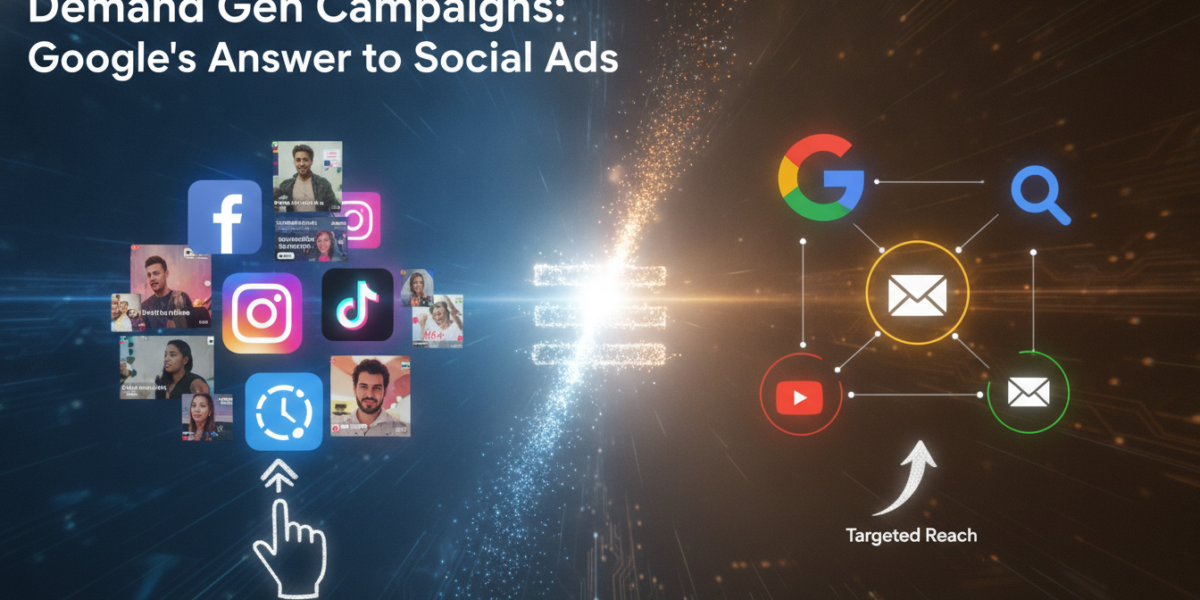
For years, advertisers have had to make a choice: run intent-based campaigns on Google Search, or chase awareness and discovery on social platforms like Meta, TikTok, and Pinterest. Demand Gen campaigns are Google’s attempt to collapse that distinction. Launched as a successor to Discovery Ads in 2023, Demand Gen puts visually rich, audience-targeted advertising directly into the feeds people scroll every day — YouTube, Gmail, and Google Discover — without asking users to search for anything first.
If you’ve been running social ads and wondering whether Google can compete on that turf, or if you’re a Google-first advertiser curious about reaching people earlier in the buying journey, Demand Gen is worth understanding properly.
What Are Demand Gen Campaigns?
Demand Gen is a campaign type within Google Ads designed specifically to generate awareness and interest — not just capture existing demand. Unlike Search campaigns, which respond to what someone is already looking for, Demand Gen puts your brand in front of people while they’re passively consuming content.
Where Your Ads Actually Appear
Demand Gen ads can appear across:
- YouTube In-Feed and Shorts — appearing in the YouTube home feed, search results, and the Shorts vertical scroll experience
- Google Discover — the personalised content feed on Android devices and the Google app
- Gmail — in the Promotions and Social tabs of users’ inboxes
Combined, these placements reach over 3 billion users monthly, according to Google’s own figures. That’s a surface area comparable to Facebook and Instagram combined, which makes the proposition harder to dismiss than it might first appear.
How It Differs From Discovery Ads
Discovery Ads were Google’s earlier attempt at feed-based advertising. Demand Gen builds on that foundation but adds several meaningful upgrades: support for video creatives (including YouTube Shorts), lookalike audience segments, and more granular creative controls. Google effectively retired Discovery Ads and migrated accounts to Demand Gen throughout 2024, signalling that this is the direction the platform is heading.
Why Google Built Demand Gen
Google’s core business has always been intent. Someone searches, someone clicks, someone buys. It’s a clean, high-converting loop. But that model has a ceiling — you can only capture demand that already exists.
Meanwhile, Meta has been collecting enormous ad budgets from brands that want to create demand. They want to introduce people to products they didn’t know they needed, build brand recall, and warm audiences before the purchase decision even forms. Google was largely missing from that conversation.
Demand Gen is the platform’s structured response. It’s designed to compete on the same ground as social advertising — visual storytelling, audience-first targeting, and feed-based placement — while leveraging Google’s data advantage around user intent and behaviour.
Demand Gen Campaigns and Audience Targeting
One of the most compelling features of Demand Gen is its audience toolset, which is substantially more sophisticated than what was available with Discovery Ads.
Lookalike Segments
You can upload a customer list — say, your top 500 purchasers — and Google will build a lookalike audience of users who share similar characteristics. This mirrors one of Meta’s most popular targeting methods and gives advertisers a way to scale beyond their existing customer base without relying purely on broad interest targeting.
The quality of your seed list matters significantly here. A list of 1,000 recent buyers will typically generate a better lookalike than a list of 10,000 old newsletter subscribers. Think of it as input quality shaping output quality.
Interest and Life Event Targeting
Demand Gen also supports Google’s affinity and in-market audience segments, which are built using real search and browsing behaviour rather than self-reported interests. If someone has been researching home renovation loans, reading architecture blogs, and watching kitchen makeover videos on YouTube, Google can infer a high level of intent — even if that person hasn’t typed "home renovation loan" into a search bar recently.
Creative Formats and What Actually Works
Demand Gen supports a mix of static images, carousels, and video — including vertical video for YouTube Shorts. The platform accepts up to 20 creative assets per ad group, and its machine learning will test combinations to find what performs.
Static vs. Video: Which Should You Prioritise?
For most advertisers, video outperforms static in Demand Gen placements, particularly on YouTube. A 15–30 second video that leads with a hook in the first three seconds tends to generate stronger engagement than a static image in the same placement. This mirrors what most social advertisers already know from running Meta or TikTok campaigns.
That said, don’t neglect static entirely. Gmail and Discover placements often favour image-based formats, and having a mix of creative types ensures your ads can render appropriately across all eligible placements.
Practical Creative Tips
- Lead with the problem, not the product — people scroll fast; give them a reason to stop in the first two seconds
- Use captions — a significant percentage of YouTube viewing happens with the sound off
- Keep Shorts content vertical and native-feeling — overly polished ads often underperform authentic-looking content in short-form environments
- Test one variable at a time — swap out the headline, the opening frame, or the CTA, but not all three at once
Setting Up a Demand Gen Campaign: A Practical Overview
Getting started with Demand Gen follows a similar structure to other Google Ads campaign types, but with some configuration choices that are worth thinking through carefully.
Step 1: Define your goal. Demand Gen supports objectives like website traffic, conversions, and product and brand consideration. Choose based on where your audience is in the funnel — don’t optimise for conversions if you’re targeting cold audiences who’ve never heard of your brand.
Step 2: Build your audiences. Upload customer lists if you have them. Layer in Google’s in-market and affinity segments relevant to your product category. For most campaigns, starting with a combination of lookalikes and in-market audiences gives you both scale and relevance.
Step 3: Configure your creative. Upload a mix of image and video assets. Follow Google’s recommended sizes (1:1, 4:5, and 16:9 for images; horizontal and vertical for video). Write multiple headline and description variations — the system needs options to test.
Step 4: Set your budget and bidding. Demand Gen works well with Target CPA or Maximise Conversions bidding for lower-funnel goals. For awareness, Target CPM is available. Give the campaign at least two to three weeks before drawing conclusions — the algorithm needs data to optimise effectively.
Step 5: Review and iterate. Check placement-level performance to understand where your impressions are concentrating. If YouTube Shorts is eating most of your budget but generating weak results, you may want to adjust or create Shorts-specific creative.
How Demand Gen Compares to Meta Ads
This is the question most advertisers eventually ask. The honest answer is: it depends on your business and your audience.
Where Demand Gen Has an Edge
Google’s audience signals are built on behavioural data — what people search, watch, and read — rather than what they click "like" on. This can make targeting feel more accurate for high-consideration purchases, particularly in categories like financial services, home improvement, B2B software, and healthcare.
YouTube also offers a uniquely engaged environment. People actively choose to watch content on YouTube, which can mean higher attention levels than the passive scroll on Instagram or Facebook.
Where Meta Still Leads
Meta’s social graph remains powerful for lifestyle and fashion brands, impulse purchases, and products that benefit from social proof (comments, shares, reactions). The creative feedback loop on Meta is also faster — you can see engagement signals within hours of launching an ad.
For most advertisers, the practical answer is to run both and let the data guide budget allocation. Treating Demand Gen and Meta as competitors misses the point; they’re complementary tools serving overlapping but distinct audiences.
Measuring Success in Demand Gen Campaigns
Because Demand Gen operates higher in the funnel than Search, standard conversion-focused metrics can be misleading if applied in isolation.
Look beyond last-click conversions and consider:
- View-through conversions — users who saw your ad but converted later without clicking
- Brand search lift — an increase in branded search queries following a Demand Gen push
- Assisted conversions — tracked in Google Analytics 4 by following the user journey across touchpoints
Google also offers Brand Lift studies for accounts spending at sufficient scale, which can measure recall and awareness impact directly. These are more commonly used by larger advertisers but provide valuable signal if your goal is upper-funnel impact.
Frequently Asked Questions
What is a Demand Gen campaign in Google Ads?
Demand Gen is a Google Ads campaign type that shows visually rich ads across YouTube, Gmail, and Google Discover. It’s designed to create awareness and interest — reaching people before they search — rather than capturing existing demand like Search campaigns do.
How is Demand Gen different from Performance Max?
Performance Max runs across all Google channels, including Search and Shopping, and is heavily automated. Demand Gen is limited to feed and video placements (YouTube, Gmail, Discover) and gives advertisers more control over audiences and creative. They can work well together, but they serve different purposes.
Is Demand Gen worth it for small budgets?
It can be, but it needs sufficient budget to generate meaningful data. A minimum of €30–€50 per day is a reasonable starting point. Below that, the algorithm struggles to optimise and results become difficult to interpret. Advertisers with very tight budgets may find Search campaigns deliver more reliable returns in the short term.
How long does a Demand Gen campaign take to optimise?
Allow at least two to three weeks before evaluating performance. Google’s Smart Bidding needs a learning period to calibrate. Avoid making major changes — budget, bid strategy, or audience — during this window, as it restarts the learning phase.
Can I use Demand Gen for B2B advertising?
Yes, and it can be effective, particularly for building awareness among decision-makers who consume content on YouTube or Gmail. Use LinkedIn-style targeting signals (job function, company size) layered with Google’s in-market audiences to reach more relevant professionals.
Conclusion
Demand Gen campaigns represent a genuine shift in how Google approaches the advertising funnel. Rather than waiting for users to express intent, it puts brands into the spaces where people discover, browse, and consume — positioning Google as a more complete advertising platform than it’s historically been seen as.
For advertisers who’ve been running Social Ads as their primary awareness channel, Demand Gen offers a credible alternative worth testing — especially if your audience spends significant time on YouTube. And for those already invested in Google Ads, it’s a natural extension that doesn’t require learning an entirely new platform.
The key is approaching it like social, not like Search: invest in creative, give the algorithm time, and measure impact across the full funnel rather than optimising purely for last-click conversions.
Ready to explore whether Demand Gen campaigns are the right fit for your business? Our team works with advertisers across a range of industries and budgets, and we’re happy to talk through your options — no pressure, just practical advice. Reach out by email at moc.ssobebolg@ofni or give us a call at +353 1 868 2345 and we’ll help you figure out the best next step.
Related Posts
 Google ads bug inflating some cost per click cpcs for non us campaigns
 Google ads to discontinue content targeting for youtube conversion campaigns in 2023
 Competitor Bidding in Google Ads: Legal, Ethical, Worth It?
 Google Ads Management & SEO Strategy | Globe Boss Dublin
 Skyrocket Conversions with Expert Meta Ads Campaigns
 How Google Ads Can Dominate Your Local Market
 Maximize ROI with Expert Google Ads Management in Dublin
 How to track conversions with google ads and google tag manager 2025 send dynamic values