
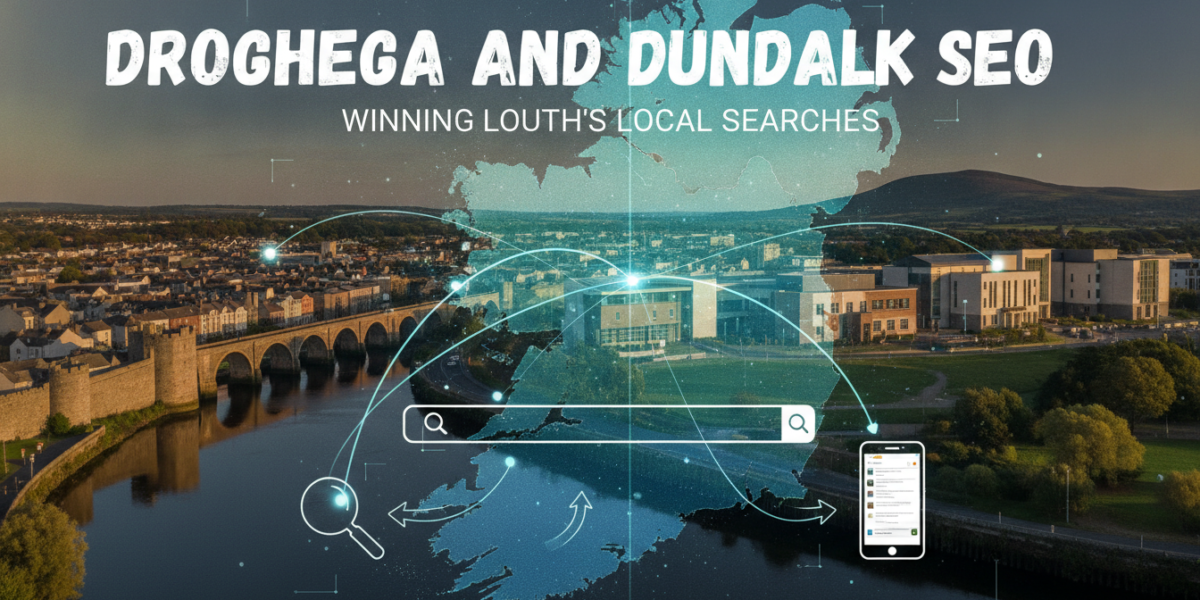
If your business is based in County Louth and you’re not showing up when local customers search for what you offer, you’re handing those leads straight to a competitor. Drogheda and Dundalk SEO isn’t just a buzzword — it’s the practical, ongoing work of making sure your business appears in the right place, at the right time, for the right people. In a county with two of Ireland’s most commercially active towns, getting that visibility right matters more than most business owners realise.
Why Local SEO in County Louth Is Different
The Louth Market Has Its Own Dynamics
County Louth sits at a strategic crossroads. Drogheda is a short commute from Dublin, which means it competes for attention with capital-city businesses that have deep marketing budgets. Dundalk, meanwhile, is close to the Northern Ireland border, which gives it a unique trading environment where some customers are comparing prices and services across two jurisdictions.
These aren’t theoretical differences — they affect how people search, what they trust, and which businesses they ultimately choose. A customer in Drogheda searching "solicitors near me" is likely in a different mindset than someone in Dundalk searching "family law Dundalk." One is urgency-driven; the other is comparison-driven.
Understanding these nuances is what separates effective local SEO from generic advice that doesn’t move the needle.
Search Volume and Competition Are Both Real
Drogheda has a population of over 45,000 and Dundalk over 40,000, making them two of the largest urban centres outside the main Irish cities. The search volume for local services — from builders and accountants to restaurants and dentists — is significant and growing.
At the same time, competition is heating up. More County Louth businesses now understand the value of appearing in Google’s local results, which means the window for easy gains is narrowing. The businesses investing now are building a lead that will be hard to close later.
The Building Blocks of Drogheda and Dundalk SEO
Getting local search right isn’t one single tactic — it’s a layered set of activities that work together. Here’s how to think about it systematically.
Google Business Profile: Your Most Visible Local Asset
If there’s one thing that directly determines whether you appear in the Google Maps results (the "local pack" that shows three businesses at the top of a search), it’s your Google Business Profile. It’s free to set up, but most businesses either don’t have one or have one that’s badly incomplete.
A well-optimised profile includes:
- Accurate NAP (Name, Address, Phone number) that matches your website exactly
- Business categories that reflect what you actually do
- Opening hours kept up to date, including public holidays
- Photos — businesses with photos receive 42% more requests for directions, according to Google’s own data
- Regular posts to signal activity and relevance
For Louth businesses, adding your town name naturally in your business description helps Google associate your profile with local searches. Don’t stuff it — write it as you would explain your business to a customer.
Your Website and On-Page Signals
Your website needs to tell Google clearly where you operate and what you do. This sounds obvious, but many small business websites in County Louth are either missing location references entirely or only mention them once in the contact page footer.
Create dedicated location pages if you serve both Drogheda and Dundalk. These shouldn’t be copy-paste versions of each other with the town name swapped — Google penalises thin, duplicated content. Instead, write genuinely useful content for each location: local landmarks, specific service considerations, or neighbourhood knowledge that only a real local business would have.
Your homepage title tag and meta description should reference your service and location clearly. Something like "Plumbers in Drogheda | Emergency and Planned Work | [Business Name]" is more effective than a generic business name alone.
Building Authority in the Local Search Landscape
Citations and Directory Listings
A citation is any mention of your business name, address, and phone number online. Search engines use citations as a trust signal — if your business appears consistently across directories, it suggests you’re a legitimate, established operation.
For County Louth businesses, the key directories to focus on include:
- Google Business Profile (already covered — your top priority)
- Bing Places for Business
- Yelp Ireland
- Golden Pages
- IrishPages
- Local Chamber of Commerce listings (both Drogheda and Dundalk have active chambers)
The critical thing is consistency. If your address appears as "Main Street" in one place and "Main St" in another, it creates a small but real ambiguity that chips away at trust over time. Audit your existing listings and correct any discrepancies.
Reviews: Social Proof That Also Drives Rankings
Reviews matter to local SEO in two ways. First, they directly influence your ranking in the local pack — Google considers the quantity, recency, and quality of reviews when deciding which businesses to show. Second, they convert searchers into customers by providing evidence that others have had a positive experience.
A business with 45 reviews averaging 4.7 stars will outperform a business with 8 reviews averaging 5.0 in most cases — both in rankings and in click-through rates. Volume and recency signal that the business is active and consistently good.
The most effective way to get reviews is simply to ask. After a job or service, follow up with a message thanking the customer and including a direct link to your Google review page. Most people are happy to leave one if asked at the right moment.
Content Strategy for Louth Businesses
What to Write About (and Why It Works)
Content that serves real local intent is one of the most underused tools in Drogheda and Dundalk SEO. Most small businesses have a basic website with a homepage, services page, and contact form — and nothing else. That leaves a huge opportunity on the table.
Consider writing blog posts or guides around questions your customers actually ask:
- "What permits do I need for a home extension in Louth?"
- "Best time of year to get your roof checked in the northeast of Ireland"
- "How to choose a local accountant in Drogheda"
These aren’t glamorous topics, but they attract people who are actively considering a purchase or service. Someone reading "how to choose a local accountant in Drogheda" is very likely looking for an accountant. If you’re an accountant in Drogheda and you have that article, you’re in a strong position.
Hyperlocal References Add Real Credibility
Weaving in genuine local knowledge makes your content more trustworthy to readers and more relevant to Google’s local algorithms. References to the Boyne Valley, the Dundalk bypass, St. Patrick’s Cathedral, or the Millmount area aren’t just flavour — they signal authenticity.
Don’t force it. If a local reference fits naturally, use it. If it doesn’t, leave it out. Readers — and algorithms — can tell the difference between a business that genuinely operates locally and one that’s just dropping place names for effect.
Technical Foundations You Can’t Ignore
Strong content and good citation management won’t fully compensate for a slow, broken, or mobile-unfriendly website. Google has been explicit that page experience is a ranking factor, and mobile usage in local search is dominant — most "near me" searches happen on phones.
Run your site through Google’s PageSpeed Insights tool (it’s free). A score below 50 on mobile is a red flag. Common fixes include compressing images, reducing unnecessary plugins, and enabling browser caching. These aren’t always simple, but they’re worth prioritising.
Also make sure your site uses HTTPS, has no broken links, and has a clear XML sitemap submitted to Google Search Console. These are table-stakes requirements for any serious local SEO effort.
Tracking Progress and Knowing What’s Working
The Metrics That Actually Tell You Something
SEO without measurement is guesswork. The good news is that the core tools are free. Google Search Console shows you which queries are driving impressions and clicks to your site. Google Analytics 4 shows you what happens once visitors arrive — which pages they visit, how long they stay, and whether they take action.
For local SEO specifically, your Google Business Profile dashboard is invaluable. It shows how many people have seen your profile, called your phone number directly from Google, or requested directions. These are direct indicators of local visibility and real-world engagement.
Set a monthly review date and check these numbers consistently. Look for trends over time, not just week-to-week fluctuations. SEO is a long game — meaningful results typically emerge over three to six months of consistent effort.
Frequently Asked Questions
What’s the difference between regular SEO and local SEO?
Regular SEO aims to rank your website for broader search queries that aren’t tied to a specific location. Local SEO focuses on helping your business appear in geographically relevant searches — for example, when someone searches "electrician Dundalk" or "dentist near Drogheda." Local SEO places particular emphasis on Google Business Profiles, map pack results, and location-specific content.
How long does it take to see results from local SEO in Drogheda or Dundalk?
Most businesses start to see meaningful movement in local rankings within three to six months of consistent effort. Some quick wins — like fully completing your Google Business Profile or fixing citation inconsistencies — can show results faster. Competitive industries in busy areas may take longer. The key is consistency rather than short bursts of activity.
Is it worth hiring someone to do SEO, or can I manage it myself?
For a one-location business with a small budget, it’s entirely possible to handle the basics yourself — particularly Google Business Profile management, requesting reviews, and writing occasional blog content. However, technical SEO, link building, and competitive keyword strategy benefit from specialist knowledge. Many Louth businesses start with the DIY basics and bring in professional help once they’re ready to scale.
Do I need separate SEO strategies for Drogheda and Dundalk?
Yes, if you’re targeting both towns, you’ll get better results with tailored approaches. This doesn’t mean completely different campaigns, but it does mean separate location pages on your website, town-specific content, and ensuring your Google Business Profile is accurate for whichever location is your primary base. If you have physical premises in both towns, set up two separate Google Business Profiles.
How important are reviews for local SEO in County Louth?
Very important. Reviews influence both your position in the local pack and the likelihood that searchers will click on your listing. A steady stream of genuine, recent reviews sends a strong signal to Google that your business is active and well-regarded. Even a handful of new reviews each month can make a noticeable difference over time.
Conclusion
County Louth is a competitive and commercially active region, and the businesses that invest in Drogheda and Dundalk SEO now are the ones that will dominate local search results over the next few years. This isn’t about gaming an algorithm — it’s about making sure that when someone in your area needs what you offer, they can actually find you.
The work involved is real but manageable: a well-maintained Google Business Profile, a website that clearly communicates where you operate and what you do, consistent citations, genuine reviews, and content that reflects the community you serve. Start with the fundamentals, measure what’s working, and build from there. Local search rewards consistency and genuine local relevance more than any shortcut.
Ready to Grow Your Visibility in County Louth?
If you’d like to discuss your local SEO options or get a clearer picture of where your business stands in search results, we’d be glad to help. Whether you have a specific question or want to explore what a proper strategy would look like for your business, you’re welcome to reach out in whichever way suits you best.
Email us at moc.ssobebolg@ofni or call us on +353 1 868 2345 — we’re happy to talk through your situation and point you in the right direction, with no pressure and no jargon.
Related Posts
 Naas Local SEO: Win Searches Across County Kildare
 Local SEO in Blanchardstown: Win Dublin 15 Searches
 How to Rank #1 for ʼNear Meʼ Searches in Dublin
 How do I optimise my website for ʼnear meʼ searches in Dublin?
 Dominate Dublin Searches with Powerful Local SEO Tactics
 How to optimise a website for Dublin searches
 Locksmith SEO: Own Emergency Searches in Your City
 Pest Control SEO: Seasonal Search Strategies for Ireland