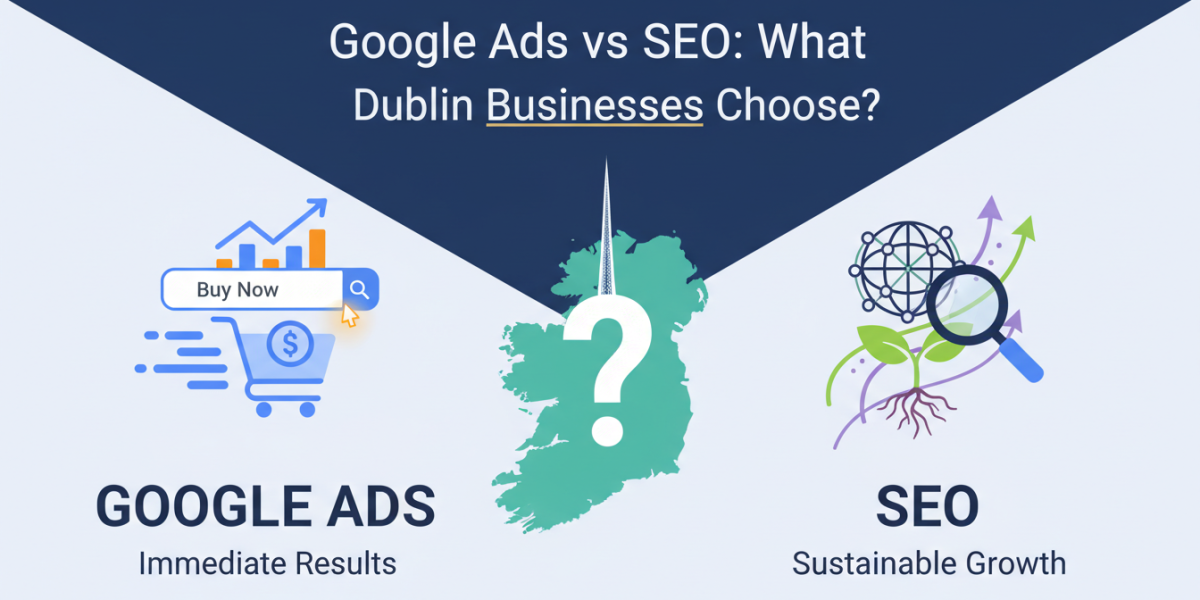
If you run a business in Dublin and you’re trying to grow your online presence, you’ve almost certainly encountered the debate around Google Ads vs SEO. Both are powerful digital marketing channels. Both can drive real traffic and genuine customers. But they work in very different ways, and the right choice depends heavily on your goals, your budget, and where your business is right now.
This isn’t a question with a single right answer — but it’s absolutely one worth thinking through carefully before you start spending money.
Understanding the Basics: What Are We Actually Comparing?
Google Ads
Google Ads (formerly Google AdWords) is a paid advertising platform. You bid on keywords, and when someone searches for those terms, your ad can appear at the top of the results page. You pay when someone clicks — hence the term Pay-Per-Click, or PPC.
It’s immediate. Set up a campaign today, and you can have traffic tomorrow. But the moment you stop paying, the traffic stops too.
SEO
Search Engine Optimisation is the process of improving your website so it ranks higher in Google’s organic (unpaid) results. This involves technical improvements, content creation, link building, and a range of on-page factors.
SEO takes time — typically 3 to 6 months before you see meaningful results, sometimes longer in competitive markets. But once you’ve earned those rankings, the traffic keeps coming without paying for every click.
The Dublin Market: Why Context Matters
Dublin is a competitive city. Whether you’re in hospitality, legal services, construction, e-commerce, or tech, you’re probably competing with dozens — if not hundreds — of businesses targeting the same customers in the same geographic area.
That competition affects both channels differently. In high-demand sectors like personal injury solicitors or property management, Google Ads costs per click can reach €10–€30 or more. In contrast, a well-executed SEO strategy for a local Dublin plumber might drive consistent leads for a fraction of that over time.
The Local SEO Opportunity
For many Dublin-based businesses, local SEO is particularly underutilised. Ranking in Google’s "local pack" — those three map results that appear for searches like "accountant Dublin 2" or "coffee shop Rathmines" — can drive substantial foot traffic and phone calls without any ad spend.
Google Business Profile optimisation, local citations, and locally relevant content all contribute to this. It’s a slow burn, but for bricks-and-mortar businesses or those serving specific Dublin postcodes, it’s often the highest-return investment available.
Google Ads vs SEO: A Head-to-Head Breakdown
Speed of Results
This is where Google Ads wins clearly. A new Dublin restaurant launching in October doesn’t have the luxury of waiting until spring to see organic results — they need bookings now. Google Ads can fill that gap immediately.
SEO, by comparison, is a longer game. But the wait is not wasted time; you’re building an asset. A website that ranks on page one for "solicitors Dublin" or "web design Dún Laoghaire" is generating traffic day and night without ongoing ad spend.
Cost Considerations
Neither channel is inherently cheap if done properly, but they cost differently.
With Google Ads, you have direct control over spend. A Dublin retailer might set a €500/month budget and know exactly what they’re getting — a certain number of clicks, at a certain cost, generating a certain number of conversions. The downside: when that €500 is gone, so is the traffic.
SEO investment goes into work — content, technical fixes, link acquisition — and the returns compound over time. A piece of content that ranks well this year might continue driving traffic for three or four years. According to BrightEdge research, organic search drives over 50% of all website traffic across most industries, which illustrates how substantial that long-term channel can be.
Targeting Precision
Google Ads offers incredibly precise targeting. You can target specific keywords, times of day, device types, and geographic areas down to a specific Dublin postcode. Want to only show ads to people searching "emergency boiler repair" within 5km of Tallaght on a weekday morning? You can do that.
SEO targeting is less granular in real time, but strategic content creation lets you attract specific audiences. A Dublin law firm might publish detailed guides on landlord-tenant disputes, attracting exactly the type of client they want through highly relevant search queries.
Trust and Click-Through Behaviour
Studies consistently show that organic results receive more clicks than paid ads for most search queries. Users often skip ads instinctively, particularly for informational searches. Paid ads perform best for transactional, high-intent searches — someone searching "buy office chairs Dublin" is likely ready to purchase, and an ad suits that moment perfectly.
For research-based or trust-sensitive searches — say, "best therapist in Dublin" or "accountant for small business Dublin" — organic results tend to carry more credibility in the reader’s mind.
When Google Ads Makes More Sense
There are situations where paid search is the clearer choice, at least in the short term.
You’ve just launched. A brand-new business has no domain authority, no backlinks, and no existing content. SEO won’t help you for months. Google Ads buys you time while your organic presence develops.
You’re promoting something time-sensitive. A seasonal sale, an event, a new product launch — these have windows of opportunity that SEO simply can’t serve in time.
Your margins support it. A Dublin solicitor generating €5,000 in fees per new client can comfortably justify a €40 cost-per-click. A business selling €25 products cannot.
You need trackable, scalable testing. Google Ads is excellent for testing messaging, offers, and landing pages quickly. Those insights can then feed your SEO and content strategy.
When SEO Is the Smarter Investment
Building Long-Term Value
If you’re thinking in terms of 12–24 months rather than next week, SEO almost always delivers better return on investment. A Dublin estate agent who invests in local content, technical SEO, and authoritative backlinks is building something that pays dividends indefinitely — unlike an ad campaign that stops the moment the budget does.
Lower Ongoing Cost Per Lead
Once you’ve achieved strong organic rankings, the marginal cost of each additional visitor is essentially zero. Compare that to Google Ads, where every click costs money regardless of how long you’ve been advertising.
Building Authority in Your Niche
Consistent, quality content helps your business become a trusted resource in your field. A Dublin accountancy firm that publishes clear, useful guides on topics like VAT returns for sole traders or tax deadlines for SMEs will gradually become the go-to authority for those queries — which is both an SEO win and a brand-building exercise.
The Case for Doing Both
Here’s the honest answer many digital marketers give when pushed: the most effective approach for established Dublin businesses is usually a combination of both.
Google Ads can fund your business while SEO builds momentum. As your organic rankings improve, you can reduce ad spend on those specific terms and redirect the budget toward more competitive or experimental campaigns.
Think of it as a relay race rather than a competition. Ads carry the baton at the start; SEO takes over as it builds speed.
A Dublin e-commerce business, for example, might use Google Shopping Ads to drive immediate sales while simultaneously investing in category page SEO and blog content. Over 12–18 months, as organic traffic grows, the reliance on paid clicks decreases, and profit margins improve.
FAQ
How long does SEO take to show results for a Dublin business?
Most businesses start seeing meaningful movement in organic rankings within 3 to 6 months, though competitive industries or newer websites may take 9 to 12 months. Local SEO for Dublin-specific searches can sometimes show results more quickly, especially through Google Business Profile optimisation.
Is Google Ads worth it for a small Dublin business with a limited budget?
It can be, but budget management is critical. Even €300–€500 per month can generate leads if campaigns are tightly focused on high-intent, lower-competition keywords. The key is to avoid broad match keywords that burn through budget without converting. For very tight budgets, local SEO may offer better long-term value.
What’s the average cost per click for Google Ads in Dublin?
It varies enormously by industry. Competitive sectors like legal, financial services, or property can see CPCs of €10–€40. Less competitive niches — a local florist or a niche B2B service — might pay €0.50–€3 per click. Researching keyword costs before committing to a budget is essential.
Can I do SEO myself, or do I need an agency?
Basic SEO — updating your Google Business Profile, adding relevant content, improving page titles — can be done in-house. But technical SEO, link building, and competitive keyword strategy are areas where professional expertise tends to deliver significantly better results, especially in a competitive market like Dublin.
Which delivers better ROI: Google Ads or SEO?
Over the long term (12+ months), SEO typically delivers better ROI because traffic costs don’t increase with volume. In the short term, Google Ads provides more predictable and immediate returns. The right answer depends on your timeline, industry, and current website authority.
Conclusion
For Dublin businesses, the Google Ads vs SEO debate rarely has a single winner — it has a right answer for your specific situation. If you need leads now and can support the cost per click, Google Ads is a smart starting point. If you’re building for the long term and want a channel that compounds in value, SEO is your foundation.
The most successful businesses in Dublin typically don’t choose one over the other permanently. They use paid search strategically while investing consistently in organic growth — treating both as complementary tools rather than competing options. The businesses that grow steadily online are usually the ones who understand the strengths and limitations of each channel, and deploy them accordingly.
Ready to figure out the right strategy for your Dublin business? Whether you’re just starting out or looking to get more from your current digital marketing, our team is happy to talk through your options — no jargon, no pressure.
Get in touch today: email us at moc.ssobebolg@ofni or call +353 1 868 2345 and we’ll help you work out what makes sense for your goals and budget.
Related Posts
 Globe Boss: Local SEO for Dublin Businesses
 How to Rank in ChatGPT Search for Dublin Businesses
 Globe Boss Google Ads Management Dublin
 Globe Boss: PPC and Google Ads Dublin
 SEO FAQs for Small Businesses: How to Rank Higher on Google in Dublin
 The Biggest Google Ads Mistakes Irish Businesses Make
 Why Meta Ads Are Still Worth It for Dublin Businesses
 Google Ads Management & SEO Strategy | Globe Boss Dublin