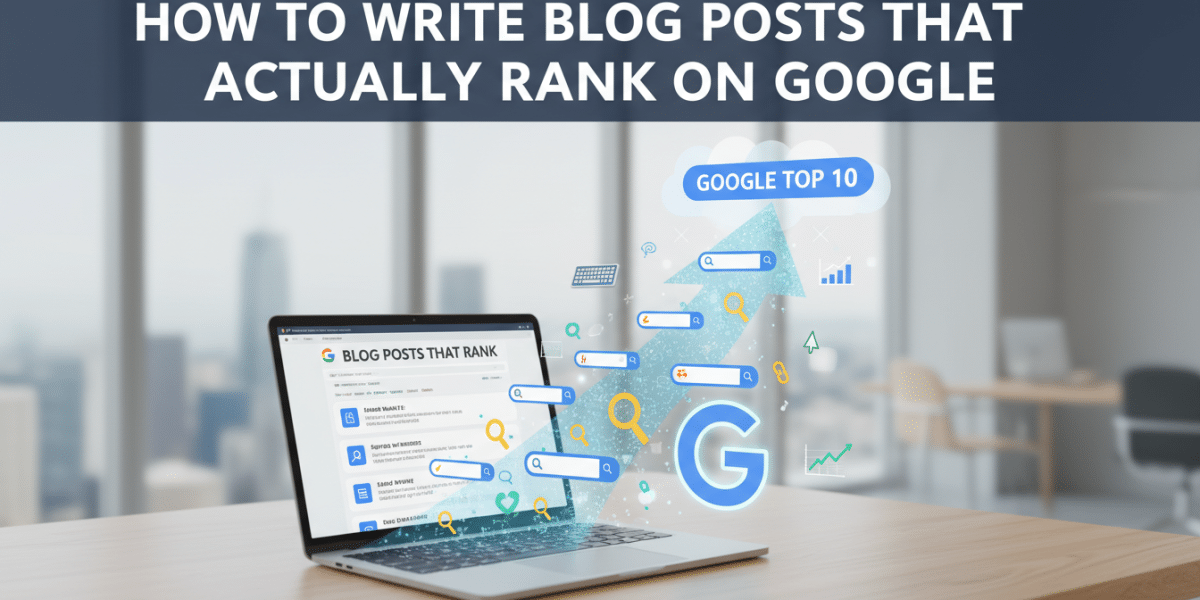
Beyond the Buzzwords: How to Write Blog Posts That Actually Rank on Google
In the vast, ever-expanding ocean of online content, simply publishing a blog post often feels like dropping a message in a bottle – hopeful, but unlikely to be found. Every day, millions of articles go live, and a significant portion of their creators share the same core goal: to appear prominently in Google’s search results. But the question remains: How to write blog posts that actually rank on Google?
It’s a challenge many face, but it’s far from an insurmountable one. Ranking isn’t about tricking algorithms or stuffing keywords; it’s about providing genuine value and meeting user intent in a technically sound way. This comprehensive guide will walk you through the essential steps, strategies, and mindset shifts required to transform your blog posts from digital whispers into authoritative voices that Google recognizes and rewards.
It All Starts with Understanding Your Audience (and Their Search Intent)
Before you even open a blank document, the most crucial step is to understand who you’re writing for and what they hope to find. Google’s primary mission is to deliver the most relevant and satisfying answer to every search query. If you can align your content with that mission, you’re already halfway to ranking success.
The Foundation: Keyword Research (Beyond Just Volume)
Keyword research isn’t just about finding terms with high search volume. It’s about uncovering the language your target audience uses, the questions they ask, and the problems they’re trying to solve.
- Go Long-Tail: While “digital marketing” might be too competitive, “how to improve organic traffic for small businesses” is a long-tail keyword that indicates specific intent. These keywords often have lower search volume but much higher conversion rates because the user knows exactly what they’re looking for.
- Embrace Questions: Tools like AnswerThePublic or Google’s “People Also Ask” section can reveal the exact questions users type into the search bar. Structuring your blog post around answering these direct questions naturally aligns with search intent.
- Analyze Competitors: See what’s ranking for your target keywords. What topics do they cover? How are their articles structured? What gaps can you fill or how can you offer a superior perspective? This isn’t about copying; it’s about understanding the current landscape and finding opportunities to differentiate.
Decoding Search Intent: What Do They Really Want?
Once you have your keywords, critically examine the intent behind them. Google categorizes search intent into a few main types:
- Informational: The user wants to learn something (e.g., “what is content marketing?”). Your post needs to be comprehensive and educational.
- Navigational: The user wants to find a specific website or page (e.g., “Facebook login”). Not typically relevant for blog posts, unless you’re guiding them to a specific resource.
- Transactional: The user wants to buy something (e.g., “best running shoes deals”). Your post might compare products or offer buying guides that lead to a purchase.
- Commercial Investigation: The user is researching before buying (e.g., “SEO software reviews”). Your post should offer in-depth comparisons, pros, cons, and recommendations.
Understanding intent helps you tailor not just the content, but also the format and depth of your blog post. A user looking for a quick definition doesn’t want a 3000-word essay, and someone researching a complex topic won’t be satisfied with a mere paragraph.
Crafting Content That Google (and Humans) Love
With your audience and intent firmly in mind, it’s time to create the actual content. This is where quality, structure, and readability become paramount. Remember, Google’s algorithms are incredibly sophisticated; they prioritize content that genuinely helps users.
The Irresistible Title Tag and Meta Description
Your title tag (what appears in the browser tab and search results) and meta description (the snippet below the title) are your first impression. They are crucial for attracting clicks, even if you rank well.
- Title Tag: Include your main keyword naturally, make it compelling, and keep it under 60 characters (to avoid truncation). Use power words (“Ultimate,” “Guide,” “Secret,” “Proven”) or numbers (“5 Ways,” “2024 Guide”) to pique interest.
- Meta Description: This is your mini-advertisement. Summarize your blog post’s value proposition, include a call to action (even a soft one like “Learn More”), and weave in your target keyword or related terms. Aim for around 150-160 characters.
Example:
- Keyword: “How to write blog posts that actually rank on Google”
- Title Tag: The Ultimate Guide: How to Write Blog Posts That Rank on Google in 2024
- Meta Description: Learn proven strategies for how to write blog posts that actually rank on Google. From keyword research to promotion, get practical tips to boost your SEO today!
Structure for Success: Headings, Subheadings, and Scannability
A well-structured article isn’t just aesthetically pleasing; it’s fundamental for both user experience and SEO. Google uses your headings (H1, H2, H3, etc.) to understand the hierarchy and main topics of your content.
- H1 for Your Main Topic: Your blog post title should typically be your H1. It clearly states the primary subject.
- H2s for Major Sections: Break down your article into logical main sections using H2s. These should reflect the core sub-topics of your article.
- H3s for Detailed Points: Use H3s to elaborate on specific points within your H2 sections.
- Short Paragraphs & Lists: No one wants to read a wall of text. Break up your content into short, digestible paragraphs (2-4 sentences is ideal). Use bullet points and numbered lists to present information clearly and make it scannable. This improves readability and keeps users on your page longer, signaling to Google that your content is valuable.
The Art of In-Depth, Value-Driven Content
Gone are the days when short, keyword-stuffed articles could rank. Today, Google rewards comprehensive, authoritative content.
- Be Thorough: Cover your chosen topic exhaustively. If someone reads your post, they shouldn’t need to search elsewhere for related information. Answer all potential questions a reader might have about the subject.
- Offer Original Insights: Don’t just regurgitate what’s already out there. Add your unique perspective, data, case studies, or actionable steps. This demonstrates expertise and provides fresh value.
- Embrace E-E-A-T: Google heavily emphasizes Experience, Expertise, Authoritativeness, and Trustworthiness.
- Experience: Have you personally used the product/service or done what you’re writing about? Share that firsthand experience.
- Expertise: Showcase your knowledge. Cite reputable sources, display credentials, or demonstrate deep understanding of the subject.
- Authoritativeness: Are you recognized as a go-to source? Do others link to and reference your work?
- Trustworthiness: Is your information accurate and up-to-date? Is your website secure and transparent?
- Avoid Fluff: While content should be in-depth, it shouldn’t be padded with meaningless words. Every sentence should contribute to the overall message and value.
Natural Keyword Integration (The Goldilocks Zone)
While keyword stuffing is a definite no-no, completely avoiding your keywords is equally detrimental. The key is to find the “Goldilocks zone”—just right.
- Early and Often (Naturally): Include your main keyword in your introduction, within your H2s and H3s, and a few times throughout the body text.
- Use Synonyms and LSI Keywords: Google understands context. Instead of just “how to write blog posts that actually rank on Google,” use phrases like “blog post SEO,” “content ranking strategies,” “improving blog visibility,” or “optimising for search engines.” This enriches your content and signals a broader understanding of the topic.
- Prioritize Readability: Never sacrifice natural language for keyword density. If it sounds unnatural or forced, rewrite it. Write for your readers first, and Google will follow.
Beyond the Words: Technical SEO and User Experience
Writing compelling content is essential, but it’s only one piece of the puzzle. Your blog post also needs to be technically sound and offer an excellent user experience to actually rank on Google.
Optimizing for Speed and Mobile-Friendliness
Google uses Core Web Vitals (page loading speed, interactivity, and visual stability) as ranking signals. A slow or difficult-to-use site will frustrate visitors and deter Google.
- Image Optimization: Compress images before uploading them. Use appropriate file types (JPG for photos, PNG for graphics). Add descriptive alt text that includes keywords where relevant. This helps search engines understand image content and improves accessibility.
- Responsive Design: Ensure your blog is fully responsive, meaning it adapts seamlessly to any screen size (desktop, tablet, mobile). Most modern themes are built this way, but always double-check.
- Leverage Caching: Caching plugins can significantly speed up your site by storing frequently accessed data.
Internal and External Linking Strategies
Links are the highways of the internet, guiding both users and search engine crawlers.
- Internal Linking: Link to other relevant blog posts on your own site. This helps distribute “link juice” (authority) across your content, keeps users engaged on your site longer, and helps Google understand the relationships between your articles.
- External Linking: Link out to high-authority, relevant external sources when you cite statistics, research, or offer further reading. This demonstrates that your content is well-researched and trustworthy. (Make sure external links open in a new tab so users don’t leave your site entirely).
The Power of Multimedia: Images, Videos, Infographics
Breaking up text with rich media elements enhances user engagement and can help you write blog posts that actually rank on Google by reducing bounce rates and increasing time on page.
- Relevant Images: Use high-quality, relevant images that complement your text.
- Videos & Infographics: Embed videos (your own or from reputable sources like YouTube) or create custom infographics to explain complex topics visually. These are highly shareable and can significantly boost engagement.
- Alt Text for SEO: Always add descriptive alt text to your images. This is crucial for accessibility and provides another opportunity to naturally include relevant keywords.
Don’t Just Publish, Promote and Update!
Even the most perfectly optimised blog post won’t reach its full potential if no one knows it exists. Once your article is live, the work isn’t over.
Spreading the Word: Social Media and Beyond
- Social Media Sharing: Share your blog posts across all relevant social media platforms. Craft engaging captions and tailor your posts for each platform.
- Email Marketing: If you have an email list, send out a newsletter highlighting your new blog post. This is a highly effective way to drive initial traffic.
- Community Engagement: Share your post in relevant online communities, forums, or groups (where permitted and appropriate) to reach a targeted audience.
- Outreach: If your post references or expands upon another expert’s work, consider reaching out to them to let them know. They might share it with their audience.
Keeping Your Content Fresh: The Evergreen Advantage
SEO is not a “set it and forget it” game. Content degrades over time as information becomes outdated or new developments emerge.
- Regular Audits: Periodically review your older blog posts. Check for broken links, outdated statistics, or information that needs updating.
- Refresh and Republish: If a post is still relevant but underperforming, give it a comprehensive refresh. Add new sections, update examples, improve internal linking, and consider changing the publish date to reflect its renewed status. Google often rewards updated, comprehensive content.
- Monitor Performance: Use Google Analytics and Google Search Console to track which posts are performing well, which need improvement, and what keywords they’re ranking for. This data is invaluable for refining your strategy.
Conclusion: The Human-First Approach to Ranking
The ultimate secret to how to write blog posts that actually rank on Google isn’t a secret at all: it’s about consistently providing exceptional value to your readers. Google’s algorithms are constantly evolving to better understand and reward content that genuinely serves human search intent.
By diligently researching your audience, crafting comprehensive and engaging content, optimising for technical factors, and actively promoting and maintaining your posts, you’re building a foundation for sustainable ranking success. Focus on being the best possible answer to your audience’s questions, and Google will inevitably recognize and elevate your voice. It’s a commitment, not a shortcut, but the rewards of increased visibility, authority, and traffic are well worth the effort.
Dublin's ROI-Driven Digital Marketing Agency Home
Related Posts
 Why Most Dublin Blog Posts Never Rank (And How to Fix Yours)
 How Long Should a Blog Post Be to Rank in Ireland?
 How to Write Product FAQs That Rank in Googleʼs Featured Snippets
 From Experience to Rank The New E-E-A-T Pillar Explained
 How do I rank my business on Google Maps for ʼDublin 2ʼ or ʼDublin 4ʼ?
 How To Rank on Google Maps in Dublin
 How to Rank Your Online Store on Google’s First Page
 How to rank higher on Google in Dublin