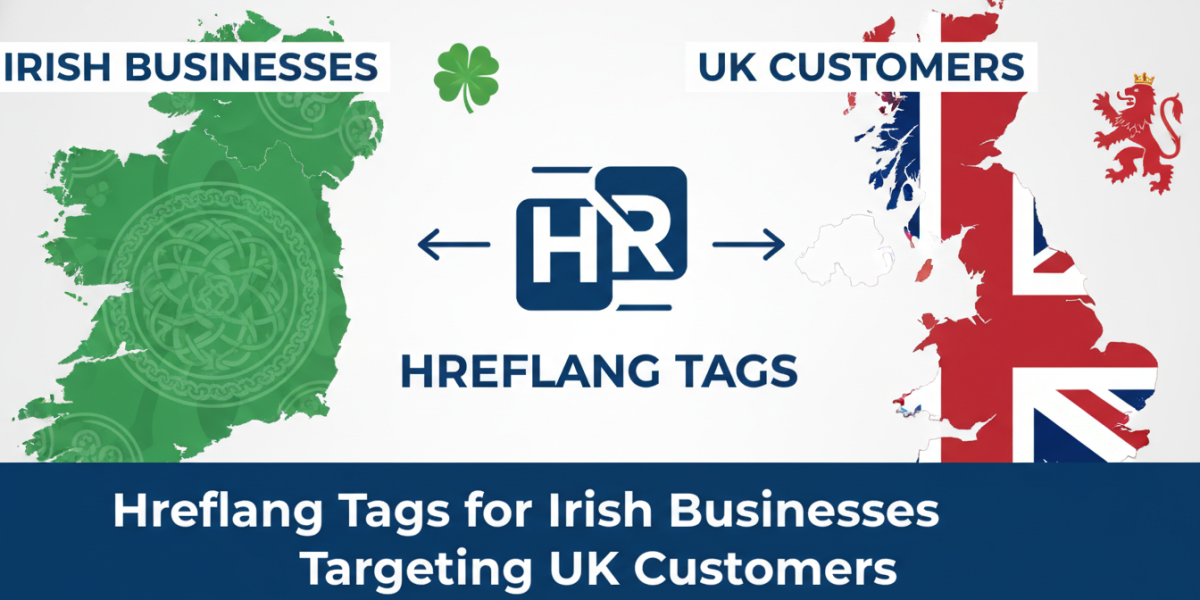
If your Irish business sells to customers in the UK, there’s a good chance your website is creating invisible barriers that stop the right people from finding you. One of the most overlooked technical SEO issues for cross-border businesses is the misuse — or complete absence — of hreflang tags. These small but powerful pieces of code tell search engines which version of your content is intended for which audience, and getting them right can make a meaningful difference to how you appear in Google search results across the Irish Sea.
This guide breaks down what hreflang tags are, why they matter specifically for Irish businesses targeting UK customers, and how to implement them without making the mistakes that trip up most websites.
What Are Hreflang Tags and Why Should Irish Businesses Care?
Hreflang tags are HTML attributes that signal to search engines — primarily Google — the language and regional targeting of a specific web page. They were introduced by Google in 2011 as a solution to a growing problem: multilingual and multi-regional websites were confusing search engines, leading to the wrong page appearing in the wrong country’s search results.
For an Irish business, this might sound simple at first glance. After all, Ireland and the UK both speak English. But that’s exactly where the misunderstanding lies.
The Ireland-UK Language Problem Isn’t Really a Language Problem
When targeting UK customers, the issue isn’t translation — it’s regional targeting. Your Irish site might use en-IE as its language locale, but a UK customer searching on Google.co.uk needs to see content tagged with en-GB. Without that distinction, Google may prioritise your pages for Irish searchers and serve a different result to someone in Manchester, Birmingham, or Edinburgh.
This matters in practice. If you’re an Irish retailer shipping to the UK, an Irish accountancy firm with UK clients, or a SaaS company based in Dublin with a growing London customer base, hreflang tags are the technical layer that ensures your content reaches the right audience consistently.
How Hreflang Tags Actually Work
The basic structure is straightforward. A hreflang tag lives inside the <head> section of your HTML, or can be delivered via an XML sitemap or HTTP header. Here’s what a typical implementation looks like for an Irish business with both an Irish and UK-facing page:
The x-default tag acts as a fallback for users who don’t match any of your specified regions — an important inclusion that’s frequently missed.
The Self-Referencing Rule Most Sites Get Wrong
One of the most common implementation errors is failing to include a self-referencing hreflang tag. Every page in your hreflang set must reference itself as well as its alternates. So your Irish page needs to reference the UK page, and the UK page must reference the Irish page — and both must reference themselves. If this reciprocal relationship breaks down, Google may ignore the tags entirely.
This sounds pedantic, but Google is explicit about it in their documentation. Think of it like a handshake — both sides need to confirm the connection for it to count.
Setting Up Hreflang for an Irish Site Targeting the UK
There are three main methods for implementing hreflang tags, and the right one depends on how your site is built and managed.
Option 1: HTML head tags — Best for smaller sites where developers can edit page templates directly. Every page needs tags inserted manually or through a CMS plugin.
Option 2: XML sitemap — Preferred for larger sites with many pages. Instead of editing individual pages, you include hreflang annotations within your existing XML sitemap. This scales better and reduces the risk of missing pages.
Option 3: HTTP headers — Used mainly for non-HTML files like PDFs. Less common for standard web pages but worth knowing exists.
For most Irish SMEs targeting the UK, the XML sitemap approach offers the best balance of control and scalability. Tools like Screaming Frog, Ahrefs, or Google Search Console can help you audit your current sitemap and identify gaps.
Choosing the Right URL Structure for UK Pages
Before you can implement hreflang tags properly, you need to decide how you’re going to serve UK-specific content. The most common approaches are:
- Subdirectory:
example.ie/uk/ - Subdomain:
uk.example.ie - Separate domain:
example.co.uk
Each has pros and cons. A .co.uk domain carries strong regional trust signals for UK users and may perform better in Google.co.uk search results. However, it requires building domain authority separately, which takes time. A subdirectory on your main .ie domain is faster to implement and benefits from existing authority, but UK users may feel less confident purchasing from an obviously Irish-branded URL.
There’s no universally correct answer — it depends on your business goals, budget, and how committed you are to the UK market long-term.
Common Hreflang Mistakes That Hurt Irish Business Websites
Getting hreflang tags wrong is remarkably easy, and the consequences can be frustratingly subtle. You won’t necessarily see a dramatic rankings drop — instead, your UK pages simply won’t perform as well as they could, and you may not immediately know why.
Incorrect Language-Region Codes
Using en-UK instead of en-GB is one of the most frequent errors. The correct ISO 3166-1 alpha-2 country code for the United Kingdom is GB, not UK. Similarly, Ireland is IE, not IR. A small typo in a tag that’s meant to target millions of potential customers is worth double-checking.
Missing Pages in Your Hreflang Set
If you have 200 product pages and you only tag 150 of them, the untagged 50 are operating without regional guidance. Google will make its own decisions about who to show those pages to — which may not align with your intended audience.
Redirecting UK Users Before Hreflang Can Work
Some businesses implement automatic geo-redirects that send UK visitors to a UK page before the page even loads. While this seems helpful, it can prevent Google’s crawler from seeing the full hreflang relationship, because Googlebot typically crawls from US IP addresses and may never follow the redirect path. If you use geo-redirects, make sure they don’t interfere with how search engines access your pages.
Why This Is Especially Relevant Post-Brexit
Brexit changed the Irish-UK business relationship in ways that extended beyond customs paperwork. From an SEO perspective, the Irish market and the UK market now operate in clearly distinct commercial environments — different VAT regimes, different consumer protections, different regulatory bodies.
This means UK customers have good reasons to want UK-specific information when they search for products or services. Pricing in sterling, shipping timelines to UK addresses, compliance with UK consumer law — these are genuine concerns that deserve their own content, not just a generic Irish page with a currency converter bolted on.
Hreflang tags alone won’t solve this, but they’re the technical foundation that tells Google your UK-specific content exists and deserves visibility. Combined with genuinely localised content, they significantly improve your chances of ranking for UK search queries.
How Long Does It Take to See Results?
This is a reasonable question with an honest answer: it depends. Google typically processes hreflang annotations within a few weeks of them being live and crawled, but you won’t see overnight changes in rankings. In most cases, businesses that implement hreflang correctly alongside substantive UK-focused content see measurable improvements in UK organic traffic within two to four months.
The caveat is that hreflang is not a ranking factor in itself — it’s a signal about audience targeting. It won’t make a weak page rank. But it will help a strong page reach the right audience instead of the wrong one.
Frequently Asked Questions
What’s the difference between hreflang for language targeting and for regional targeting?
Language targeting tells Google a page is in a particular language — for example, French. Regional targeting tells Google a page is intended for users in a specific country. For Irish businesses targeting the UK, you’re dealing with regional targeting, since both countries use English. You’d use en-IE for Ireland and en-GB for the UK to make this distinction.
Do I need a separate website to target UK customers with hreflang?
No. You can target UK customers from a subfolder on your existing Irish website, such as example.ie/uk/. A separate domain like example.co.uk may offer stronger regional trust signals, but it’s not required. What matters is that your UK-facing pages have distinct URLs and correct hreflang annotations pointing to them.
Is it worth implementing hreflang if I only have a small number of UK customers?
If UK customers are currently finding you by accident rather than by design, hreflang is part of the solution for growing that traffic intentionally. That said, hreflang only adds value when you have genuinely distinct content for different regions. If your site has one generic set of pages with no UK-specific content, fix the content issue first.
How do I check if my hreflang tags are working correctly?
Google Search Console is the starting point — it will flag hreflang errors under the International Targeting report. Tools like Screaming Frog (free up to 500 URLs) can crawl your site and audit hreflang relationships across all pages. For ongoing monitoring, Ahrefs and SEMrush both offer hreflang audit features.
Can hreflang tags cause my pages to be penalised?
No. Incorrect hreflang tags won’t trigger a manual penalty. The worst outcome is that Google ignores the tags and makes its own decisions about regional targeting. However, in a competitive UK market, leaving that decision to Google is not a strategy — it’s a missed opportunity.
Conclusion
Hreflang tags won’t transform your business overnight, but they are a fundamental part of getting your technical SEO right when operating across the Irish-UK border. For Irish businesses that have invested in building a UK customer base, leaving regional targeting to chance is the equivalent of running great ads that point to the wrong landing page.
The good news is that hreflang implementation, while technical, is entirely manageable with the right approach. Start by auditing what you currently have, identify where UK-facing content exists or needs to be created, choose the right URL structure, and build your hreflang set carefully — with self-referencing tags, correct language-region codes, and an x-default fallback. Do it once, do it right, and then monitor it through Search Console on a regular basis.
The businesses that win UK organic search traffic aren’t necessarily the ones with the biggest budgets — they’re the ones who give Google clear, consistent signals about who their content is for.
Ready to get started or have questions about hreflang implementation for your Irish business? Our team is happy to walk you through your options and review your current setup. Email us at moc.ssobebolg@ofni or call +353 1 868 2345 — whichever works best for you. We’ll help you make sure the right customers are finding the right pages.
Related Posts
 Meta Tags Mastery: Unlock SEO Potential for Irish Businesses
 SEO FAQs for Irish Businesses: What to Expect | Globe Boss
 Technical SEO and Why Irish Businesses Need It
 How Often Should Irish Businesses Publish Blog Content
 The Biggest Google Ads Mistakes Irish Businesses Make
 What Is Remarketing and Why Should Irish Businesses Use It
 The Most Important Digital Marketing KPIs for Irish Businesses
 The Best Email Marketing Platforms for Irish Small Businesses