
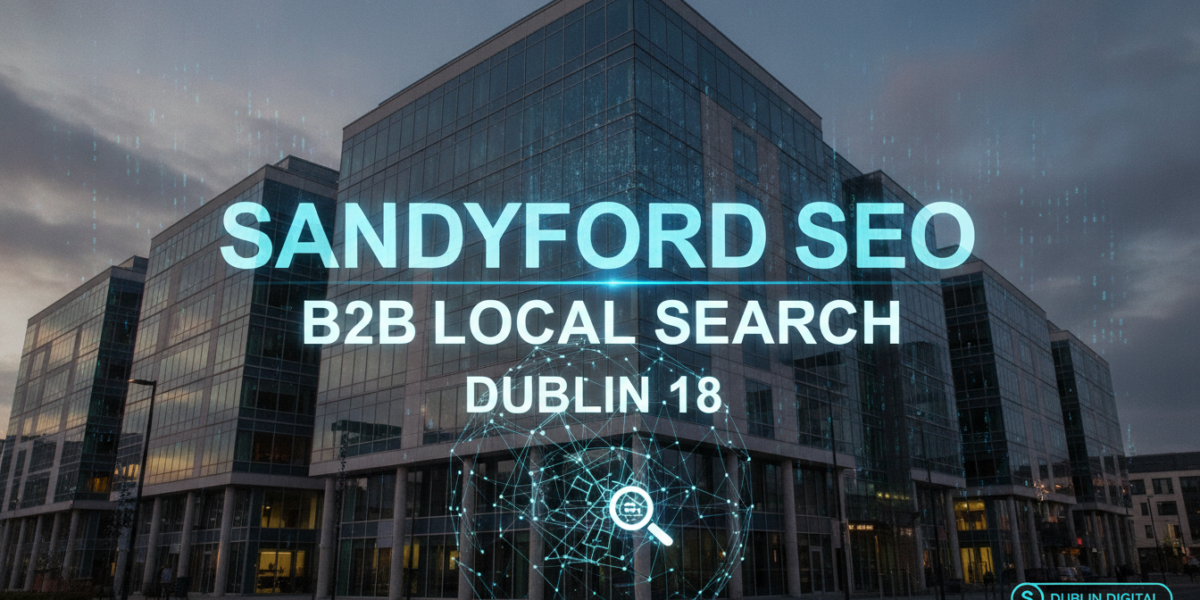
If your business operates in or around Sandyford, you already know the competition is fierce. Dublin 18 is home to one of Ireland’s most concentrated clusters of tech companies, professional services firms, and corporate headquarters. Getting found online in that environment isn’t just a marketing nice-to-have — it’s a commercial necessity. That’s where Sandyford SEO comes in, specifically tailored for B2B companies that need to reach other businesses, not just general consumers.
This article breaks down what local search actually means for B2B companies in Sandyford, why standard SEO advice often misses the mark, and what a focused local strategy looks like in practice.
Why Sandyford Is a Unique Local SEO Challenge
A Dense, Competitive Business District
Sandyford Business District — anchored by the Leopardstown Road corridor and surrounding areas — hosts everything from multinational tech firms to boutique consultancies. The sheer volume of businesses operating within a relatively small postcode means that search engine results pages (SERPs) in Dublin 18 are crowded, and visibility doesn’t come easily.
When a procurement manager in a Sandyford office searches for "IT support Dublin 18" or "accountancy firm Sandyford," they’re typically seeing a mix of large national providers, aggregator directories, and a handful of genuinely local operators. The companies that win those clicks have usually put deliberate SEO work in behind the scenes.
B2B Search Behaviour Is Different
B2B buyers don’t search the same way consumers do. They’re often further into a decision-making process before they search, they use more specific language, and they care less about star ratings and more about credibility signals like case studies, accreditations, and clear service descriptions.
This means a B2B company in Sandyford needs a local SEO strategy that reflects how their actual buyers search — not a strategy borrowed from a plumber or a restaurant. The intent is different. The content should be too.
What "Local" Actually Means in a B2B Context
Geographic Relevance vs. Physical Footfall
For a restaurant, local SEO is about foot traffic. For a B2B firm in Sandyford, it’s about establishing relevance and trust with businesses in a defined geographic market — whether those clients visit your office or not.
Google’s local search algorithm still rewards businesses that clearly signal their location and service area. This includes consistent NAP (Name, Address, Phone) data across directories, a properly optimised Google Business Profile, and locally relevant content on your website. These signals matter even if your clients never need to walk through your door.
The Role of the Sandyford Postcode
Dublin 18 carries commercial weight. Many B2B buyers specifically filter for local providers when shortlisting vendors — partly for ease of relationship management and partly because proximity often implies familiarity with local market conditions.
Using "Sandyford," "Dublin 18," and related terms (Leopardstown, Carmanhall, Beechwood) purposefully and accurately throughout your web presence helps search engines connect your business to searches from people in and around that area. It’s not about stuffing postcodes into content — it’s about genuinely reflecting where you operate and who you serve.
Core Components of an Effective Sandyford SEO Strategy
1. Google Business Profile Optimisation
Your Google Business Profile (GBP) is often the first thing a local searcher sees. For a B2B company in Sandyford, this listing should be treated as a live, regularly updated asset — not a set-and-forget registration.
Key actions include:
- Accurate business category selection — choose the primary category that most precisely describes what you do
- Service descriptions — use the services section to describe specific offerings in clear, searchable language
- Regular Google Posts — these signal activity and relevance, and they appear in your listing
- Photo content — images of your office, team, or work in progress add authenticity
One often-overlooked feature is the Q&A section. Seeding this with genuinely useful questions and answers (written by you) lets you control the narrative and capture long-tail search intent directly on the results page.
2. On-Site Local SEO
Your website needs to tell Google — and your potential clients — exactly where you are and what you do. This sounds obvious, but it’s surprisingly common to find B2B websites in Sandyford that bury location information in a footer or omit it from service pages entirely.
Practically speaking, this means:
- Including your full address on your contact page with an embedded map
- Referencing Sandyford, Dublin 18, or relevant surrounding areas naturally in your service page copy
- Creating a location-specific landing page if you serve multiple areas
- Using structured data markup (LocalBusiness schema) to give search engines clear signals about your NAP and service area
3. Content That Reflects Your Market
B2B content for local SEO doesn’t mean writing generic blog posts with your postcode dropped in occasionally. It means creating genuinely useful resources that speak to the concerns and questions of businesses in your sector and location.
For example, a financial consultancy in Sandyford might publish a guide to R&D tax credits for tech companies — relevant to many of the businesses nearby. An HR firm might write about hybrid working policies and what they mean for multi-site companies operating across Dublin.
This kind of content builds topical authority, attracts relevant organic traffic, and demonstrates expertise in a way that a list of services never quite manages on its own.
Building Local Authority Through Links and Citations
Why Citations Still Matter
A citation is any online mention of your business’s name, address, and phone number — even without a link. Citation consistency across platforms like Yelp, Hotfrog, Kompass, and industry-specific directories tells search engines that your business is established and legitimate.
For Sandyford businesses specifically, getting listed in Dublin Chamber directories, Irish business networks, and Dún Laoghaire–Rathdown Chamber of Commerce resources adds both citation value and the kind of local credibility that B2B buyers notice when they’re vetting a supplier.
Earning Relevant Links
Link building for B2B local SEO is less about volume and more about relevance. A single link from a respected Irish trade association or a well-regarded industry publication does more for your local authority than dozens of generic directory submissions.
Practical routes to relevant links include publishing guest articles in trade publications, being cited in local business news, sponsoring local events or industry gatherings, and building genuine partnerships with complementary businesses in the Sandyford area.
Measuring What Actually Matters for Sandyford SEO
Tracking SEO performance in a B2B context requires different metrics than consumer-facing campaigns. Organic traffic volume is interesting, but it tells an incomplete story.
The metrics that matter more for B2B local search include:
- Organic leads — form completions and phone calls that originate from organic search
- Keyword rankings for commercial intent terms — not just informational phrases
- Local pack appearances — how often your GBP listing shows in the map pack for relevant searches
- Time-on-site and page depth — signals that visitors are engaging seriously with your content
- Return visit rate — B2B buyers often research over weeks, not minutes
Setting up goal tracking in Google Analytics 4 and connecting your Google Search Console account gives you a clear view of which pages and keywords are driving real business outcomes — not just traffic.
Common Mistakes B2B Companies in Sandyford Make
Targeting the wrong keywords. Many companies optimise for high-volume generic terms they’ll never realistically rank for, while ignoring specific, commercially relevant phrases that a well-resourced local strategy could actually win.
Ignoring mobile experience. Even in B2B, a large proportion of initial research happens on mobile — often during commutes on the Luas green line. A site that loads slowly or displays poorly on mobile loses those potential leads immediately.
Inconsistent business information. Having three slightly different versions of your address across Google, your website, and various directories creates confusion for search engines and quietly undermines your local rankings.
Neglecting the GBP review strategy. B2B buyers do read reviews. A well-managed Google Business Profile with a steady stream of genuine client reviews builds trust faster than almost any other content investment. Asking satisfied clients to leave a review is simple — and remarkably few companies actually do it consistently.
Frequently Asked Questions
What is Sandyford SEO and how is it different from general SEO?
Sandyford SEO refers to search engine optimisation strategies targeted specifically at businesses operating in the Sandyford and Dublin 18 area. It differs from general SEO in that it prioritises local search signals, geographic relevance, and the competitive context of that specific business district — rather than trying to rank nationally for broad keywords.
How long does it take to see results from local SEO in Dublin 18?
Most businesses begin to see measurable improvement in local search visibility within three to six months, provided the foundational work — GBP optimisation, on-site corrections, and citation building — is done properly. More competitive keywords and sectors can take longer. Consistent effort tends to compound over time rather than deliver overnight results.
Is local SEO worth investing in for B2B companies that operate nationally?
Yes — and the two aren’t mutually exclusive. A strong local presence in Sandyford builds credibility that extends beyond Dublin 18. Many B2B companies find that local search brings in higher-quality leads because searchers with geographic intent are often further along in the buying process.
Do I need a physical office in Sandyford to rank in local search there?
Having a verified physical address in the area gives the strongest local signals, particularly for Google Business Profile. However, businesses that serve the Sandyford area without a physical location can still build local relevance through content, citations, and service-area targeting on their GBP listing.
How do I know if my current SEO is actually working?
Connect your website to Google Search Console and set up conversion tracking in Google Analytics 4. Look specifically at which search queries are bringing people to your site, whether those visitors are converting into leads, and how your local pack rankings are trending over time. If you can’t answer those questions from your current data, that’s a useful starting point for any SEO audit.
Conclusion
Sandyford’s business landscape rewards companies that invest in being genuinely findable online. For B2B firms in Dublin 18, that means going beyond basic SEO hygiene and building a local search presence that reflects how your actual buyers research and make decisions.
The good news is that the bar isn’t as high as it might seem. Many businesses in the area still have poorly optimised profiles, inconsistent citations, and websites that don’t speak to local buyers effectively. A focused, well-executed Sandyford SEO strategy doesn’t require a huge budget — it requires the right priorities, consistent effort, and a clear understanding of your market.
Ready to Improve Your Local Search Visibility?
If you’re a B2B business in Sandyford or the wider Dublin 18 area and you’d like to discuss your local SEO strategy, we’d be happy to help. Whether you’re starting from scratch or looking to improve on what’s already in place, we can walk you through what’s working, what isn’t, and what the clearest path forward looks like.
Get in touch with our team — email us at moc.ssobebolg@ofni or call +353 1 868 2345 and we’ll be happy to talk through your requirements.
Related Posts
 Stillorgan SEO: Local Search for South County Dublin
 Clontarf SEO: Local Search Tips for Dublin 3 Businesses
 How Dublin Solicitors Can Win Local Search in 2026
 Globe Boss Local SEO Dublin
 Google My Business Optimization for Dublin Local Search
 Dominate Local Search in Dublin Northside
 Increase Local Search Visibility in Dublin City
 Dominate Dublin Searches with Powerful Local SEO Tactics