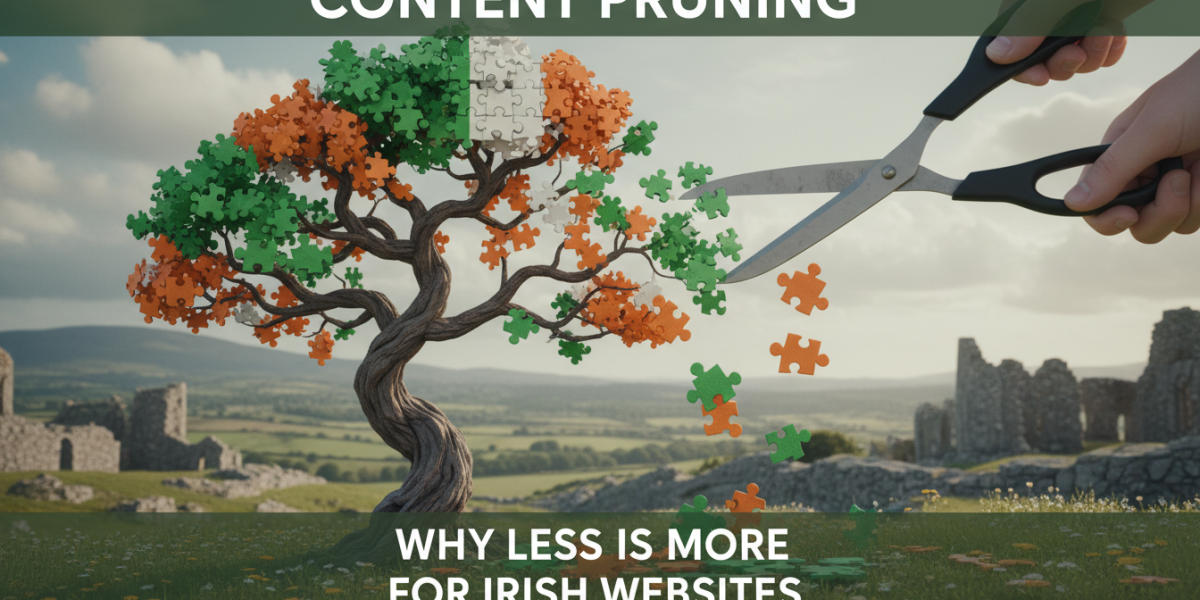
If you’ve been building your Irish website for a few years, there’s a good chance it’s carrying more dead weight than you realise. Blog posts that stopped getting traffic in 2019, product pages for items you no longer sell, outdated guides full of irrelevant statistics — this kind of accumulated content quietly drags your entire site down. Content pruning is the process of auditing and removing or improving that underperforming content, and for Irish businesses competing online, it can be one of the most impactful things you do this year.
What Is Content Pruning and Why Does It Matter?
Content pruning is exactly what it sounds like: cutting back the parts of your website that aren’t pulling their weight. Just as a gardener removes dead branches to help a tree grow stronger, pruning your website’s content helps the pages that actually matter perform better.
Search engines like Google evaluate your site as a whole, not just page by page. If a significant portion of your site consists of thin, outdated, or duplicate content, it can dilute the overall authority of your domain. This concept — often discussed in SEO circles as "crawl budget" and "content quality signals" — means that having hundreds of low-value pages can actively hurt your rankings, even if your best pages are genuinely excellent.
For Irish websites in particular, this is worth paying close attention to. Whether you’re running a small Dublin-based e-commerce shop, a Galway hospitality business, or a Cork law firm, the competitive landscape online has grown significantly tighter. Making sure every page on your site earns its place is no longer optional — it’s a strategic necessity.
The Hidden Cost of Too Much Content
When More Becomes a Liability
There’s a persistent myth in digital marketing that more content always means better SEO. It made some sense in the early days of search, when volume was rewarded. But Google’s algorithms have matured considerably. The Helpful Content updates rolled out from 2022 onwards were specifically designed to demote sites where large volumes of low-quality or unhelpful content exist alongside otherwise good pages.
Think about it from a practical angle: if you have a website with 400 pages but only 80 of them generate any meaningful traffic or engagement, the other 320 pages aren’t neutral — they’re a liability. They consume crawl budget, confuse site structure, and send mixed signals to search engines about what your site is actually about.
Real-World Examples Irish Businesses Will Recognise
Imagine a Kerry-based tourism operator who added weekly blog posts religiously between 2016 and 2020. Many of those posts were short, rushed, and covered topics with very little search interest. By 2024, those posts account for over half the site’s indexed pages but generate less than 3% of its traffic.
Or consider a Limerick solicitors’ firm that has multiple pages covering similar legal topics — perhaps three separate pages about conveyancing services written at different points in time, all competing against each other. This is called keyword cannibalisaton and it actively undermines the firm’s chances of ranking well for any of them.
How to Conduct a Content Pruning Audit
Content pruning isn’t about blindly deleting pages. Done carelessly, it can actually harm your site. Done well, it’s a methodical process with clear criteria and careful execution.
Step 1: Pull Your Data First
Before touching a single page, gather the evidence. Use Google Analytics 4 and Google Search Console to identify which pages are receiving traffic, which are generating clicks from search, and which have been effectively invisible for the past 12 months or more.
Export a full list of indexed URLs. Tools like Screaming Frog, Ahrefs, or Semrush can help you map out your entire site quickly and flag thin pages (typically those with fewer than 300 words), duplicate content, or pages with no inbound links.
Step 2: Categorise Every Page
Once you have your data, sort each page into one of four categories:
- Keep and improve — pages with strong traffic or clear potential that just need updating
- Consolidate — similar pages that should be merged into one stronger piece
- Redirect — pages with little value but that may have inbound links worth preserving
- Remove — pages with no traffic, no links, no value, and no path to improvement
This categorisation is where judgment matters. A page with low traffic isn’t automatically worthless — it might be a key service page that just needs better optimisation. Context is everything.
Step 3: Act and Monitor
Once you’ve made your decisions, implement them carefully. Use 301 redirects for removed pages wherever appropriate, especially if those pages have been indexed for some time. After pruning, monitor your rankings and organic traffic over the following four to eight weeks. Most sites that prune strategically see measurable improvements within two to three months.
Content Pruning and the Irish Search Landscape
Local Search Signals and Topical Authority
For Irish businesses, content pruning has a particularly relevant dimension: local SEO. Google’s local search results are heavily influenced by topical relevance and overall site quality. A Waterford accountancy firm that has a tightly focused, high-quality website — even with just 30 to 40 well-maintained pages — is likely to outperform a competitor with 200 cluttered pages, all else being equal.
Irish consumers increasingly search with local intent. Phrases like "best wedding venue in Tipperary" or "solicitor in Drogheda" are competitive but winnable for businesses whose websites clearly signal expertise and relevance. Pruning helps you achieve that signal clarity.
Seasonal and Industry-Specific Considerations
Some Irish industries have particularly high rates of content decay. Tourism and hospitality sites often accumulate event pages, seasonal offers, and outdated COVID-era guidance. Retail sites carry discontinued product listings. Construction and trades companies sometimes have blog posts referencing old regulations or grant schemes that have since changed.
In Ireland, planning and building regulations, tax thresholds, and grant schemes (such as SEAI home energy grants) change regularly. Having outdated guidance on your site doesn’t just hurt SEO — it can mislead actual customers, which damages trust more seriously than any algorithm update ever could.
What to Do With Pruned Content
Deleting a page and forgetting about it is rarely the best approach. Here’s how to handle the content you decide to cut:
Redirect where possible. If a page has accumulated any backlinks or has been indexed for years, set up a 301 redirect to the most relevant surviving page. This preserves any link equity and prevents visitors from landing on error pages.
Merge related pages thoughtfully. If you have three blog posts covering similar ground, combine the best elements of each into one definitive piece. Update the statistics, refresh the examples, and make it genuinely useful. Then redirect the two old URLs to the new consolidated page.
Repurpose high-effort content. Sometimes a long, well-researched post simply needs reformatting. A 2,000-word article from 2017 might work brilliantly as an updated guide with a new structure, fresh data, and a 2025 publication date.
Frequently Asked Questions
What is content pruning in simple terms?
Content pruning is the process of reviewing all the pages on your website and deciding which to keep, improve, merge, or remove. The goal is to ensure every page on your site serves a clear purpose and contributes positively to your overall online presence.
Will deleting pages hurt my Google rankings?
It depends entirely on how it’s done. Removing truly low-quality pages that receive no traffic and have no inbound links rarely causes any negative impact — and often improves overall rankings. The risk comes from deleting pages carelessly without redirects or without data to back up the decision.
How often should Irish businesses review their content?
A thorough content audit once a year is a reasonable baseline for most small to medium-sized Irish businesses. Larger sites with frequently updated content — such as news publishers or e-commerce stores — may benefit from quarterly reviews.
Is content pruning the same as a content audit?
A content audit is the analysis stage — reviewing what you have and how it’s performing. Content pruning is the action stage — making the decisions and changes based on that audit. They’re closely linked, but not identical.
My website only has 30 pages. Do I still need to prune?
Even smaller sites can benefit from this process. If several of those 30 pages are thin, outdated, or covering very similar topics, consolidating them can strengthen the pages that remain. Quality over quantity applies at every scale.
Conclusion
Content pruning isn’t about doing less work — it’s about making your existing effort count for more. For Irish businesses competing in a landscape where Google increasingly rewards relevance, expertise, and quality, a leaner and more focused website will almost always outperform a bloated one.
The businesses that treat their websites as living assets — regularly reviewing, updating, and cutting where necessary — are the ones that hold their ground in search results year after year. If your website has been growing unchecked for several years, a structured pruning exercise might be the single highest-return activity you can do in the next quarter.
Ready to take a closer look at your website’s content? Whether you want advice on running an audit, help prioritising what to keep, or a full content strategy review, our team would be glad to help. Get in touch at moc.ssobebolg@ofni or call us on +353 1 868 2345 — we’re happy to talk through your requirements and point you in the right direction.
Dublin's ROI-Driven Digital Marketing Agency Home
Related Posts
 E-E-A-T for Irish Websites: How to Prove Expertise
 Crawl Budget Optimisation for Large Irish Websites
 The Beginnerʼs Guide to On-Page SEO for Irish Websites
 How Often Should Irish Businesses Publish Blog Content
 What a Good Bounce Rate Looks Like for Irish Websites
 Content Marketing Strategy for the Irish Digital Market
 On Page SEO Optimization for Irish Business Websites
 High Quality Copywriting and SEO Content in Ireland