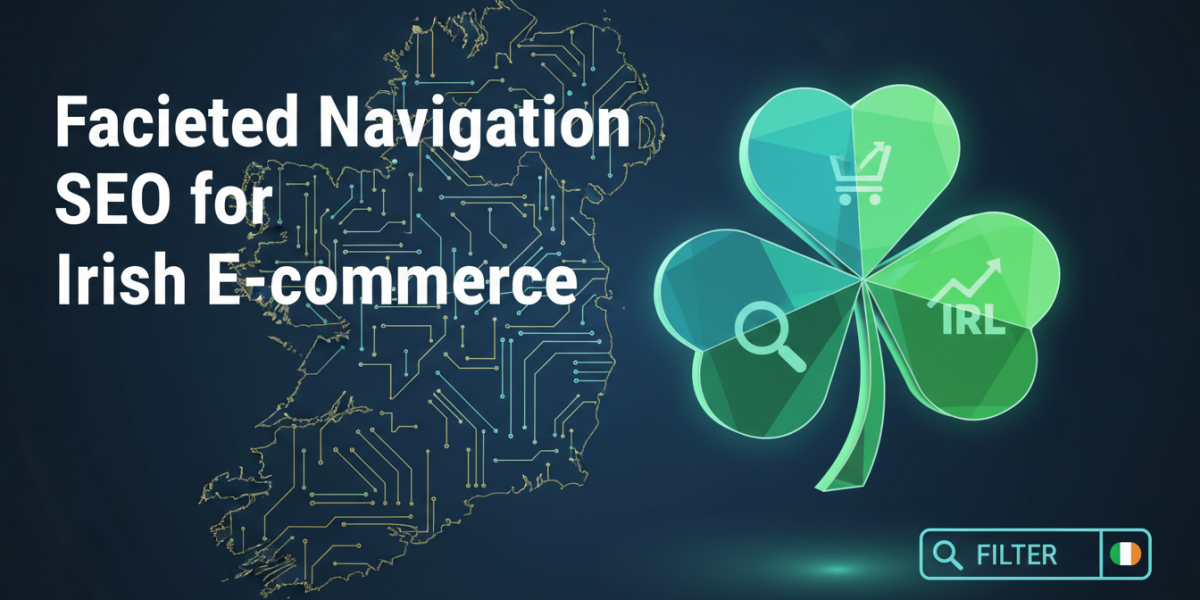
If you run an e-commerce store in Ireland, faceted navigation SEO is one of those topics you genuinely can’t afford to ignore. Filtering systems — the ones that let shoppers narrow results by size, colour, price, brand, or location — are essential for user experience, but they’re quietly one of the most damaging things you can do to your organic search performance if left unmanaged. The good news is that with the right approach, faceted navigation can be controlled, configured, and even turned into a genuine SEO asset.
What Is Faceted Navigation and Why Does It Cause SEO Problems?
Faceted navigation refers to the filtering and sorting system on e-commerce category pages. On a clothing site, for example, a shopper might filter by "Women’s > Jackets > Size 12 > Navy > Under €80." Every combination of filters typically generates a unique URL — and that’s where things get complicated.
Search engines like Google crawl and index URLs. When your site generates hundreds or thousands of filter combinations, you end up with an enormous volume of near-duplicate or very thin pages competing with each other. This is often called crawl budget waste, and for smaller Irish e-commerce sites in particular, it can quietly drain the SEO value from your entire site.
The Scale of the Problem
Consider a mid-sized Irish retailer selling furniture with 300 products across 10 categories. With filters for material, colour, size, price range, and availability, the site could theoretically generate tens of thousands of unique URLs. Google has confirmed that crawl budget is a real concern for sites with large volumes of low-quality or duplicate URLs — even if the actual product catalogue is modest.
Google’s own documentation (Search Central) explicitly flags faceted navigation as a common source of duplicate content and crawl inefficiency.
How Faceted Navigation Affects Irish E-commerce Specifically
Ireland’s e-commerce market has grown substantially over the past decade. The Central Statistics Office (CSO) reported that 65% of Irish internet users purchased goods or services online in recent years, and competition for visibility in Irish search results is rising sharply — particularly across categories like fashion, home goods, electronics, and sports equipment.
For Irish retailers, the challenge is often compounded by the fact that many use off-the-shelf platforms like Shopify, Magento, or WooCommerce. These platforms generate faceted URLs by default, and unless you actively intervene, they’ll happily create thousands of indexable pages Google has no business crawling.
The Local Angle
Irish e-commerce sites also frequently target both Irish (.ie) and broader UK/international audiences. This creates additional complexity — if your site targets "sofas Dublin" and "sofas Ireland" through filtered pages, managing which URLs get indexed becomes even more critical to avoid cannibalism and wasted authority.
Core Faceted Navigation SEO Strategies
There’s no single fix for this problem. The right solution depends on your platform, your catalogue size, and your existing site architecture. Here are the most widely used approaches.
1. Use Robots.txt or Noindex Tags Selectively
One of the most common approaches is to prevent search engines from indexing filter-generated URLs altogether. You can do this by:
- Adding
noindexmeta tags to filtered pages - Blocking filter parameters in
robots.txt - Using Google Search Console’s URL Parameter Tool (though this is now largely deprecated)
This works well when your filter pages genuinely offer no unique value — for instance, "Colour: Grey" applied to a general furniture category. If Google can’t see these pages, it won’t waste crawl budget on them.
Caveat: Be careful not to block pages that genuinely could rank for valuable search queries. Blanket blocking is often too aggressive.
2. Canonical Tags to Consolidate Authority
Where you want certain filter combinations visible to users but not indexed, canonical tags are your best friend. A canonical tag tells Google: "This page exists, but the main version is over here." All link equity flows to the canonical URL, keeping your authority consolidated.
For example, if you have a page for /womens-boots/?colour=black, you’d set the canonical to /womens-boots/, signalling Google to index the parent category rather than the filtered variant.
3. Create Dedicated Landing Pages for High-Value Filter Combinations
This is where faceted navigation actually becomes an SEO opportunity rather than just a problem to manage.
If your data shows that people in Ireland regularly search for "black leather office chairs" or "outdoor furniture Galway," those are queries worth targeting with dedicated, indexable pages — not dynamically generated filter URLs, but properly structured landing pages with unique titles, meta descriptions, introductory copy, and internal links.
Done correctly, this approach turns your filtering system into a source of targeted, rankable pages. The key is being selective: only create dedicated pages where there’s genuine search demand, not for every possible combination.
4. JavaScript Rendering Considerations
If your site uses JavaScript to handle filtering (as many Shopify and Magento builds do), you need to ensure Google can actually render and understand these pages. Server-side rendering or pre-rendering is preferable for filterable content. JavaScript-dependent filtering that isn’t rendered properly simply won’t be crawled accurately, meaning even the pages you want indexed might not be.
Auditing Your Current Setup
Before making any changes, you need to understand what’s actually happening on your site. A proper faceted navigation audit typically involves:
- Crawling your site with a tool like Screaming Frog or Sitebulb to identify all URLs being generated by filters
- Checking Google Search Console to see which filtered URLs Google has already indexed
- Reviewing your crawl budget data through GSC’s crawl stats report
- Identifying high-value filter combinations using keyword research (Ahrefs, Semrush, or even Google’s own autocomplete)
- Classifying URLs into three buckets: block, canonicalise, or promote to a dedicated page
This process takes time but is genuinely worth it. Many Irish e-commerce sites we see have thousands of indexed URLs generating zero organic traffic — a direct drag on the performance of the pages that actually matter.
Platform-Specific Notes for Irish Retailers
Shopify
Shopify is widely used across Irish retail. By default, Shopify uses ?sort_by= and tag-based filtering (e.g., /collections/jackets/navy). These tag URLs are indexable by default. Using apps like Boost Commerce or Searchpie can help manage filtering behaviour, but you’ll still need to review your canonical and noindex settings manually or through a developer.
WooCommerce
WooCommerce on WordPress gives you more control, but also more room for error. The Yoast SEO or Rank Math plugins allow noindex settings on archive and taxonomy pages. For more complex filtering, combining these with a caching/crawl management plugin is often recommended.
Magento / Adobe Commerce
Magento has native layered navigation that generates large numbers of filtered URLs. The platform allows you to configure crawlers via the robots.txt settings within the admin panel, but properly auditing and managing this typically requires a developer with Magento-specific experience.
Frequently Asked Questions
What is the biggest mistake Irish e-commerce sites make with faceted navigation?
The most common mistake is doing nothing — leaving all filter-generated URLs fully indexable without any canonical tags, noindex directives, or crawl management. This silently dilutes site authority and wastes Google’s crawl budget on pages that will never rank.
How do I know which filter combinations are worth creating dedicated pages for?
Use keyword research tools to check monthly search volume for specific filter combinations relevant to your products. If "women’s running shoes size 8 Ireland" gets meaningful traffic, it’s worth a dedicated landing page. If "blue ceramic mug with handle" gets zero searches, it isn’t.
Is faceted navigation SEO something I can manage myself, or do I need a developer?
Some elements — like reviewing Search Console data or adding noindex tags via a WordPress plugin — are manageable without development skills. But more complex interventions, like adjusting how a Shopify or Magento site generates URLs or implementing server-side rendering, typically require developer involvement.
Will fixing faceted navigation issues actually improve my rankings?
Yes, in many cases — particularly if your site has a large number of indexed, low-quality filter pages. Cleaning these up improves crawl efficiency and consolidates authority to your most important pages. However, results take time; typically expect to see improvements in crawl stats within weeks and organic traffic shifts over a few months.
Does this apply to small Irish e-commerce sites, or only large ones?
It applies to any site using filtering, but the urgency scales with site size. A site with 50 products and basic filtering is unlikely to suffer as severely as a 5,000-product retailer. That said, getting the architecture right from the start is always easier than cleaning it up later.
Conclusion
Faceted navigation SEO is one of those technical challenges that sits at the intersection of user experience and search performance — and getting it right genuinely matters for Irish e-commerce sites competing in an increasingly crowded digital landscape. The filtering systems that make your site easier to shop on can also be silently undermining your organic visibility if left unmanaged.
The path forward isn’t about choosing between a good user experience and good SEO. With careful auditing, the right combination of noindex tags, canonicals, and selective landing page creation, you can have both. Start with a proper audit of what’s currently being indexed, identify where your crawl budget is being wasted, and build a prioritised plan from there. Small, methodical improvements in this area often deliver outsized results.
Ready to take the next step? If you’d like expert guidance on auditing and optimising your Irish e-commerce site’s faceted navigation, our team is happy to help — whether you’re just starting out or dealing with a complex existing setup. Email us at moc.ssobebolg@ofni or call +353 1 868 2345 and we’ll talk through your specific situation. No pressure, just practical advice.
Dublin's ROI-Driven Digital Marketing Agency Home
Related Posts
 Page Speed Optimisation for Irish E-commerce Stores
 Shopify vs WooCommerce SEO for Irish Online Stores
 The Complete Irish E-Commerce SEO Checklist for 2026
 How to Use Google Shopping Ads to Grow an Irish E-Commerce Brand
 How to Reduce Cart Abandonment on Your Irish E-Commerce Site
 Leading SEO Company for Irish E-commerce Brands
 E-Commerce SEO For Irish Online Shops
 Are chatbots replacing customer service in Irish e-commerce?