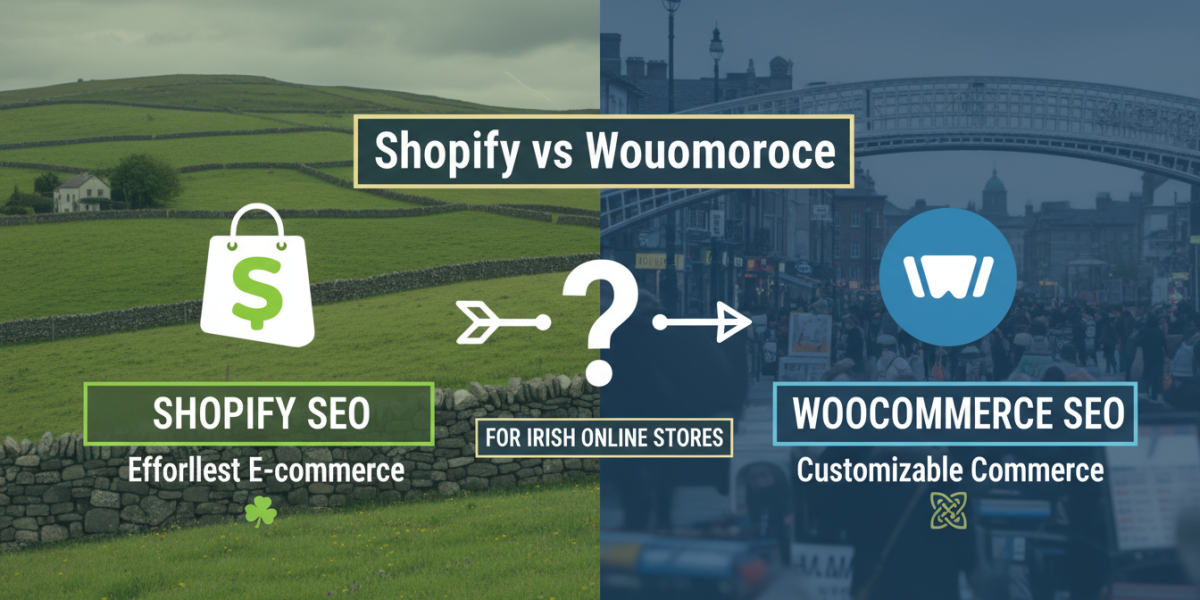
If you’re running an online store in Ireland — or planning to launch one — the platform you choose matters more than most people realise. Not just for how your store looks or functions, but for how well it performs in search. The debate around Shopify vs WooCommerce SEO comes up constantly, and for good reason: both platforms have genuine strengths, but they approach search engine optimisation in very different ways. For Irish eCommerce businesses trying to compete locally and internationally, understanding those differences could be the deciding factor in which platform actually helps you grow.
Why SEO Should Influence Your Platform Choice
Most business owners choose an eCommerce platform based on price, ease of use, or design. SEO often gets treated as something you bolt on later. That’s a mistake.
The technical foundation of your platform affects how search engines crawl and index your site. It influences your page speed, your URL structure, your ability to add structured data, and how much control you have over your content. Choosing the wrong platform can mean spending months fixing problems that never needed to exist in the first place.
For Irish stores in particular, local SEO considerations add another layer. You may be targeting customers searching in Ireland specifically, competing against both local and international retailers, and dealing with multi-currency or multi-region requirements that create their own SEO challenges.
Shopify SEO: Clean, Convenient, but With Limits
What Shopify Does Well
Shopify has made significant strides in SEO over the past few years. Out of the box, it handles quite a few technical fundamentals automatically. It generates a sitemap.xml for you, includes canonical tags to manage duplicate content, and makes it straightforward to add meta titles and descriptions to every page.
Page speed is another area where Shopify generally performs well. Because stores are hosted on Shopify’s own infrastructure — built on a global CDN — load times tend to be consistently fast. Google has made page speed a ranking factor, and Core Web Vitals are now part of how sites are assessed. For store owners who don’t want to manage hosting, this is a genuine advantage.
Shopify also integrates easily with tools like Google Search Console and Google Analytics, and installing a structured data app (for product schema, breadcrumbs, etc.) is relatively straightforward.
Where Shopify Falls Short for SEO
Here’s where things get more complicated. Shopify’s URL structure is rigid. Product pages live under /products/, collections under /collections/, and you can‘t change that. If you’ve done keyword research and your target terms don’t map neatly to Shopify’s fixed structure, you’re working around a constraint rather than optimising freely.
Duplicate content is a known issue with Shopify. When a product appears in multiple collections, Shopify generates multiple URLs for the same product — one under /products/ and one under each collection path. The canonical tag is supposed to handle this, but it doesn’t always resolve cleanly in practice.
Blogging on Shopify is functional but limited. If content marketing is a key part of your SEO strategy — and for most Irish businesses, it should be — Shopify’s blog simply isn’t as capable as WordPress. Categories, internal linking structures, and content taxonomies are harder to manage.
WooCommerce SEO: Flexibility With a Learning Curve
The Case for WooCommerce
WooCommerce is a plugin built on WordPress, which is the most widely used content management system in the world. WordPress was built with SEO in mind from the ground up, and it shows.
With WooCommerce, you have full control over your URL structure. You can customise slugs for products, categories, and tags. You can create a content architecture that reflects your keyword strategy rather than bending your keyword strategy to fit the platform. For businesses with a clear, well-researched SEO plan, this flexibility is invaluable.
The plugin ecosystem is another major advantage. Tools like Yoast SEO or Rank Math give you granular control over meta data, sitemaps, schema markup, breadcrumbs, and more. These plugins are mature, well-documented, and used by millions of sites worldwide.
For Irish stores targeting specific regions, WooCommerce integrates well with multilingual and multi-region plugins like WPML or Polylang. If you’re serving both the Republic of Ireland and Northern Ireland, or targeting Irish diaspora internationally, this level of control matters.
The Trade-Offs You Should Know About
WooCommerce requires hosting, and hosting quality directly affects SEO. A cheap shared hosting plan can lead to slow load times, which hurts your rankings. You’ll want a reputable managed WordPress host — providers like Kinsta, WP Engine, or SiteGround’s managed WordPress plans are well regarded in this space. This is an extra cost and an extra decision that Shopify removes from the equation.
Maintenance is another consideration. WordPress and WooCommerce require regular updates — core software, themes, and plugins all need to be kept current. Neglected sites can develop security vulnerabilities or compatibility issues. This isn’t a dealbreaker, but it’s something a business owner needs to account for, either in their own time or through a maintenance agreement with a developer.
Head-to-Head: Key SEO Factors Compared
| SEO Factor | Shopify | WooCommerce |
|---|---|---|
| Technical defaults | Good out of the box | Good, with the right plugins |
| URL control | Limited | Full flexibility |
| Blogging capability | Basic | Excellent |
| Page speed | Consistently strong | Depends on hosting |
| Schema/structured data | App-dependent | Plugin-driven, extensive |
| Local SEO control | Moderate | High |
| Ongoing maintenance | Minimal | Requires attention |
Local SEO Considerations for Irish Online Stores
Targeting Irish Customers Specifically
Whether you’re using Shopify or WooCommerce, local SEO for Ireland involves some specific considerations that go beyond general eCommerce best practice.
Using .ie domain extensions helps signal to Google that your site is relevant to Irish users. Both platforms support custom domains, so this is a choice available on either. You should also ensure your Google Business Profile is properly set up and linked to your site — this matters even for online-only retailers, as it affects trust signals and local search visibility.
Hreflang tags become relevant if you’re targeting both Irish and UK audiences. If your store serves .ie and .co.uk customers, you need to tell search engines which version of a page is intended for which audience. WooCommerce gives you more control here; Shopify requires careful configuration or app support to handle this cleanly.
Content That Resonates Locally
Irish consumers increasingly search with local intent — "next-day delivery Ireland," "Irish-owned," "ships to Republic of Ireland." Building content that speaks directly to those search terms, and to the values behind them, can be a meaningful differentiator.
WooCommerce’s superior blogging capabilities make this easier to execute at scale. You can build out location-specific landing pages, category pages optimised for Irish search intent, and a content hub that establishes genuine topical authority. Shopify can support some of this, but with more friction.
Which Platform Should Irish Stores Actually Choose?
There’s no universal right answer here — it genuinely depends on your business situation.
Choose Shopify if you want to move quickly, you’re not highly technical, and your primary SEO strategy is straightforward product and category optimisation. Shopify’s defaults are solid, and for many smaller Irish stores, they’re sufficient.
Choose WooCommerce if SEO is central to your growth strategy, you have (or plan to invest in) ongoing technical support, and you want the flexibility to build a content-rich site that ranks for a wide range of terms. It rewards investment and expertise.
A practical way to think about it: Shopify is like a well-maintained rented workspace — everything works, but you can’t knock down walls. WooCommerce is like owning the building — more responsibility, but you can configure it exactly as needed.
FAQ: Shopify vs WooCommerce SEO for Irish Stores
Is Shopify or WooCommerce better for ranking on Google in Ireland?
Both can rank well on Google, but WooCommerce gives you more tools to optimise specifically for Irish search intent. If content marketing and technical SEO flexibility are priorities, WooCommerce has the edge. For businesses focused primarily on paid channels with lighter SEO demands, Shopify works well.
Can I do local SEO on Shopify?
Yes, but with some limitations. You can add location-based content, set up Google Business Profile, and use structured data through apps. However, things like hreflang management and custom URL structures are harder to control than on WooCommerce.
How much does SEO setup cost for either platform in Ireland?
Costs vary widely depending on your needs. A basic SEO setup on either platform might cost €500–€1,500 for initial configuration and auditing. Ongoing SEO content and technical work typically runs from €500–€2,000+ per month for professional services, depending on scope.
Does migrating from Shopify to WooCommerce hurt my SEO?
It can, if not handled carefully. Migrations require proper redirect mapping (301 redirects from old URLs to new ones), careful preservation of meta data, and thorough post-migration crawl audits. Done correctly, a migration doesn’t have to result in lasting ranking drops.
Is WooCommerce harder to maintain for a non-technical business owner?
It’s more involved than Shopify, yes. But with a reliable managed hosting provider and either a basic maintenance package or a trusted developer relationship, most Irish business owners manage it without major issues. The learning curve is real but not insurmountable.
Conclusion
The Shopify vs WooCommerce SEO debate doesn’t have a single winner — it has a right answer for your specific business, your budget, and your growth ambitions. Shopify offers convenience and strong defaults that work well for stores that want to launch quickly and maintain cleanly. WooCommerce offers depth, flexibility, and a superior content infrastructure for businesses where SEO is a primary acquisition channel.
For Irish online stores navigating a competitive landscape — with local search intent, growing consumer expectations, and international competition from large retailers — getting your platform choice right from the start saves significant time and money down the line. If you’re already on one platform and wondering whether to switch, an honest technical audit is almost always worth doing before making a move.
Ready to talk through your options? Whether you’re launching a new Irish eCommerce store or looking to improve the SEO performance of an existing one, our team is happy to help you figure out which platform makes sense for your goals. Get in touch at moc.ssobebolg@ofni or call us on +353 1 868 2345 — we’ll give you a straight answer based on your actual situation, not a sales pitch.
Related Posts
 Page Speed Optimisation for Irish E-commerce Stores
 The Best Payment Gateways for Irish Online Stores in 2026
 E-Commerce SEO For Irish Online Shops
 E-commerce SEO Ireland: Growing demand for optimising online stores
 Woo commerce SEO the definitive guide for your online store
 Content Marketing for E-Commerce
 Agentic Commerce Hype Versus Reality: Irish E-Commerce Brand Guide
 Faceted Navigation SEO for Irish E-commerce