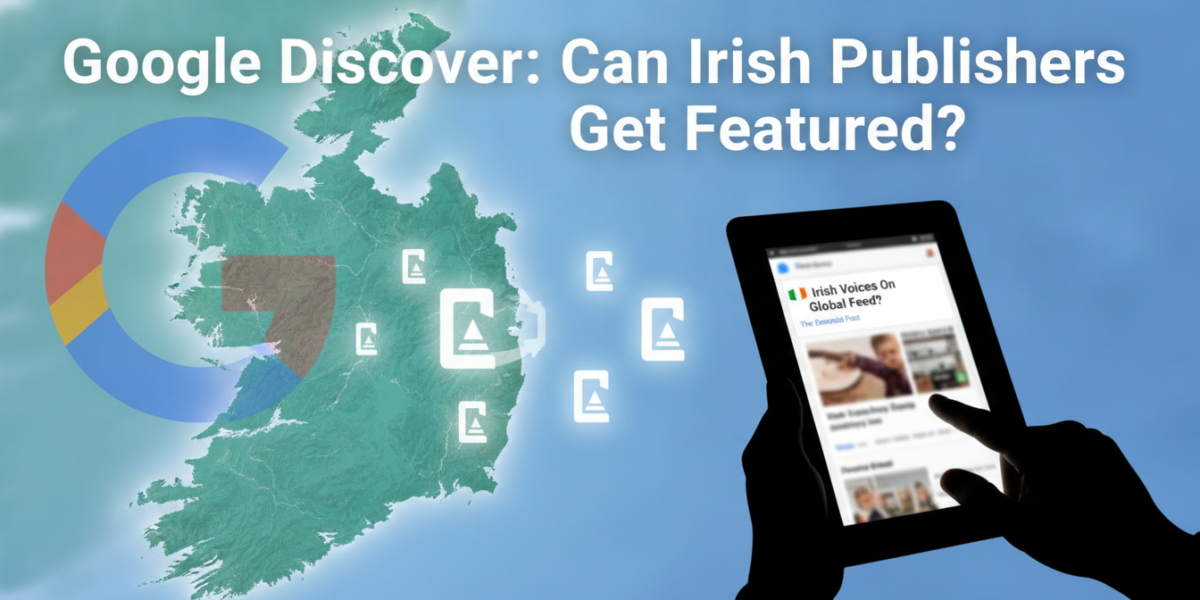
If you run a website in Ireland — whether it’s a news outlet, a lifestyle blog, or a niche content platform — you’ve probably heard the buzz around Google Discover. It’s one of those traffic sources that can feel almost mysterious: some publishers seem to get a flood of visits from it, while others barely see a trickle. So what exactly is Google Discover, and can Irish publishers realistically get featured on it? The short answer is yes — but it takes more than luck.
What Is Google Discover and Why Does It Matter?
Google Discover is a personalised content feed that appears on the Google app and mobile browsers when users open a new tab or visit google.com on their phone. Unlike traditional search, users don’t type anything — Google proactively surfaces content it thinks they’ll find interesting, based on their search history, location, interests, and browsing behaviour.
The scale of this is hard to ignore. Google has reported that Discover reaches over 800 million users globally. For publishers, appearing in that feed can mean significant traffic — often without the user ever searching for your content.
How Discover Differs from Traditional Search
This is an important distinction. With standard SEO, you optimise for queries — you know what people are searching for and you structure your content to match. Discover is different. It’s interest-based and behaviour-driven, which means Google is essentially predicting what a user wants to read before they ask.
That changes the game considerably. Instead of chasing keywords, you’re building content that earns genuine engagement, demonstrates expertise, and stays current enough to be surfaced at the right moment.
The Technical Side: What Google Requires
Before worrying about content strategy, there are baseline technical requirements your site needs to meet to even be eligible for Discover.
Mobile-friendliness is non-negotiable. Since Discover lives on mobile devices, Google will not regularly surface content from sites that perform poorly on smartphones. Run your site through Google’s Mobile-Friendly Test tool to see where you stand.
Page speed matters more here than almost anywhere else. Core Web Vitals — specifically Largest Contentful Paint (LCP), Cumulative Layout Shift (CLS), and Interaction to Next Paint (INP) — are key signals. A page that loads slowly or shifts around as it loads is a poor candidate for Discover.
Structured Data and Open Graph Tags
While structured data isn’t a hard requirement for Discover, it helps. Using Article schema markup, and ensuring your Open Graph tags are correctly set up (particularly og:image and og:title), gives Google better context about your content.
Image size matters too. Google explicitly recommends using high-quality images of at least 1200 pixels wide in your content. Small or low-resolution featured images are a common reason Irish publishers miss out on Discover traffic.
Google Discover and Irish Publishers: The Opportunity
Ireland has a vibrant digital publishing scene. From national outlets like The Irish Times and The Journal to regional blogs, sports commentary sites, food and travel platforms, and everything in between — there’s a wealth of content being produced every day.
The good news is that Google Discover doesn’t discriminate by country. What it cares about is content quality, relevance, and engagement signals. An Irish lifestyle blog that covers walking routes in Connemara can appear in the Discover feed of someone in Dublin who regularly searches for outdoor activities — just as easily as a piece from an international travel site.
Local Content Has an Advantage
There’s actually a structural opportunity here for Irish publishers. Hyper-local content tends to have less competition in the Discover ecosystem than broad, internationally-focused topics. A well-crafted piece about the best farmers’ markets in Cork, or a timely explainer on planning regulations in Galway, might surface for highly relevant local users with less effort than a generic article competing against global publishers.
Regional news sites and county-based blogs are particularly well-positioned. When Google understands through location signals that a user has strong ties to a specific part of Ireland, it tends to prioritise content from local publishers it trusts.
Content Signals That Drive Google Discover Features
Getting featured on Discover isn’t about tricking an algorithm. It’s about producing content that genuinely earns attention. Here’s what the evidence suggests matters most.
Freshness and timeliness. Discover heavily favours new content, particularly on topics that are trending or in the news cycle. Publishing quickly and accurately on developing stories gives Irish news and current affairs sites a real edge.
Evergreen content that stays relevant. On the flip side, certain long-form evergreen pieces — think comprehensive guides, in-depth explairations, or deeply researched features — can continue to appear in Discover feeds weeks or months after publication, particularly if engagement remains strong.
Click-through rate and dwell time. If users who see your content in Discover click on it and stay to read it, Google takes that as a strong signal. If they bounce immediately, your chances of being surfaced again diminish. This means your headlines need to be genuinely compelling, and your content needs to deliver on what the headline promises.
E-E-A-T: Experience, Expertise, Authoritativeness, Trustworthiness
Google’s quality guidelines place significant weight on E-E-A-T. For Irish publishers, this means:
- Author bylines matter. Articles attributed to named, credible authors with visible expertise — especially in health, finance, or legal topics — are more trusted.
- About pages and author bios help Google understand who is producing your content and why they should be trusted.
- Citing sources and linking to authoritative references signals editorial rigour.
A local Irish financial blog, for example, would benefit enormously from having contributors who hold recognised qualifications, and from citing data from sources like the Central Bank of Ireland or the CSO.
Practical Steps for Irish Publishers to Optimise for Google Discover
Rather than abstract advice, here’s a concrete approach Irish publishers can take.
1. Audit your technical foundation first.
Before anything else, check your Core Web Vitals in Google Search Console. If your LCP is above 2.5 seconds or your CLS score is high, fix those issues before investing heavily in content strategy.
2. Enable Google Discover reporting in Search Console.
Many Irish site owners don’t even realise they’re getting Discover traffic because they haven’t checked. Search Console has a dedicated Discover performance report. If you’re already appearing there, use that data to understand which content types resonate.
3. Use large, high-quality images consistently.
This is one of the simplest wins available. Every article should have a featured image at least 1200px wide. Avoid stock photos that feel generic — original or locally relevant imagery performs better.
4. Build a consistent publishing schedule.
Discover rewards publishers who publish regularly. A site that publishes five quality articles a week is more likely to be surfaced than one that publishes sporadically.
5. Write about what your audience genuinely cares about.
This sounds obvious, but many Irish publishers chase topics that don’t align with their actual audience’s interests. Use Google Trends (filtered to Ireland) and your existing Search Console data to identify what topics are generating real demand.
Common Mistakes Irish Publishers Make With Discover
A few pitfalls are worth calling out explicitly.
Ignoring image quality. As mentioned, Google is explicit that pages without large images are unlikely to appear in Discover. This is one of the most frequently overlooked technical requirements.
Publishing thin content. A 200-word post that scratches the surface of a topic won’t earn the engagement signals Discover needs. Even for news items, adding context, background, and genuine value increases dwell time.
Not building topic authority. Google Discover works better for publishers who have established clear topical relevance over time. A site that covers everything from recipes to cryptocurrency to celebrity news — without depth in any area — is harder for Google to categorise and recommend.
FAQ: Google Discover for Irish Publishers
What types of content perform best in Google Discover?
Timely news content, visually rich articles, and deeply useful evergreen guides tend to perform well. Content that triggers curiosity or addresses strong emotional interests — local news, sport, health, food — appears most frequently. Crucially, the content needs to deliver real value once the user clicks through.
How long does it take to start seeing Google Discover traffic?
There’s no fixed timeline, but most publishers who meet the technical requirements and publish consistently begin seeing Discover impressions within a few weeks to a few months. It’s not an overnight channel — it builds as Google gains trust in your site’s quality and consistency.
Is it worth optimising for Google Discover as a small Irish blog?
Absolutely. Small, niche publishers can actually outperform large general outlets on Discover for specific topics. A dedicated Irish hiking blog, for instance, can earn significant Discover traffic for users with active outdoor interests — simply because it’s more topically focused and locally relevant than a large international site.
Does Google Discover work differently in Ireland compared to other countries?
The underlying algorithm is the same globally, but content surfaced is influenced by the user’s location, language settings, and search history. Irish users will naturally see more Irish content surfaced. This means Irish publishers have an inherent local advantage for audiences based in Ireland.
Can I check if my site has ever appeared in Google Discover?
Yes. Log into Google Search Console and look for the "Discover" tab in the Performance section. If your site has generated any Discover impressions in the last 16 months, you’ll see the data there — including clicks, impressions, and click-through rate by article.
Conclusion
Google Discover represents a genuine and underutilised opportunity for Irish publishers. Whether you’re running a local news site, a specialist blog, or a content-driven business website, the principles are the same: build a technically sound site, produce content that earns real engagement, demonstrate genuine expertise, and publish consistently on topics your audience cares about.
The Irish digital publishing landscape is well-suited to benefit from Discover’s local relevance signals. With less competition for region-specific content and a growing mobile-first audience, the window is open. The publishers who take the technical requirements seriously and commit to quality content are the ones who’ll see the results in their traffic reports.
Ready to Make the Most of Google Discover?
If you’d like to explore how your website can be better optimised for Google Discover — or if you want to discuss a broader digital strategy for your Irish publishing project — our team is happy to help. Whether you have a quick question or want a full site review, feel free to reach out.
Email us at moc.ssobebolg@ofni or call us on +353 1 868 2345 and we’ll be glad to point you in the right direction.
Related Posts
 Google Discover Topic Overviews With Video: Opportunity For Irish Content Brands
 40% Drop In Google Search: Effects On Irish Content Publishers
 Pinterest for Irish Retailers: Traffic Beyond Google
 Googleʼs Query Fan-Out R4T-Diffusion: Impact On Irish SEO Tactics
 Redditʼs Role in Googleʼs Irish Forum Results
 Google Analytics Hostname Filters: What Irish Marketers Must Know Now
 Google Indexing API Silent Failures: Crisis For Irish Job Board Sites
 International SEO For Irish Publishers: Cross-Border Growth Playbook