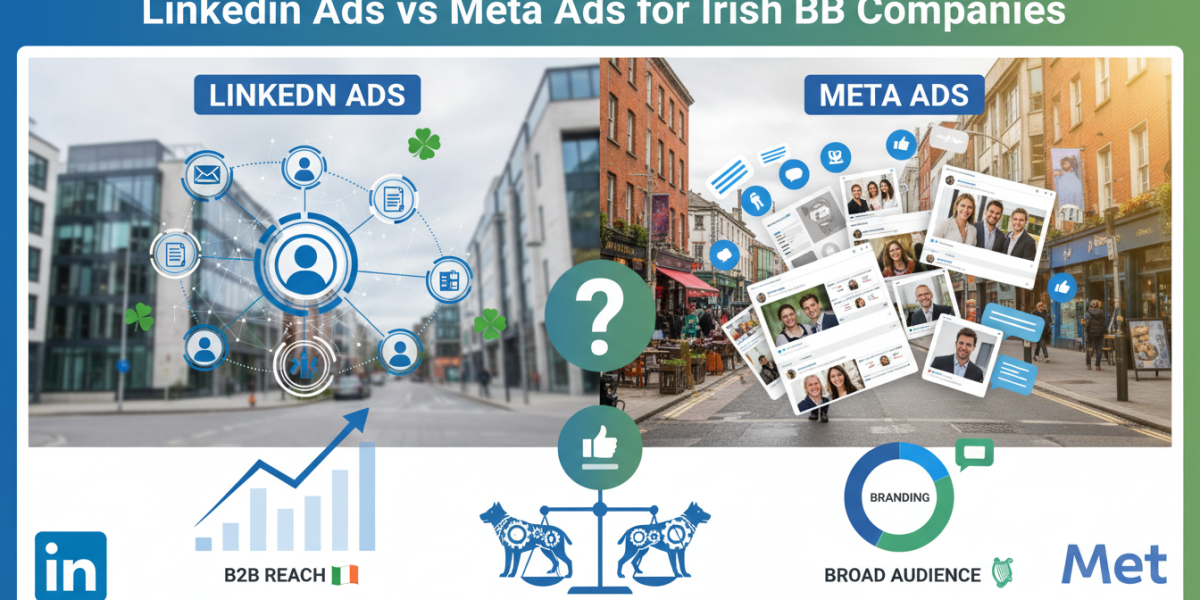
If you’re running a B2B company in Ireland and trying to decide where to spend your paid advertising budget, the choice between LinkedIn Ads and Meta Ads is one that comes up constantly. Both platforms are powerful, both can deliver real results, and both will happily take your money — but they work very differently, and picking the wrong one can mean months of wasted spend before you realise the issue.
This guide breaks down the key differences, practical considerations, and real trade-offs so you can make a more informed decision for your business.
Why Platform Choice Matters More Than Most People Think
A common mistake Irish B2B businesses make is treating paid social as a single channel with interchangeable platforms. It isn’t. The platform shapes everything — who sees your ad, what mindset they’re in, how they respond, and ultimately whether they convert into a qualified lead or an expensive click that goes nowhere.
LinkedIn and Meta (Facebook and Instagram) serve fundamentally different audience relationships. LinkedIn users are in a professional context. They’re thinking about work, industry trends, career progression, and business problems. Meta users are scrolling through holiday photos, memes, and news. Neither is better by default — but one will almost certainly suit your specific goals better than the other.
Understanding the Core Difference: Mindset vs Scale
Professional Intent on LinkedIn
When someone logs into LinkedIn, they’ve mentally switched into "work mode." This is why LinkedIn tends to outperform Meta for B2B audiences in terms of lead quality, even when the volume is lower. A financial services firm in Dublin targeting CFOs will find LinkedIn’s audience targeting far more precise — you can narrow by job title, company size, industry, seniority level, and even specific companies.
LinkedIn has over 1 million users in Ireland, with a particularly strong concentration in sectors like technology, financial services, professional services, and pharmaceutical — all of which are major pillars of the Irish B2B economy.
Meta’s Reach Advantage
Meta, on the other hand, offers unmatched scale. Facebook alone has over 3 million Irish users, and Instagram adds significant reach on top of that. If your product or service appeals to business owners, managers, or entrepreneurs who might not be active LinkedIn users (think smaller SMEs, tradespeople, hospitality operators, or retail business owners), Meta can get you in front of them at a fraction of the cost.
Meta’s algorithm is also exceptionally good at finding the right people based on behaviour and interest signals — even without the explicit professional data that LinkedIn holds.
Comparing Costs: What Irish B2B Advertisers Actually Pay
This is where a lot of businesses get a shock. LinkedIn Ads are expensive — there’s no sugarcoating it. The minimum daily budget is around €10, but to run competitive campaigns targeting mid-to-senior professionals in Ireland, you’re typically looking at cost-per-click (CPC) rates of €6–€12 or more, and cost-per-lead figures that can range from €50 to over €200 depending on the offer and audience.
Meta Ads are significantly cheaper on a per-click basis. Typical CPCs for B2B-focused Meta campaigns in Ireland range from €0.80 to €3.00, and you can generate leads through Lead Gen Forms for €15–€50 in many sectors.
So Is LinkedIn Worth the Premium?
Often, yes — but only if your average deal value justifies it. A SaaS company selling a €30,000/year enterprise contract can easily absorb a €150 cost-per-lead if conversion rates are reasonable. A training company selling €500 workshops cannot.
The rule of thumb most experienced paid media specialists use: if your target buyer has a specific job title or works in a specific type of company, LinkedIn’s precise targeting is worth paying for. If your buyer is defined more by behaviour, interest, or general business ownership, Meta will typically deliver better ROI.
Audience Targeting: Where LinkedIn Genuinely Wins for B2B
LinkedIn’s targeting capabilities were built specifically for professional audiences, and it shows. You can layer multiple filters simultaneously:
- Job title (e.g., "Head of Operations", "IT Manager")
- Company industry (e.g., Pharma, Financial Services, Construction)
- Company size (e.g., 50–200 employees)
- Seniority level (Director, VP, C-Suite)
- Member skills (e.g., "ERP systems", "Procurement")
- Specific named companies — useful for Account-Based Marketing (ABM) strategies
For an Irish B2B company targeting, say, procurement managers in mid-sized manufacturing firms across Munster, LinkedIn can get remarkably close to that exact audience. That specificity is genuinely hard to replicate elsewhere.
Meta’s B2B targeting has improved over the years, but it remains behavioural and interest-based rather than role-based. You can target "small business owners" or people with interests in "business software," but you can’t reliably filter to "IT Directors in companies with 100–500 employees in Ireland."
Ad Formats and Creative Approaches
LinkedIn’s Format Options
LinkedIn offers several ad formats worth knowing:
- Sponsored Content — native posts that appear in the feed, supporting single images, carousels, and video
- Message Ads — delivered directly to LinkedIn inboxes (higher engagement, but can feel intrusive if not crafted carefully)
- Lead Gen Forms — pre-filled forms that allow users to submit contact details without leaving LinkedIn
- Conversation Ads — branching message experiences that let users self-select their interest area
- Text Ads — small sidebar ads, less visually prominent but cheap for awareness
For Irish B2B companies starting out, Sponsored Content combined with LinkedIn Lead Gen Forms is generally the most practical and measurable combination.
Meta’s Creative Flexibility
Meta gives you more creative room to play. Video performs particularly well on Meta — short, engaging clips (under 30 seconds) that lead with a clear problem-solution narrative regularly outperform static image ads. Carousel ads work well for showcasing multiple services or a step-by-step process.
Meta also supports retargeting in highly granular ways — you can show different creative to people who visited specific pages on your website, watched a certain percentage of your video, or interacted with your Facebook page in the last 90 days. This kind of warm-audience nurturing can work very well as a complement to LinkedIn’s top-of-funnel awareness.
When to Use Both Platforms Together
The most effective approach for many Irish B2B companies isn’t LinkedIn or Meta — it’s a deliberate combination of both.
A practical example: an Irish HR software company could use LinkedIn Ads to reach HR Directors and People Managers at companies with 50+ employees (top-of-funnel awareness and direct lead generation), then use Meta retargeting ads to stay visible to people who visited their pricing page but didn’t convert. This two-platform strategy uses each channel for what it does best.
The key is to assign each platform a clear role in your funnel rather than running the same campaign on both and comparing results directly. They’re playing different games.
Local Considerations for the Irish Market
Ireland’s B2B landscape has some specific characteristics that affect platform strategy. The market is relatively small compared to the UK or US, which means audience sizes on LinkedIn can be limited — sometimes only a few thousand users match a very specific target profile. This can drive up costs and limit frequency.
For highly niche sectors, this is worth modelling before committing large budgets. LinkedIn’s Audience Forecast tool (available in Campaign Manager) will show you estimated reach before you launch — always check this first.
Ireland also has a strong culture of relationship-driven business, particularly outside Dublin. Meta’s community-feel and less formal environment can actually work to advantage here, especially for companies targeting SMEs in regional markets where LinkedIn penetration may be lower.
Measuring Success: The Metrics That Actually Matter
Vanity metrics — impressions, likes, reach — don’t pay the bills. For Irish B2B advertisers, the core metrics to track are:
- Cost per qualified lead (not just any lead)
- Lead-to-opportunity rate (are leads converting to actual sales conversations?)
- Customer acquisition cost (CAC) vs average deal value
- Platform-attributed pipeline (tracked through CRM integration)
Both LinkedIn and Meta offer conversion tracking, but setup requires connecting your ad platforms to your website via tracking pixels/tags and ideally integrating with your CRM (HubSpot and Salesforce both integrate with both platforms). Without this, you’re flying blind on what’s actually driving revenue.
FAQ
Is LinkedIn Ads worth it for small Irish B2B companies with limited budgets?
It depends on your deal value and how specific your target audience is. If you’re selling high-value B2B services and need to reach senior decision-makers, LinkedIn can justify the higher costs. If your budget is under €500/month, you’ll struggle to generate meaningful data on LinkedIn — Meta would likely give you more to work with at that level.
What budget should I start with on LinkedIn Ads in Ireland?
A realistic starting budget for LinkedIn Ads in Ireland is €1,500–€2,000/month. This gives you enough data to test audiences and creatives without burning through budget too quickly. Running LinkedIn on less than €800/month typically produces too few leads to draw reliable conclusions.
Can I target Irish businesses specifically on Meta Ads?
Yes, Meta allows geographic targeting at country, region, and city level. You can target people in Ireland and layer on interest and behaviour signals. However, you can’t specifically filter to "Irish-based companies" — you’re targeting people who happen to be in Ireland.
How long before I see results from LinkedIn Ads?
Give it at least 6–8 weeks before making major decisions. LinkedIn’s algorithm needs time to optimise, and B2B sales cycles mean leads from week one may not convert for months. Track pipeline contribution, not just immediate conversions.
What’s the biggest mistake Irish B2B companies make with paid social?
Running the same generic ad to a broad audience and expecting qualified leads. The more specific your targeting and the more tailored your creative to that audience’s exact pain point, the better your results will be — on either platform.
Conclusion
LinkedIn Ads and Meta Ads both have a genuine place in the Irish B2B advertising landscape, but they work best when used with a clear understanding of their respective strengths. LinkedIn offers unmatched precision for professional audiences and is the default choice when you need to reach specific roles or industries — but it comes at a cost that needs to be justified by deal value. Meta delivers scale, lower costs, and strong retargeting capabilities that complement LinkedIn’s reach.
For most Irish B2B companies, the smarter long-term approach is to test both, assign each a clear role in your funnel, and let the data guide your budget allocation over time. Start focused, measure rigorously, and don’t expect either platform to deliver overnight results — but with the right setup and realistic expectations, both can become reliable drivers of qualified pipeline.
Ready to figure out the right paid advertising strategy for your Irish B2B company?
Whether you’re just getting started or want a second opinion on your current campaigns, our team is happy to have a no-pressure conversation about what’s likely to work for your specific situation. Get in touch by emailing us at moc.ssobebolg@ofni or calling +353 1 868 2345 — we’ll be glad to help you make sense of the options and point you in the right direction.
Dublin's ROI-Driven Digital Marketing Agency Home
Related Posts
 LinkedIn Ads vs Facebook Ads for Irish B2B Companies
 B2B Lead Generation with Expert LinkedIn Ads Strategies
 Why LinkedIn Is the Most Underused Tool for Irish B2B Growth
 The Biggest Google Ads Mistakes Irish Businesses Make
 Why Meta Ads Are Still Worth It for Dublin Businesses
 How to Set Up a Google Ads Campaign from Scratch in Ireland
 How to Use Google Shopping Ads to Grow an Irish E-Commerce Brand
 B2B Lead Generation through SEO for Irish Firms