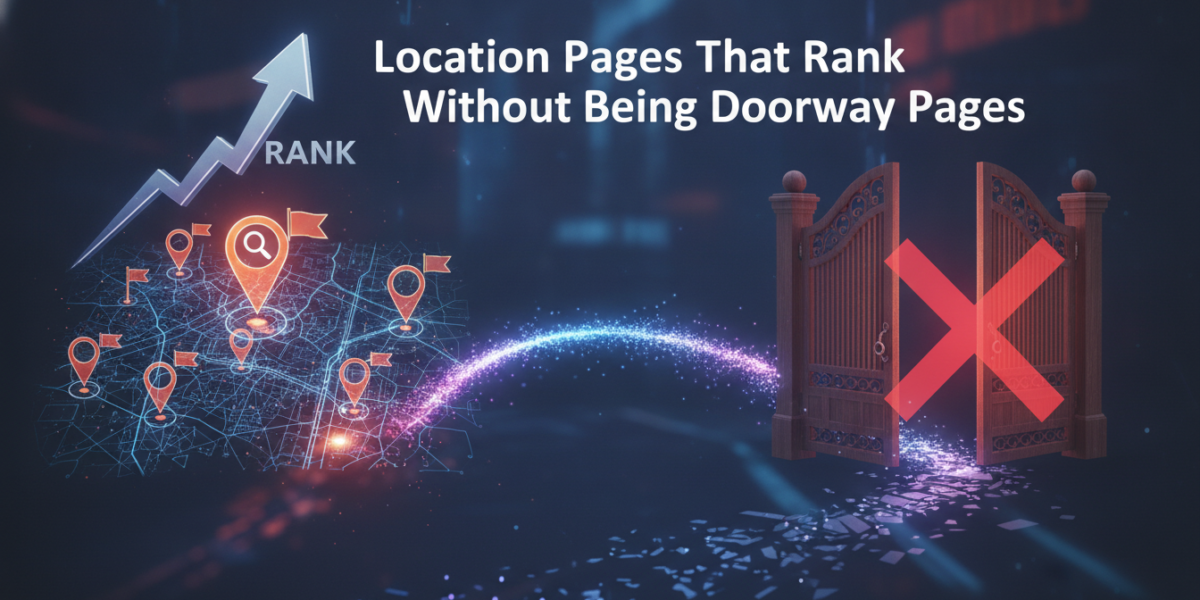
If you’ve ever tried to build location pages for a multi-city business, you’ve probably run into the same dilemma: how do you create enough pages to rank in different cities without tripping Google’s doorway page filters? It’s one of the more nuanced challenges in local SEO, and getting it wrong can quietly tank your visibility across the board. The good news is that location pages that rank — genuinely and sustainably — do exist, and they follow a clear set of principles that separate them from the thin, templated pages that Google has been cracking down on for years.
What Makes a Page a Doorway Page (and Why It Matters)
Google defines doorway pages as pages created primarily to rank for specific search queries rather than to serve users. They’re typically characterised by near-identical content replicated across multiple locations, with only the city name swapped out.
Think of a plumbing company that builds 50 pages — one for every county in Ireland — using the exact same text, the same bullet points, and the same testimonials, just with "Dublin" replaced by "Cork" or "Galway." Those pages exist for the crawler, not the customer.
The Real Risk
Google’s algorithm has become increasingly good at identifying these patterns. In its quality guidelines, Google specifically flags pages that "funnel visitors into the actual usable or relevant portion of your site" as problematic. But beyond algorithm risk, there’s a practical issue: if a user lands on a thin location page and immediately bounces, your engagement signals suffer too.
The penalty isn’t always a manual action. Often, it’s simply that these pages never rank in the first place — or they rank briefly and then fall away as Google refines its understanding of the content.
What Legitimate Location Pages Actually Look Like
Here’s where the distinction gets useful. A well-built location page isn’t just a city name bolted onto a generic service page. It’s a page that answers real questions a local customer would have — and answers them with information that’s specific to that place.
Think Like a Local Customer
Someone searching for "commercial cleaning services in Limerick" isn’t just looking for proof that the company exists. They want to know:
- Does this company actually serve Limerick, or is it based in Dublin and just claiming the area?
- Who are the local contacts or team members?
- Are there any relevant local details — nearby clients, local regulations, service radius?
- Can I see reviews from people in my area?
A page that answers even two or three of these questions with real, verifiable information is already leagues ahead of the templated alternative.
The Role of Unique Content
Each location page should contain a meaningful block of content that couldn’t be copy-pasted from another page without it feeling out of place. This doesn’t mean you need to write 2,000 words for every city. It means that the core substance — the details that make that page relevant to that location — should be genuinely different.
For a recruitment agency, this might mean referencing the dominant industries in a given city. For a solicitor’s firm, it might mean noting the relevant local courts or council areas they work with. These aren’t gimmicks — they’re the kind of details a knowledgeable local business would naturally include.
Building Location Pages That Rank: A Practical Framework
Getting this right isn’t about luck or guesswork. There’s a repeatable process that separates location pages built to rank from location pages built to pretend.
Step 1: Audit what’s genuinely different about each location.
Before writing a single word, list the real differences in how you serve each area. Different staff? Different service hours? Different local partners or suppliers? Different pricing due to logistics? If you can’t identify anything meaningful, that’s a signal you may not have enough presence in that location to justify a dedicated page yet.
Step 2: Research local search intent.
Use tools like Google Search Console, Google’s autocomplete, or a keyword tool to understand what people in that city are actually searching for. "Emergency electrician Cork" has different intent signals than "electrical inspection services Cork." Your page should align with how people in that area actually phrase their needs.
Step 3: Write for the customer, then optimise for search.
Draft the page as if you’re writing a brochure for a local audience. What would make someone in that city trust you? What local context would reassure them? Once that content exists, you can naturally work in your target terms — but the content should make sense without them.
Step 4: Add locally verifiable signals.
This is a big one. Include your local phone number, a Google Maps embed, nearby landmarks or areas you serve, and — if possible — case studies or testimonials from clients in that region. These signals aren’t just useful for users; they help search engines verify that the page has genuine local relevance.
Step 5: Link internally with purpose.
Don’t let location pages float in isolation. Connect them to relevant service pages, blog posts about local topics, and your main contact page. Internal linking tells Google these pages are part of a coherent site structure, not a cluster of independent doorway pages.
Common Mistakes That Tip Pages Into Doorway Territory
Even well-intentioned businesses fall into patterns that make their location pages look thin. Here are the most common traps:
Swapping only the city name. If your page reads "We provide [service] in [City]" and every other page follows the same structure word-for-word, it will likely be treated as doorway content. Even if each page has a unique paragraph, the overall pattern matters.
Using auto-generated content. AI-generated location pages that are clearly templated — especially those produced at scale without editorial review — are one of the fastest ways to trigger quality filters. This doesn’t mean you can’t use AI as part of your workflow, but the output needs human refinement and genuine local input.
Targeting areas you don’t actually serve. Building a page for a city where you have no staff, no clients, and no credible local presence is a reliability problem as much as an SEO problem. If a customer books a service based on that page and then learns you’re actually based three hours away, the trust damage is real.
Ignoring page performance. A location page that nobody visits, converts, or engages with is a liability. Regularly audit your location pages with Google Search Console. If a page is generating impressions but no clicks, the meta content needs work. If it’s getting clicks but poor engagement, the content itself may be the problem.
How Many Location Pages Is Too Many?
There’s no magic number, but a useful heuristic is this: build one location page per area where you have genuine, demonstrable presence or activity. For a national service business with offices in five cities, five well-built pages will outperform fifty thin ones every time.
Some businesses do legitimately serve dozens of areas — a large courier company, a national franchise, a cleaning service with regional teams. In those cases, a tiered approach works well: build full, rich pages for your primary locations and create leaner but still distinct pages for secondary areas, each with at least some unique content and local signals.
The key metric isn’t the number of pages — it’s whether each one can stand on its own as a useful resource for a real user in that location.
Frequently Asked Questions
What’s the actual difference between a location page and a doorway page?
A location page is built to genuinely serve local users with relevant, specific information about a business and its services in that area. A doorway page is built primarily to rank for a geo-targeted keyword, with little or no unique value for the visitor. The distinction lies in intent and substance, not in structure alone.
How much unique content does each location page need?
There’s no fixed word count, but as a practical guide, aim for at least one or two substantial sections — perhaps 150 to 300 words — that are entirely unique to that location. This might be local team information, area-specific services, or testimonials from clients in the region. The rest of the page can follow a consistent template, provided the core local content is genuinely distinct.
Can I use the same testimonials on multiple location pages?
Using the exact same testimonials across every location page is a red flag for both users and search engines. Where possible, source testimonials from clients in each specific area. If that’s not feasible, at minimum make sure the testimonials you use are relevant to the services featured on that page, and don’t present them as locally sourced if they aren’t.
Is it okay to create a location page for a city where I don’t have an office?
Yes, provided you genuinely serve that area. Many service businesses operate without physical offices in every location. What matters is that you can credibly deliver your service there and that the page reflects real local knowledge — not just a pinned location on a map.
How do I know if my location pages are being treated as doorway pages?
Watch for patterns in Google Search Console: pages with near-zero impressions, sudden drops in clicks after initial indexing, or pages consistently failing to rank for their target terms. A manual review under Google Search Console’s "Manual Actions" report will show if there’s an explicit penalty, but the more common issue is simply that thin pages fail to gain traction organically.
Conclusion
Location pages that rank aren’t a mystery. They rank because they genuinely deserve to — because they give real users in real places a reason to trust a business, engage with its content, and take the next step. The businesses that get this right aren’t doing anything exotic. They’re just building pages with the same care and specificity they’d apply to any other piece of content.
The doorway page trap is easy to fall into, especially under pressure to expand into new markets quickly. But the short-term gain of having a page indexed in fifty cities is rarely worth the long-term cost of appearing thin and untrustworthy in all of them. Build fewer pages, build them well, and let the quality compound over time.
Ready to get your location pages working harder? If you’d like to talk through your current setup or get expert help building a location strategy that ranks without risking penalties, our team is happy to help. Reach out at moc.ssobebolg@ofni or call us on +353 1 868 2345 — we’ll take a look at what you have and help you figure out the best path forward.
Related Posts
 Building Local Pages AI Systems Trust: Dublin Business Practical Guide
 SEO FAQs for Small Businesses: How to Rank Higher on Google in Dublin
 Google Adds Local Businesses To EEA Search Units: Major Win For Irish Local SEO
 SEO FAQs for Irish Businesses: What to Expect | Globe Boss
 Dundrum Local SEO: Rank Beside Irelandʼs Biggest Shopping Centre
 Drumcondra Local SEO: How to Rank in Dublin 9
 How to Rank #1 for ʼNear Meʼ Searches in Dublin
 How to Rank on Page One in Dublin Without Paying for Ads