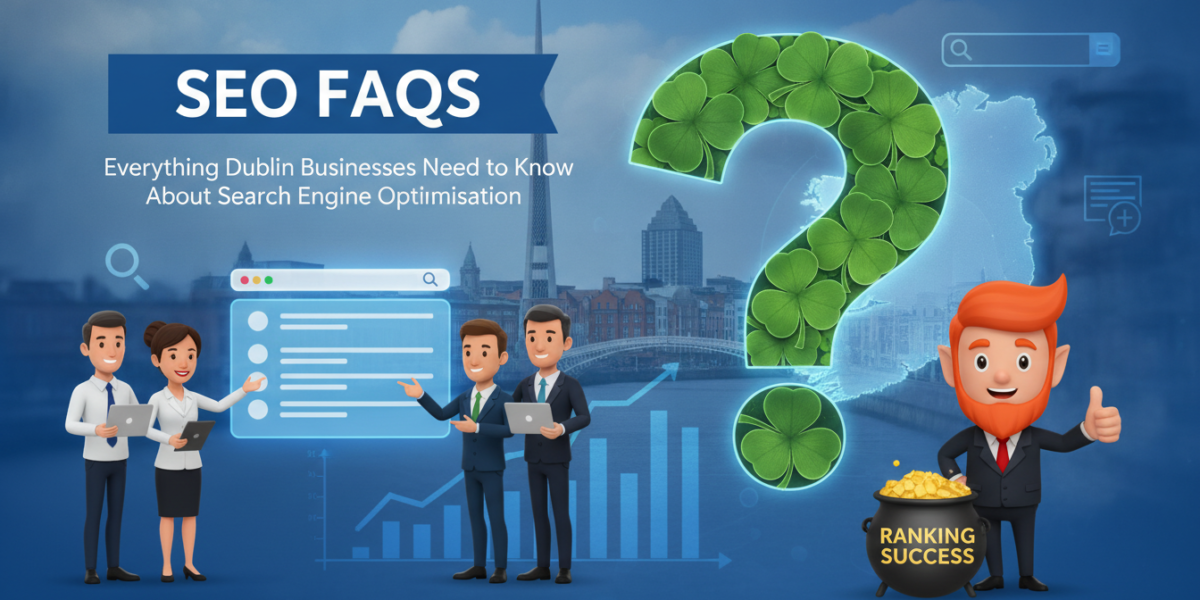
If you run a business in Dublin and you’ve been hearing a lot about SEO lately, you’re not alone. Search engine optimisation has become one of the most talked-about — and most misunderstood — areas of digital marketing for Irish businesses. Whether you’re a sole trader in Rathmines, a growing e-commerce brand in the Docklands, or a professional services firm in the city centre, understanding how SEO works (and what it can realistically do for you) is worth your time.
This guide answers the questions we hear most often from Dublin business owners, clearly and honestly.
What Is SEO and Why Does It Matter for Dublin Businesses?
SEO stands for search engine optimisation. In plain terms, it’s the practice of improving your website so that it appears higher in search engine results — primarily Google — when people search for products or services you offer.
Why does this matter? Because the vast majority of online experiences begin with a search. According to data from BrightEdge, organic search drives approximately 53% of all website traffic across industries. That means more than half of potential visitors to your site could be arriving through search — or not arriving at all if you don’t rank.
For a Dublin business, this becomes even more specific. Someone searching “accountant in Dublin 2” or “best coffee roaster Dublin” is showing clear purchase intent. If your site doesn’t appear in those results, a competitor’s does.
How Does Google Actually Decide Who Ranks?
The Core Ranking Factors
Google uses hundreds of signals to determine rankings, but most SEO professionals group them into three broad categories: relevance, authority, and user experience.
- Relevance refers to how well your content matches what someone is searching for.
- Authority is largely built through backlinks — other websites linking to yours as a trusted source.
- User experience covers factors like page speed, mobile-friendliness, and how easy your site is to navigate.
The Role of Content
Google’s algorithms have become increasingly sophisticated at understanding natural language, thanks to updates like BERT (2019) and the Helpful Content Update (2022 and beyond). These changes shifted the focus firmly toward content that genuinely answers a user’s question — not content stuffed with keywords.
In practical terms, this means a Dublin solicitor who publishes a genuinely useful guide on Irish property law will likely outperform a competitor who simply repeats the phrase “solicitor Dublin” twenty times on a page.
How Long Does SEO Take to Show Results?
This is one of the most common questions — and the honest answer is: it depends, but expect to wait.
For a new or low-authority website, meaningful ranking improvements typically take between three and six months. Competitive industries in Dublin, such as financial services, recruitment, or healthcare, can take longer — sometimes nine to twelve months before significant organic traffic gains are visible.
That timeline isn’t a flaw in the process. It reflects how Google builds trust in websites over time. A brand-new site can’t simply outrank established competitors overnight, any more than a new shop on Grafton Street becomes the busiest business on the street in its first week.
The good news? The results tend to compound. Unlike paid advertising, where traffic stops the moment you stop paying, well-executed SEO continues to generate results over time.
What’s the Difference Between Local SEO and General SEO?
General SEO
General SEO focuses on ranking for broader search terms — sometimes nationally or internationally. A Dublin-based SaaS company trying to attract customers across Europe would typically pursue this kind of strategy.
Local SEO
Local SEO specifically targets searches with geographic intent, such as “plumber near me” or “Dublin wedding photographer.” This type of optimisation includes:
- Google Business Profile — claiming and optimising your free listing on Google Maps
- Local citations — ensuring your name, address, and phone number appear consistently across directories like Yelp, Golden Pages, and Bing Places
- Location-specific content — pages and blog posts that reference Dublin neighbourhoods, landmarks, or local context
For most brick-and-mortar or service-area businesses in Dublin, local SEO often delivers the fastest and most tangible return. A well-optimised Google Business Profile alone can significantly increase calls and footfall.
Do I Need to Blog to Rank on Google?
Not necessarily — but it helps more than most business owners realise.
A blog isn’t just a marketing exercise. It’s a way to create content that targets specific search queries your customers are actually typing. For example, a Dublin-based mortgage broker might not rank for “mortgage broker Dublin” easily against well-established competitors. But they could rank for “how much deposit do I need for a house in Ireland” — a question many first-time buyers are actively searching for.
This approach, sometimes called a content funnel or topical authority strategy, helps smaller or newer sites compete by targeting longer, more specific search queries before working their way toward broader terms.
Consistency matters more than volume. Publishing one well-researched, genuinely useful article per month will outperform publishing four thin, rushed posts.
Is SEO Worth It for Small Dublin Businesses?
For many small businesses, this question really comes down to comparing SEO with paid alternatives like Google Ads.
Google Ads can deliver traffic quickly, but costs in competitive Dublin markets can be steep. A single click for “personal injury solicitor Dublin” can cost upwards of €15–€40 in paid search. SEO doesn’t charge per click — once you rank, the traffic is essentially free.
That said, SEO requires upfront investment — either in time, professional support, or both — and patience. The businesses that benefit most are those treating it as a long-term asset rather than a short-term campaign.
For a local trades business, a professional services firm, or a Dublin retailer competing against national brands, SEO often offers the best sustainable return on investment over a 12–24 month horizon.
What Should I Look for in an SEO Agency or Consultant in Dublin?
The SEO industry, unfortunately, has no shortage of bad actors. Here’s what separates credible providers from those best avoided:
Transparency — A good agency explains what they’re doing and why. If someone offers to “guarantee” you position one on Google, that’s a red flag. No one can guarantee specific rankings, and Google itself says as much in its official guidelines.
Reporting — You should receive regular reports tied to meaningful metrics: organic traffic, keyword rankings, conversions, and Google Business Profile performance. Vanity metrics alone (like “impressions”) tell only part of the story.
Ethical practices — Ask whether they use “white hat” techniques in line with Google’s Webmaster Guidelines. Tactics like buying bulk links or keyword-stuffed doorway pages might produce short-term gains but risk serious penalties, including removal from Google’s index entirely.
Local knowledge — For Dublin businesses, working with someone who understands the Irish market, local search behaviour, and competitive landscape can make a real difference. Generic, templated strategies don’t always translate well to specific local contexts.
Frequently Asked Questions
What is the difference between on-page and off-page SEO?
On-page SEO refers to everything you control directly on your website — content, title tags, headings, internal links, and page speed. Off-page SEO covers external factors, primarily backlinks from other reputable websites. Both are important; on-page gives Google the right signals about your content, while off-page authority helps establish your site’s credibility.
How do I know if my website is already ranking on Google?
You can use free tools like Google Search Console (which Google provides directly) to see which queries your site is appearing for, how many clicks you’re receiving, and your average position. It’s free to set up and provides genuinely useful data.
Is social media part of SEO?
Social media signals are not a direct Google ranking factor, but social media supports SEO indirectly. Content that performs well on social platforms tends to attract more backlinks, more branded searches, and more site visits — all of which contribute positively to your overall search presence.
How much does SEO cost for a Dublin business?
Costs vary significantly depending on scope and competition. Freelancers may charge from €500–€1,500 per month, while established agencies often start at €1,000–€3,000+ per month for ongoing campaigns. One-off audits and consultations are available for lower costs if you’re starting out. The key is understanding what’s included and what success looks like before committing.
Can I do SEO myself?
Yes — especially for a small local business. Learning the basics of Google Business Profile optimisation, on-page SEO, and content creation is achievable with time and effort. Resources like Google’s own Search Essentials documentation, Moz’s Beginner’s Guide to SEO, and Ahrefs’ blog are all free and highly credible starting points. As your business grows or competition intensifies, professional support often becomes a worthwhile investment.
Conclusion
SEO isn’t magic, and it isn’t a shortcut. But for Dublin businesses serious about building a sustainable online presence, it remains one of the highest-value investments available in digital marketing. The fundamentals — creating genuinely useful content, earning reputable links, ensuring your site works well on mobile, and keeping your Google Business Profile up to date — haven’t changed dramatically in years. What has changed is how much more competitive the landscape has become.
The businesses winning in search today are those who started treating SEO as a long-term strategy rather than a one-off project. Whether you’re just starting out or looking to improve an existing site, the best time to begin is now — and the second-best time is this time next month when your competitors will have moved further ahead.
Ready to take the next step? If you’d like to discuss your business’s SEO needs, ask a specific question, or get a no-obligation quote, our team is happy to help. Reach out by email at moc.ssobebolg@ofni or give us a call at +353 1 868 2345 — whichever suits you best.
Dublin's ROI-Driven Digital Marketing Agency Home
Related Posts
 Globe Boss Search Engine Optimization Dublin
 Answer Engine Optimisation The New SEO Playbook for Dublin Businesses
 SEO Strategies for Irish Businesses to Boost Online Visibility
 Clontarf SEO: Local Search Tips for Dublin 3 Businesses
 Search engine optimisation ireland globe boss
 SEO FAQs for Small Businesses: How to Rank Higher on Google in Dublin
 Why Cork and Galway Businesses Need Different SEO than Dublin
 How to Rank in ChatGPT Search for Dublin Businesses