
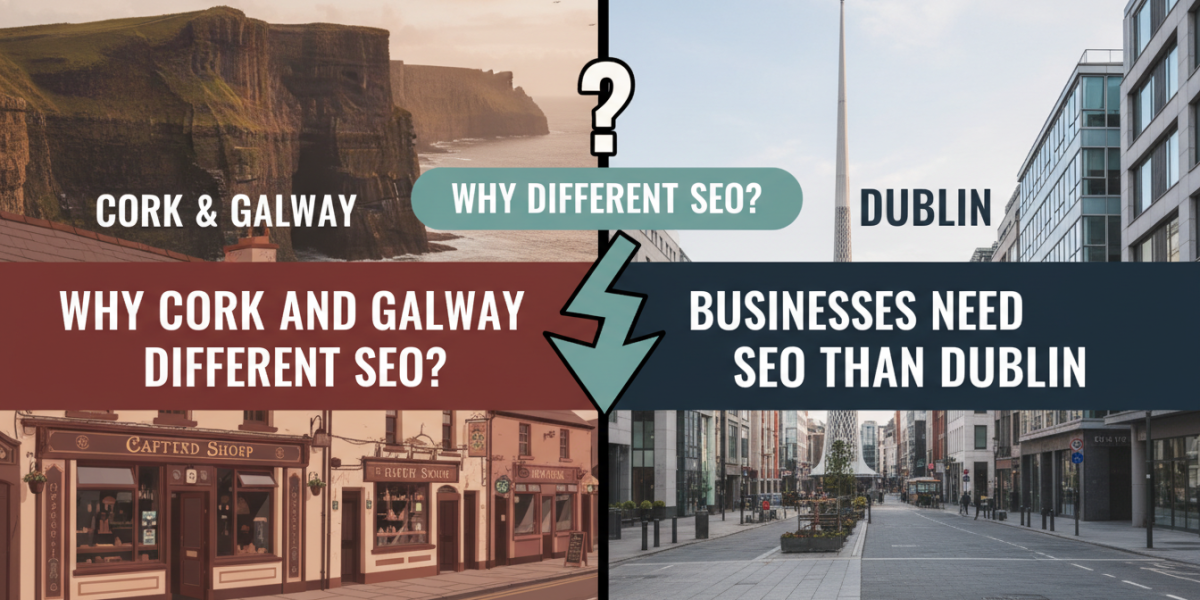
If you run a business in Cork or Galway and you’ve been trying to apply the same SEO playbook used by Dublin companies, you’re probably wondering why the results don’t quite add up. The truth is that local SEO in Ireland isn’t one-size-fits-all. The search behaviour, competition landscape, and audience expectations in Cork and Galway are fundamentally different from those in the capital — and treating them as identical is one of the most common and costly mistakes regional businesses make.
This isn’t about Dublin being better or worse. It’s about understanding that each city has its own digital ecosystem, and what works on the north side of the Liffey won’t necessarily move the needle on the south side of the Lee.
The Dublin SEO Problem Nobody Talks About
Dublin dominates Irish digital marketing conversations. Most SEO agencies are based there, most case studies reference it, and most generic advice is built around its competitive dynamics. That’s a problem for businesses in Cork and Galway, because the two cities operate in very different commercial realities.
Dublin has a population of over 1.4 million people in the greater metro area. The search volume is higher, but so is the competition. Ranking for "accountant in Dublin" means going up against dozens of established firms, many of whom have been investing in SEO for years. The cost-per-click on paid search is higher, the domain authority of competitors tends to be stronger, and the sheer noise makes it harder to break through.
In Cork and Galway, the dynamics shift considerably. Lower competition doesn’t mean lower opportunity — it means the opportunity is more accessible if you approach it correctly.
How Search Behaviour Differs Outside the Capital
People Search Differently in Regional Cities
Cork and Galway residents tend to use more place-specific language in their searches. Rather than generic terms, you’ll often see searches like "solicitor on the Western Road" or "coffee shop near Eyre Square." This hyper-local specificity matters because it signals intent — someone who includes a street or neighbourhood in their search is usually ready to act.
Google’s own data consistently shows that "near me" searches have grown over the past decade, but the patterns vary by city size. In smaller urban markets, users are more likely to include landmark references, local place names, or well-known areas as part of their query. An SEO strategy for a Cork-based business needs to account for this.
Local Landmarks and Colloquial Geography Matter
In Galway, for example, areas like Salthill, the Westend, and Newcastle carry strong local meaning. A physiotherapy clinic optimised for "Galway city physiotherapist" is missing an opportunity if it doesn’t also target "physio near Salthill" or "physiotherapist Westend Galway." These are the terms real people use when they’re looking for something they trust.
The same logic applies in Cork. Neighbourhoods like Ballincollig, Douglas, and Blackpool are distinct communities with distinct search habits. Treating Cork as a monolithic market ignores the way its residents actually navigate the city and its surroundings.
The Competition Gap — and Why It’s an Advantage
Lower Competition Means Faster Results
One of the clearest practical differences between Cork or Galway SEO and Dublin SEO is how long it takes to see traction. In Dublin, a competitive keyword might take 12 to 18 months of consistent effort to crack — and even then, you may be fighting for a spot on page two against national brands with enormous domain authority.
In Cork and Galway, well-optimised, locally relevant content can start generating organic visibility in three to six months for the right keywords. That’s not a shortcut — it’s a reflection of the competitive environment. Fewer businesses are competing seriously for those local terms, which means the bar for appearing on the first page of Google is meaningfully lower.
But Lower Competition Doesn’t Mean No Standards
The flip side is that Cork and Galway businesses sometimes underinvest in SEO precisely because they assume it’s easier. That assumption can backfire. If your competitor in Cork is doing basic local SEO well — consistent NAP (name, address, phone) across directories, a well-maintained Google Business Profile, and a few quality local backlinks — and you’re doing nothing, they’ll own the first page while you sit invisible.
The key is proportionality. You don’t need a Dublin-scale SEO budget to compete in Cork. But you do need a coherent, locally informed strategy.
Building a Cork or Galway SEO Strategy That Actually Works
Start With Local Intent, Not National Keywords
The first instinct many business owners have is to target broad, high-volume keywords. "Plumber Ireland." "Accountant Ireland." This rarely works for regional businesses, and it’s a particularly poor fit for Cork and Galway markets.
Instead, the foundation should be built on locally specific, commercially relevant queries. Think "emergency plumber Cork city," "tax accountant Galway," or "wedding photographer Connemara." These terms have lower search volume, but the conversion intent is far higher. Someone searching for a wedding photographer in Connemara is almost certainly planning a wedding there — that’s a warm lead.
Google Business Profile — Your Most Underused Asset
If you haven’t fully optimised your Google Business Profile, that’s the first thing to fix. For local searches, the "local pack" — the three businesses that appear above organic results with a map — is often the most clicked section of the results page.
To appear in that pack for Cork or Galway searches, you need a complete and active Business Profile. That means:
- Accurate business category and subcategories
- Consistent address and contact details
- Regular posting of updates and offers
- A steady flow of genuine customer reviews with responses
- Photos that reflect your actual premises and work
Reviews are particularly important in regional markets, where trust networks are tighter and word-of-mouth carries significant weight. A business in Galway with 40 detailed, positive reviews has a substantial credibility advantage over one with five.
Local Content That Reflects Regional Knowledge
Content strategy for Cork and Galway businesses should go beyond swapping out a city name in a generic blog post. It should demonstrate genuine local knowledge.
A letting agency in Cork might write about the rental market trends specific to Cork’s docklands regeneration. A financial advisor in Galway might cover questions relevant to farming families in the west of Ireland. A café near Cork’s English Market might publish content about the producers they source from locally.
This kind of content builds two things simultaneously: topical authority with Google, and genuine trust with the local audience who can tell immediately whether you know their community or not.
Why Backlinks Look Different in Regional Markets
Local Links Carry Specific Weight
Backlinks — links from other websites pointing to yours — remain one of the most important ranking factors in SEO. But in Cork and Galway, the most valuable backlinks aren’t necessarily from high-traffic national publications. They’re from locally relevant sources.
A mention on CorkBeo, an article in the Connacht Tribune, a listing in a Galway business directory, or a link from a local chamber of commerce website can have an outsized impact on your local search performance. These sources signal to Google that your business is genuinely embedded in the local community — which is exactly what local ranking algorithms are designed to reward.
Sponsorships and Community Involvement Create Link Opportunities
Many Cork and Galway businesses already invest in local sponsorships — sports clubs, community events, charitable initiatives. These often come with a mention or link on the organisation’s website. If you’re already sponsoring a GAA club in Cork or a sailing event in Galway, make sure you’re actually getting a linked mention on their site. It’s a simple step that many businesses overlook.
The Mobile and Voice Search Angle
Over 60% of local searches are now performed on mobile devices, and voice search continues to grow in everyday use. In practical terms, this means your Cork or Galway business needs to be findable in the way people speak, not just the way they type.
Voice queries tend to be longer and more conversational. "Where’s the nearest mechanic in Galway?" or "Is there a good Italian restaurant open near Cork city centre tonight?" Optimising for these kinds of natural-language queries — through clear FAQ content, well-structured Google Business Profile data, and fast-loading mobile pages — is increasingly important.
If your website takes more than three seconds to load on a mobile connection, you’re losing visitors before they’ve had a chance to find out anything about you. Page speed is particularly relevant in parts of Galway and rural areas nearby, where mobile network speeds can vary.
Frequently Asked Questions
Is local SEO in Cork or Galway cheaper than Dublin?
Generally, yes — but it depends on the industry. Competition levels in most sectors are lower outside Dublin, which means you typically need less investment to achieve comparable rankings. However, highly competitive niches like insurance, legal services, or property can still require significant effort even in regional markets.
How long does it take to see SEO results in Cork or Galway?
For well-targeted local keywords with moderate competition, most businesses start seeing meaningful movement in three to six months. More competitive terms or a starting point of zero online presence may take closer to nine to twelve months. SEO is a long-term investment, not a quick fix.
Do I need a separate website for my Cork and Galway locations?
Not necessarily. A single well-structured website with dedicated, optimised location pages for each city will usually perform well. Separate domains can actually dilute your overall authority. The key is that each location page contains genuinely unique, locally relevant content — not just a copy-paste with the city name swapped out.
What’s the biggest SEO mistake Cork and Galway businesses make?
Neglecting their Google Business Profile is the most common and most damaging mistake. Many businesses set it up once and forget it. An incomplete or outdated Business Profile dramatically reduces your chances of appearing in the local pack — the most visible section of local search results.
Should I work with a local SEO agency or does location not matter?
It matters more than most people think. An agency with genuine knowledge of Cork’s neighbourhoods, Galway’s business community, and how local people search will produce more relevant strategies than one applying a Dublin template to a regional market. Ask any agency you consider how many regional Irish clients they’ve worked with and what those results looked like.
Conclusion
Cork and Galway businesses operate in rich, dynamic local markets — but those markets have their own logic, their own search behaviour, and their own competitive landscape. Applying Dublin-centric SEO thinking to a Galway accountancy firm or a Cork-based trades business is a bit like using a city map when you’re navigating country roads. The tool works, but it wasn’t made for where you are.
The good news is that regional businesses in Ireland are genuinely well-positioned to benefit from smart local SEO. Lower competition, tight community networks, and loyal local customer bases all create conditions where well-executed SEO can produce strong, sustained results. The businesses that succeed are the ones that invest in understanding their local market and build their digital presence around it — not around a Dublin template.
Ready to talk about what the right SEO strategy looks like for your Cork or Galway business? Our team works with regional Irish businesses and understands the local search landscape in detail. Whether you have questions, want a no-obligation quote, or simply want to explore your options, we’d love to hear from you.
📧 Email us at moc.ssobebolg@ofni
📞 Or call us on +353 1 868 2345
We’re happy to have a straightforward conversation about where you are now and what’s possible.
Related Posts
 SE0 consultants in Ireland for Dublin businesses globe boss
 SEO consultants
in ireland for dublin businesses globe boss
SEO consultants
in ireland for dublin businesses globe boss Galway SEO: Local Search Strategies for the West
 Cork SEO Guide: How Leeside Businesses Rank in 2026
 SEO FAQs for Irish Businesses: What to Expect | Globe Boss
 SEO Strategies for Irish Businesses to Boost Online Visibility
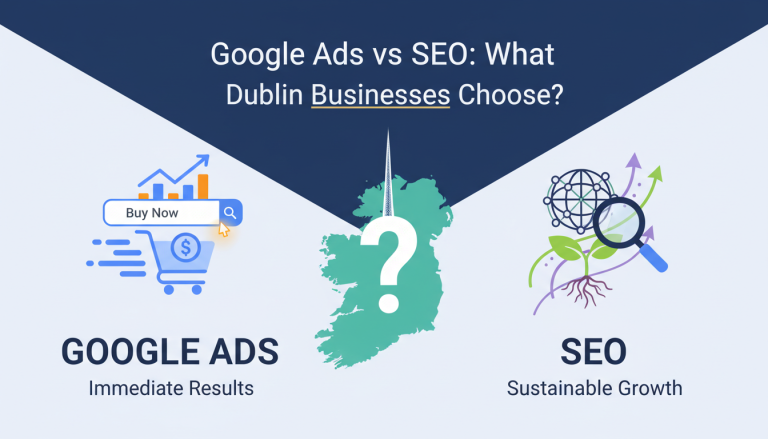 Google Ads vs SEO: What Should Dublin Businesses Choose?
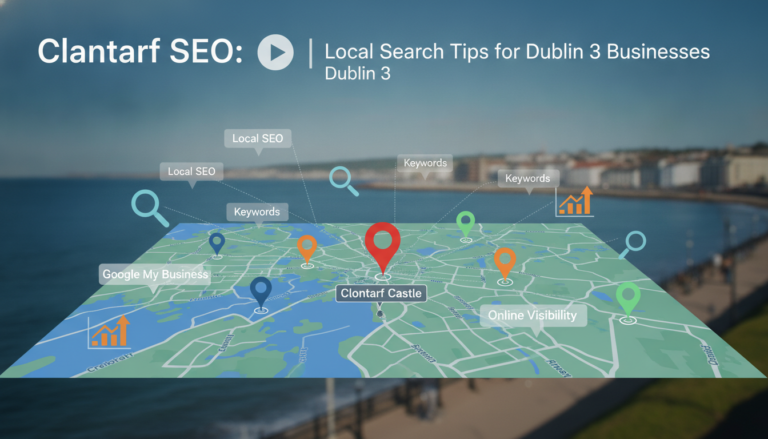 Clontarf SEO: Local Search Tips for Dublin 3 Businesses