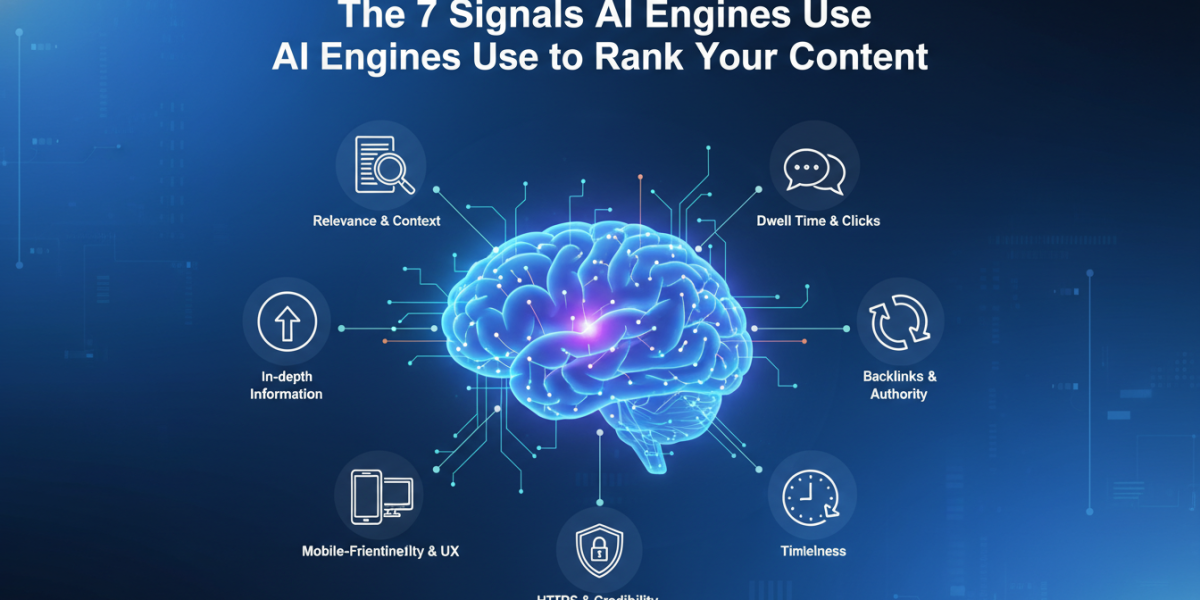
If you’ve spent any time trying to understand why some content rises to the top of search results while other pages disappear into obscurity, you’ve probably heard a lot of conflicting advice. The truth is, the way AI engines rank your content has shifted significantly over the past few years — and most of the old playbooks no longer apply.
AI-powered search engines don’t just count keywords anymore. They’re evaluating your content through a sophisticated lens, weighing multiple signals simultaneously to decide whether your page deserves to be seen. Understanding those signals isn’t just useful — it’s essential if you want your content to perform in 2024 and beyond.
Signal 1: Topical Authority and Content Depth
Why Covering One Topic Well Beats Covering Everything Briefly
AI engines have become remarkably good at identifying whether a piece of content actually knows what it’s talking about. Topical authority is the measure of how comprehensively and consistently you cover a particular subject area, and it’s one of the most powerful signals AI ranking systems use to evaluate content quality.
Think of it this way: if your website publishes 40 articles about digital marketing but only one vague post about SEO, an AI engine will treat you as a general publisher rather than a subject matter expert. In contrast, a site that consistently publishes detailed, interconnected content around a specific niche builds what SEOs call a "topical cluster" — and that structure signals genuine expertise.
Google’s Helpful Content system, introduced and refined since 2022, specifically rewards content created for humans by people with demonstrable knowledge of the subject. A practical example: a financial advice blog that covers budgeting, debt management, savings strategies, and investment basics in depth will consistently outperform a broader lifestyle blog that occasionally touches on money topics.
Signal 2: E-E-A-T — Experience, Expertise, Authoritativeness, and Trustworthiness
Google’s Search Quality Rater Guidelines are publicly available and run to hundreds of pages, but the core concept can be distilled into four letters: E-E-A-T. These aren’t just guidelines for human reviewers — they directly inform how AI ranking systems assess content credibility.
Experience refers to first-hand exposure to a topic. A review written by someone who has actually used a product carries more weight than a summary assembled from other reviews. Expertise relates to the qualifications or deep knowledge brought to a subject. A medical article authored by a licensed physician, for instance, will receive stronger trust signals than one written anonymously.
Authoritativeness grows over time and comes from third-party recognition — backlinks from credible sources, citations, mentions in reputable publications. Trustworthiness is the foundation of all four: it’s about accuracy, transparency, and reliability.
For content creators, this means author bios matter, citing sources matters, and being transparent about who you are and why you’re qualified to discuss a topic matters more than ever.
Signal 3: User Engagement Metrics
The Numbers That Reveal What Words Cannot
AI engines don’t just read your content — they watch how users interact with it. Metrics like dwell time, scroll depth, click-through rate, and bounce rate all feed back into ranking algorithms as proxies for content quality.
If someone clicks on your article and leaves within 10 seconds, that’s a strong signal that your content didn’t deliver what it promised. If readers consistently stay for three or four minutes, scroll through the full page, and then navigate deeper into your site, the algorithm notices.
This is why formatting genuinely matters. Short paragraphs, clear subheadings, and scannable structure don’t just make content easier to read — they actively improve the engagement signals your page sends back to search engines. A wall of unbroken text might contain excellent information, but if readers bounce before they find it, that information becomes effectively invisible.
Signal 4: Semantic Relevance and Natural Language Understanding
Gone are the days when repeating a keyword 20 times guaranteed a ranking. Modern AI engines use Natural Language Processing (NLP) to understand the meaning behind content, not just the words on the page.
Google’s BERT and MUM models, for example, are designed to interpret context, nuance, and relationships between concepts. They can understand that an article about "running shoes for flat feet" is semantically related to topics like pronation, arch support, and orthopedic insoles — even if those exact terms aren’t mentioned repeatedly.
What this means in practice: write naturally, use related terms and concepts organically, and focus on answering the reader’s actual question rather than engineering a keyword density percentage. Content that reads like it was written by a real person who understands the subject will consistently outperform content that reads like it was assembled by an algorithm.
Signal 5: Page Experience and Core Web Vitals
Speed, Stability, and Interactivity — The Technical Backbone of Rankings
Even brilliant content can be penalised if the page it lives on performs poorly. Google’s Core Web Vitals framework measures three key technical signals: Largest Contentful Paint (how quickly the main content loads), Cumulative Layout Shift (how stable the page is as it loads), and Interaction to Next Paint (how responsive the page is to user input).
Practically speaking, if your page takes more than three seconds to load on a mobile device, you’re losing a significant percentage of visitors before they’ve read a single word. Google’s own data suggests that as page load time increases from one second to five seconds, the probability of a mobile user bouncing increases by 90%.
Page experience signals are particularly important for local businesses and regional publishers, where competition for top positions is fierce and technical performance can be the differentiating factor between ranking first and ranking fifth.
Signal 6: Backlink Quality and Link Context
Backlinks remain one of the most enduring ranking signals, but AI engines have become considerably more sophisticated about evaluating link quality. A single link from a highly authoritative, contextually relevant source can carry more weight than 50 links from low-quality directories.
What matters now is the context of the link. A food industry publication linking to your recipe blog sends a very different signal than a random forum post linking to the same page. AI systems evaluate the topical relationship between the linking page and the linked page, the authority of the linking domain, and whether the link appears naturally within relevant content.
Link-building strategies that focus on earning genuine editorial coverage — through original research, useful tools, expert commentary, or genuinely newsworthy content — continue to produce durable results. Tactics designed purely to manipulate link counts, on the other hand, carry increasing risk of algorithmic penalties.
Signal 7: Content Freshness and Update Frequency
When Timeliness Becomes a Ranking Factor
Not every topic requires fresh content — a guide to tying a bowline knot doesn’t need monthly updates. But for time-sensitive topics like industry news, regulatory changes, product comparisons, or health guidance, content freshness is a direct ranking signal.
AI engines use a concept called Query Deserves Freshness (QDF) to identify searches where recent information is particularly important. If you’re publishing in a fast-moving field and your cornerstone articles haven’t been updated in two or three years, you’re likely losing ground to competitors who keep their content current.
A practical approach is to audit your top-performing pages every six months, checking whether statistics, product details, regulatory references, or recommended tools are still accurate. Adding a "last updated" timestamp is a small but meaningful trust signal — it tells both readers and search engines that someone is actively maintaining the content.
Frequently Asked Questions
What’s the single most important signal AI engines use to rank content?
There isn’t one — AI ranking systems are specifically designed to evaluate multiple signals together, and that complexity is intentional. That said, topical authority and E-E-A-T are consistently identified by Google’s own documentation as foundational. Get those two right and the others become much easier to build on.
How long does it take to see ranking improvements after optimising for these signals?
It varies significantly depending on your domain age, competition level, and the scale of changes made. In general, technical improvements like Core Web Vitals can produce results within a few weeks. Content and authority signals typically take three to six months to show measurable movement, sometimes longer in highly competitive niches.
Is AI-generated content treated differently by AI ranking engines?
Google’s official position is that it evaluates content based on quality, not how it was produced. However, AI-generated content that lacks genuine insight, first-hand experience, or accurate information tends to score poorly on E-E-A-T signals. The practical takeaway: AI can be a useful tool in the writing process, but it shouldn’t replace the human expertise and perspective that ranking algorithms are specifically designed to reward.
Do these signals apply equally to local businesses and national brands?
The core signals apply across the board, but their relative importance can shift depending on search intent. For local searches — such as "accountant in Dublin" or "plumber near me" — Google Business Profile optimisation, local citations, and review signals layer on top of the seven factors covered in this article. Local context matters, and regional publishers or service businesses should treat local authority as a distinct optimisation priority.
How do I know which signals my content is currently performing well on?
Tools like Google Search Console, PageSpeed Insights, and Ahrefs provide data on many of these signals directly. Search Console shows click-through rates and impressions; PageSpeed Insights reports Core Web Vitals; Ahrefs covers backlink profiles and topical authority indicators. Regular auditing across these platforms gives you a working picture of where your content stands and where the gaps are.
Conclusion
Ranking well in AI-powered search isn’t about chasing a single magic formula — it’s about understanding how multiple quality signals work together and making deliberate decisions to improve across all of them. Topical authority, E-E-A-T, user engagement, semantic relevance, page experience, backlink quality, and content freshness aren’t separate checklists. They’re interconnected dimensions of a single question: does this content genuinely serve the people searching for it?
The good news is that most of these signals align naturally with producing content that’s actually useful, honest, and well-maintained. When you focus on serving real readers rather than gaming an algorithm, you’re already working in the direction the algorithms want to reward. That alignment isn’t a coincidence — it’s the whole point.
Ready to take your content strategy further? Whether you’re looking to audit your existing content, build a stronger topical authority structure, or simply want expert guidance on where to focus your efforts, our team is here to help. Reach out at any time — email us at info@globeboss.com or call us on +353 1 868 2345 and we’ll be happy to talk through your requirements.