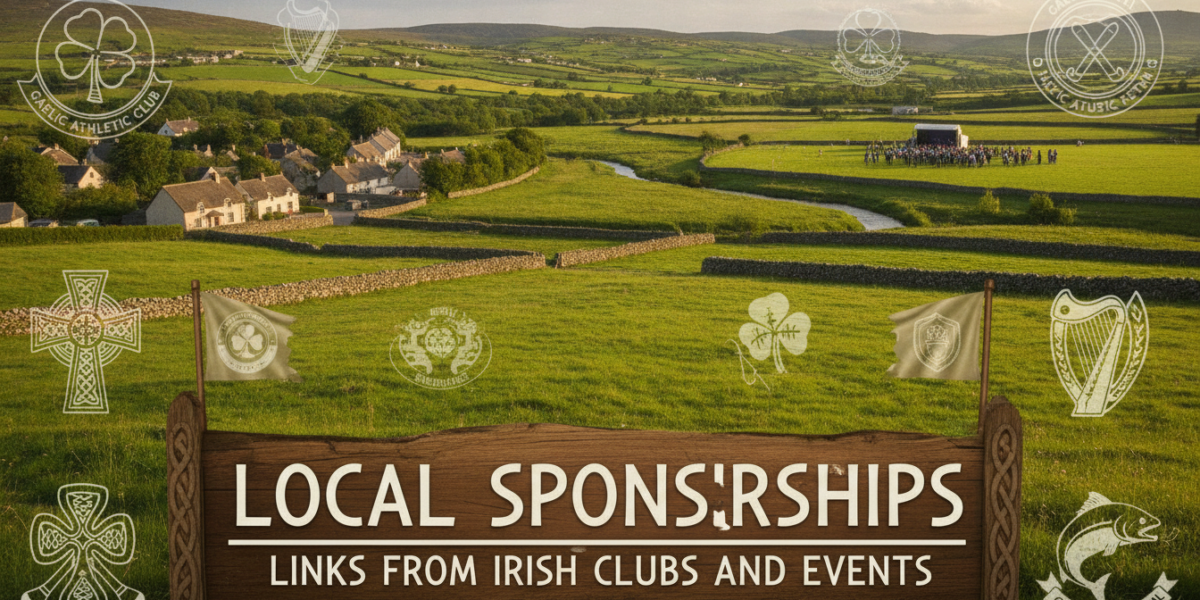
If you run a business in Ireland and you’ve been looking for ways to build local authority online, local sponsorships — and the links they generate — are one of the most underused opportunities available. While the SEO world often obsesses over technical fixes and national content strategies, the quiet power of a well-placed link from a GAA club website, a local festival page, or a community charity event can deliver real, lasting value. This article breaks down how local sponsorships work as a link-building strategy in the Irish context, why they matter more than most people realise, and how to approach them the right way.
Why Local Sponsorships Matter for Irish Businesses
Ireland has a uniquely dense network of local clubs, associations, and community events. GAA clubs alone number over 2,500 across the island. Add in soccer clubs, rugby clubs, tidy towns committees, parish fundraisers, local festivals, credit unions, and school events — and you have thousands of organisations that regularly publish sponsor acknowledgements online, often as dedicated pages with live links to supporter websites.
These aren’t throwaway placements. Many of these organisations have been online for over a decade. Their websites carry age, trust, and genuine local relevance — signals that Google values highly when assessing the credibility of a business in a specific geographic area.
The Link Equity Angle
From a pure SEO standpoint, a link from a local club or event website passes what’s known as "link equity" to your site. When a trusted, established local domain links to your business, it signals to search engines that your site is a legitimate part of that community. Over time, a handful of these links — especially from .ie domains or well-maintained club websites — can meaningfully improve your local search rankings.
The key word is relevance. A link from the Clare GAA county board to a Ennis-based solicitor’s firm isn’t just technically valuable — it’s contextually logical. That’s exactly what modern SEO rewards.
Beyond Rankings: Real-World Visibility
Local sponsorships also deliver something that pure digital tactics can’t replicate: genuine community presence. When your business name appears on the pitch-side banner at a club match, in the programme for a local arts festival, or on the homepage of a school fundraising page, you’re building brand recognition among the exact people most likely to become customers.
This dual return — search engine trust and real-world awareness — is what makes local sponsorships such an efficient channel for small and medium Irish businesses.
How Irish Club and Event Links Work in Practice
What a Typical Sponsorship Link Looks Like
Most Irish clubs and events will offer sponsoring businesses a mention on their website. This can take several forms:
- A dedicated Sponsors page with logos and hyperlinks
- A news article covering the sponsorship announcement
- A social media post tagging the business account
- Placement in digital match programmes or newsletters
The most valuable of these, from an SEO perspective, is the hyperlink on the organisation’s website — ideally using your business name or a relevant descriptor as the anchor text rather than just a plain URL.
Evaluating the Quality of a Club Website
Not all club websites are equal. Before committing to a sponsorship, it’s worth doing a quick check:
- Does the website have a working, live sponsors page? Some clubs list past sponsors who no longer have active links. Check that links are functional.
- When was the site last updated? A site that hasn’t been touched in three years may carry less value than an actively maintained one.
- Is the site indexed by Google? You can check this by searching
site:clubwebsite.iein Google. If pages appear, the site is indexed. - Does the club have a local reputation? A club that draws hundreds of people to matches each weekend has community credibility that extends online.
None of this needs to be overly technical. Even a basic check takes five minutes and helps ensure your sponsorship investment is working as hard as possible.
Types of Irish Organisations Worth Approaching
GAA Clubs
GAA clubs are the obvious starting point. Every county in Ireland has dozens of them, and many are actively seeking local business support. Sponsorship levels vary — a county champion club might charge several thousand euro for a main kit sponsorship, while smaller rural clubs may offer website placement for a few hundred euro, or even in exchange for a service donation.
The link value varies accordingly, but even a modest club in a rural area can provide a genuinely local, trusted signal — particularly if your business operates in that specific region.
Sports Clubs Beyond the GAA
Soccer, rugby, camogie, ladies football, athletics clubs, rowing clubs — Ireland’s sports landscape is broad. Many of these organisations have active websites, engaged social media followings, and a genuine need for local business support.
Smaller sports clubs often offer more flexible arrangements, and their websites sometimes carry surprisingly strong domain metrics simply because they’ve been consistently maintained over many years.
Local Festivals and Cultural Events
Ireland runs hundreds of local festivals every year — from the Galway International Arts Festival (large-scale) down to small tidy towns summer fairs and parish heritage days. Event websites are particularly interesting because:
- They often attract media coverage, which can generate additional backlinks
- They tend to have high local relevance scores
- Many operate year-on-year, meaning a sponsorship can provide recurring link value
Schools, Charities, and Community Groups
School websites in Ireland, particularly those with active parents’ associations, often publish sponsor acknowledgements. Similarly, registered charities and tidy towns groups frequently maintain websites where supporters are listed.
These links carry strong community trust signals, even if the sites themselves aren’t large. A local business supporting a well-known community initiative communicates reliability — both to Google and to potential customers.
Building a Local Sponsorship Link Strategy
Step 1: Map Your Local Area
Start by listing every club, event, festival, school, and community group within your primary service area. If you serve a specific county, that’s your focus. If you’re a hyperlocal business serving a town, narrow your focus accordingly.
A simple spreadsheet works well here — list the organisation name, their website, whether they have a sponsors page, and any contact details.
Step 2: Prioritise Based on Relevance and Quality
Not every organisation on your list is worth approaching. Prioritise based on:
- Geographic relevance — does this club operate in the area you serve?
- Website quality — is the site active and well-maintained?
- Audience alignment — are their members or supporters likely to be your customers?
A family dentist in Killarney, for example, would find far more value in sponsoring a local underage GAA team than a corporate golf club with members who largely live elsewhere.
Step 3: Make Contact Directly and Simply
Most clubs and event organisers are busy volunteers. Your initial contact should be brief, friendly, and practical. State who you are, that you’d like to discuss a local sponsorship, and ask about available packages. A phone call often works better than email at this stage — it’s more personal and faster.
Step 4: Confirm the Digital Agreement
Once you’ve agreed terms, confirm in writing that the package includes a live hyperlink from their website to yours. Ask where the link will be placed and what anchor text will be used. This isn’t being difficult — it’s a reasonable part of the agreement, and any organised club will appreciate the clarity.
Step 5: Track and Maintain
After the link goes live, monitor it periodically to ensure it remains active. Sponsorship pages sometimes get reorganised. A friendly check-in with the club every six months also keeps the relationship warm — which matters if you plan to renew.
Common Mistakes to Avoid
Sponsoring without confirming a link exists. Many businesses pay for local sponsorships and never think to ask whether their website is actually linked. Always confirm this in advance.
Ignoring anchor text. A link that says "Click here" is less valuable than one that uses your business name or location. Most clubs are happy to accommodate a simple request.
Treating it as a one-off. The real value of local sponsorship links builds over time. A business that consistently sponsors three or four local organisations over several years builds a network of trusted, relevant backlinks that compounds in value.
Going too broad. Sponsoring events outside your service area dilutes relevance. A plumber based in Mullingar gets far more benefit from links connected to Westmeath organisations than from a festival in Cork.
Frequently Asked Questions
What does a local sponsorship link actually cost in Ireland?
It varies enormously. A small club website listing might be part of a €200–€500 annual sponsorship package, while a primary placement at a major local festival could cost several thousand euro. For most SMEs, the €250–€750 range is where the best value tends to sit — enough to secure a genuine link placement without overcommitting budget.
How long does it take to see results from local sponsorship links?
SEO results from any link-building activity typically take three to six months to show up meaningfully in rankings. Local sponsorship links are no different, though you may notice an increase in direct branded searches or local awareness sooner. Patience and consistency matter here.
Is it worth getting links from small Irish club websites with low traffic?
Yes — often more than people expect. Traffic volume isn’t the primary measure of link value. What matters is domain trust, relevance, and age. A small but well-maintained GAA club website that’s been live for ten years, regularly updated, and indexed by Google can pass genuine value even if it only gets a few hundred visitors a month.
Can I approach multiple clubs at once?
Absolutely. Many businesses maintain sponsorships with several local organisations simultaneously. In fact, building a small portfolio of five to ten local sponsorship links is a much stronger strategy than relying on a single placement.
Do social media mentions from clubs count as links?
Social media links (from platforms like Facebook, Instagram, or X) are generally "nofollow," meaning they don’t pass direct SEO link equity in the traditional sense. They can still drive traffic and brand awareness, but for pure link-building value, a link on the club’s actual website is what you’re after.
Conclusion
Local sponsorships are one of the most genuinely Irish approaches to building online authority — because they’re rooted in community connection, not algorithmic manipulation. A link from a trusted GAA club, a well-established local festival, or a long-running community charity carries real meaning, both to search engines and to the people in your area who see your name associated with something they care about.
The strategy doesn’t require a large budget or technical expertise. It requires consistency, a bit of research, and a genuine willingness to support the organisations that make your local area what it is. Done right, it’s a link-building approach that improves your rankings, strengthens your brand, and actually gives something back — which is a rare combination in digital marketing.
Ready to explore how local sponsorship links could support your business’s online visibility? Our team works with Irish businesses across a range of industries to develop practical, effective local SEO strategies. Whether you have questions or want to talk through your specific situation, we’re happy to help. Drop us an email at moc.ssobebolg@ofni or give us a call at +353 1 868 2345 — whichever works best for you.
Dublin's ROI-Driven Digital Marketing Agency Home
Related Posts
 Mastering Local Backlinks The Irish Strategy for Authority
 Beyond Guest Posting The 5 High-Value Backlink Tactics for Ireland
 Link Building for Local SEO How to Earn Links in Cork and Galway
 The Best Link Building Strategies for Irish Online Shops
 The 3 Pillars of a White Hat Link Building Strategy in Ireland
 Building a Local Citation Strategy for Irish Business Success
 Stop Chasing Spam Links Build Real Irish Authority with Digital PR
 Local Backlinks Ireland