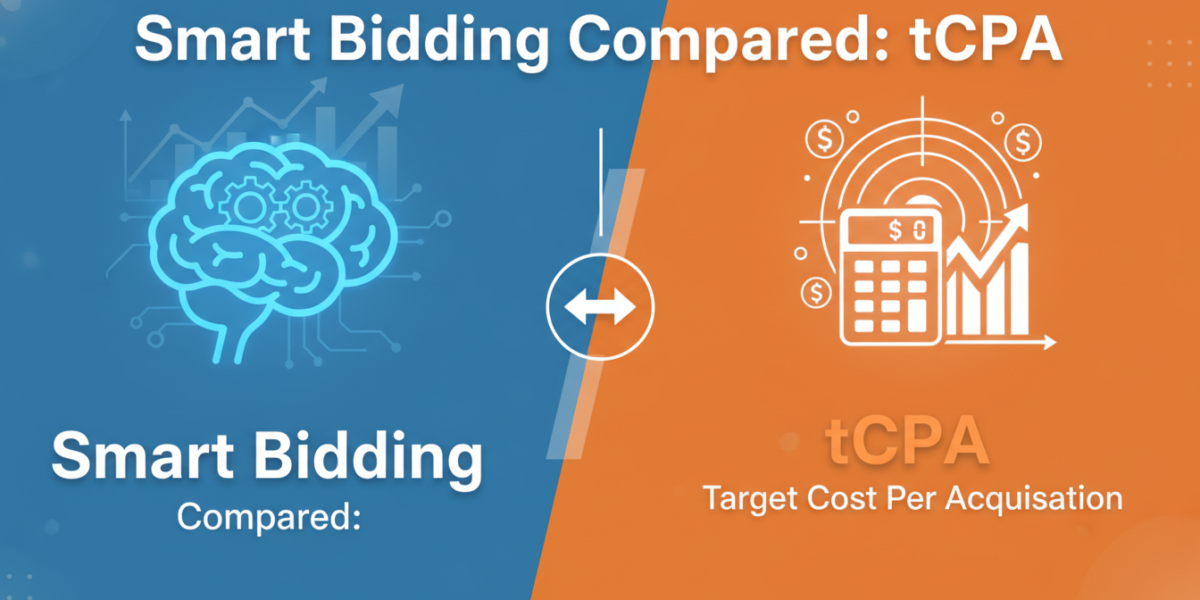
If you’ve spent any time inside Google Ads, you’ve probably come across Smart Bidding — and specifically, target CPA bidding, or tCPA. It sounds straightforward: tell Google what you want to pay per conversion, and the algorithm does the rest. But in practice, tCPA is more nuanced than that pitch suggests. It can be a powerful tool in the right hands, and a frustrating money drain in the wrong setup. This article breaks down how tCPA works compared to other Smart Bidding strategies, what makes it tick, and how to know whether it’s the right fit for your campaigns.
What Is tCPA Bidding?
Target CPA (tCPA) is a Smart Bidding strategy within Google Ads that automatically sets bids for each auction with the goal of getting conversions at or around a cost-per-acquisition you specify. Rather than manually setting bids at the keyword or ad group level, you hand that control to Google’s machine learning system.
Google uses a wide range of signals — device, location, time of day, user intent, browser, and more — to predict the likelihood that a given user will convert. It then adjusts your bid in real time to reflect that probability. The idea is that Google can process far more data, far faster, than any human campaign manager could.
How the Target Actually Works
The "target" in tCPA is an average, not a ceiling. Some conversions will cost more than your target, others less. Over time, Google aims to balance these out so your average CPA lands close to what you’ve specified.
This matters because advertisers sometimes set a tCPA, see one or two conversions come in above target, and panic. The system needs room to breathe. If you’re constantly adjusting the target or budget, the algorithm never has enough consistent data to optimise effectively.
tCPA vs. Other Smart Bidding Strategies
Smart Bidding isn’t just tCPA — it’s a family of automated strategies, each with different objectives. Understanding how they compare helps you choose the right tool for the right campaign.
tCPA vs. tROAS
Target ROAS (return on ad spend) optimises for revenue value rather than just conversions. If you sell products at vastly different price points — say, a €20 accessory and a €500 item — tROAS allows you to prioritise higher-value conversions. tCPA, by contrast, treats all conversions equally regardless of their value.
Use tCPA when your conversion values are roughly uniform (like lead generation, sign-ups, or fixed-price bookings). Use tROAS when conversion value varies significantly and you need the algorithm to chase higher-value outcomes.
tCPA vs. Maximise Conversions
Maximise Conversions doesn’t use a target — it simply tries to get you as many conversions as possible within your budget. This can be useful during the learning phase or when you have a new campaign without enough historical data for a target to be meaningful.
The tradeoff is cost control. Without a CPA target, Maximise Conversions might spend your entire budget efficiently in terms of volume but produce a CPA that makes the economics unworkable. Adding a target CPA constraint effectively converts Maximise Conversions into tCPA behaviour.
tCPA vs. Manual CPC
Manual CPC gives you full control — you set bids, you make the calls. For experienced campaign managers with granular data, it can outperform tCPA in specific niches. But it’s labour-intensive, and it misses the real-time auction signals that Smart Bidding processes automatically.
Most advertisers with consistent conversion volume will find tCPA outperforms manual CPC over time, simply because Google’s signal set is far broader than what’s visible in any dashboard.
When tCPA Performs Best
tCPA isn’t universally superior. It thrives under specific conditions — and struggles when those conditions aren’t met.
Conversion volume is the biggest factor. Google’s own guidance recommends at least 30–50 conversions per month at the campaign level before enabling tCPA. Below that threshold, the algorithm doesn’t have enough data to distinguish meaningful patterns from noise. Campaigns with fewer conversions often perform better with Maximise Conversions first, then transitioning to tCPA once volume builds.
Conversion tracking must be solid. If your conversion events are misconfigured — tracking duplicate conversions, firing on the wrong page, or missing entirely — tCPA will optimise toward the wrong signal. Garbage in, garbage out. Before enabling any Smart Bidding strategy, audit your conversion tracking thoroughly.
Budget headroom matters too. A commonly cited rule of thumb is that your daily budget should be at least 2–3x your tCPA target. If you’re targeting a €50 CPA but your daily budget is €30, the algorithm is perpetually constrained and can’t learn or perform effectively.
Setting a Realistic tCPA Target
One of the most common mistakes is setting a tCPA target that’s wishful rather than grounded in data.
Start by looking at your historical CPA from the past 30–90 days. If your average CPA has been €75, setting a tCPA of €30 isn’t ambitious — it’s counterproductive. The algorithm will become so selective in its bidding that impressions, clicks, and conversions will collapse.
A better approach is to start at or slightly below your historical average. Once the strategy stabilises and you’re seeing consistent conversion volume, you can gradually tighten the target — reducing it by 10–15% at a time and giving the algorithm two to four weeks to adjust before making further changes.
The Learning Period
Every time you make a significant change — adjusting the target, shifting budget, pausing keywords — Google’s algorithm re-enters a learning phase. During this period (typically one to two weeks), performance can be erratic. Bids are being recalibrated, and conversion patterns are being relearned.
This is normal. The mistake is interpreting the learning phase as failure and making more changes, which resets the learning clock again. Patience during this window is genuinely part of the strategy.
Real-World Scenarios Where tCPA Shines
Lead generation campaigns with a consistent form submission or call as the conversion action are ideal for tCPA. A solicitor’s firm generating consultations, a SaaS product capturing free trial sign-ups, or a tradesperson’s business collecting quote requests — all of these have relatively uniform conversion values and predictable intent signals.
E-commerce with fixed-price products also benefits from tCPA when the product range is narrow. A retailer selling one category of item at similar price points can use tCPA to control acquisition costs without the complexity of value-based bidding.
Retargeting campaigns often respond well to tCPA because the audience pool is already warm. The algorithm has stronger signals about intent, conversion probability is higher, and CPAs tend to be lower — making it easier to set a meaningful target.
Common Pitfalls to Avoid
Even well-configured tCPA campaigns can run into problems. Here are the patterns that tend to trip advertisers up:
- Setting targets too low too fast. Gradual adjustments outperform aggressive targets every time.
- Changing too many variables at once. New ad copy, landing page changes, and a revised tCPA target all in the same week make it impossible to diagnose what’s driving performance shifts.
- Ignoring auction insights. If competitors are ramping up spend in your space, your CPA may rise temporarily. That’s not always a tCPA failure — it’s market dynamics.
- Mixing campaign goals in one strategy. If one campaign is chasing brand awareness leads and another is chasing high-intent purchase conversions, they should have separate strategies and separate targets.
tCPA and Campaign Structure
The structure of your campaigns affects how well tCPA can function. Highly fragmented account structures — dozens of small ad groups, each with a handful of keywords — spread conversion data so thinly that no single campaign accumulates enough signal.
Consolidating campaigns where it makes strategic sense can dramatically improve tCPA performance. Google’s algorithm benefits from seeing conversion patterns across broader keyword sets and audience signals. Tighter, more focused campaigns with sufficient volume per campaign tend to outperform fragmented structures under Smart Bidding.
Frequently Asked Questions
What’s the minimum conversion volume needed for tCPA to work?
Google recommends at least 30–50 conversions per month at the campaign level. Below this, the algorithm lacks sufficient data to optimise reliably. If you’re not hitting that volume yet, Maximise Conversions is often a better starting point.
How long does tCPA take to start performing properly?
Expect a learning phase of one to two weeks after enabling tCPA or making significant changes to the target or budget. During this period, performance may be inconsistent. Avoid making further major adjustments until the learning phase is complete.
Is tCPA the same as setting a maximum CPA?
No — this is a common misconception. Your tCPA is an average target, not a hard cap. Individual conversions may cost more or less than your target. The algorithm aims to bring the average in line with your specified goal over time.
Can I use tCPA on a small budget?
It’s possible, but challenging. The general recommendation is that your daily budget should be at least 2–3 times your tCPA target. A very tight budget limits the algorithm’s ability to bid competitively and gather the data it needs to improve.
Should I use tCPA or tROAS for an e-commerce campaign?
It depends on your product range. If your products sell at similar price points, tCPA is simpler and effective. If conversion values vary significantly — for example, orders ranging from €20 to €500 — tROAS is usually the better fit because it allows the algorithm to prioritise higher-revenue outcomes.
Conclusion
tCPA is one of the most practical Smart Bidding strategies available to Google Ads advertisers — but it’s not a set-it-and-forget-it solution. Its performance depends heavily on campaign structure, conversion tracking accuracy, sufficient data volume, and a realistic target grounded in actual historical performance.
Compared to other Smart Bidding options, tCPA sits in a useful middle ground: more controlled than Maximise Conversions, more accessible than tROAS, and more efficient than manual CPC at scale. When the conditions are right, it genuinely delivers — but when they’re not, it needs to be set up correctly before it can. Know your data, give the algorithm room to learn, and adjust gradually. That’s the practical path to making tCPA work.
Want help setting up or auditing your Smart Bidding strategy? Whether you’re just getting started with tCPA or trying to troubleshoot underperforming campaigns, our team is happy to take a look. Reach out at moc.ssobebolg@ofni or give us a call on +353 1 868 2345 — we’ll help you find the approach that fits your goals and budget.
Dublin's ROI-Driven Digital Marketing Agency Home
Related Posts
 Competitor Bidding in Google Ads: Legal, Ethical, Worth It?
 Performance Max Campaigns: A Guide for Irish Advertisers
 How to Optimise Product Descriptions for SEO and Conversions
 How to Segment Your Email List for Higher Conversions
 What is the best way to target rural Irish audiences vs. Dublin city audiences?
 How To Drive More Conversions in Less Time with Facebook Dynamic Ads
 7 Data Driven Content Strategy Tips for Improving Conversions
 From Clicks to Conversions Your CRO Content Playbook