
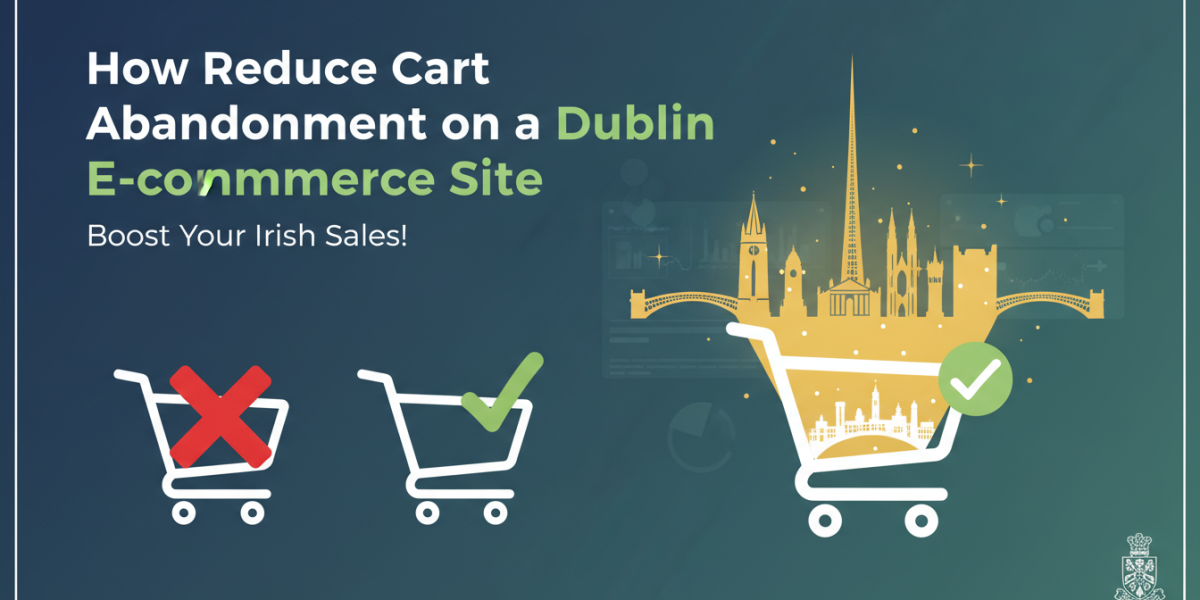
If you’re running an e-commerce business in Dublin, you’ve almost certainly felt the frustration of watching potential customers fill their baskets and then disappear without completing their purchase. Cart abandonment is one of the most common — and costly — challenges facing online retailers today. Industry research consistently puts the average cart abandonment rate at somewhere between 70% and 75%, meaning roughly three out of every four shoppers who add something to their basket never actually buy it. For Dublin-based businesses operating in an increasingly competitive digital landscape, even small improvements in that rate can translate into significant revenue gains.
This guide breaks down the most effective strategies for reducing cart abandonment, with practical steps you can start applying to your own site right now.
Why Shoppers Abandon Carts in the First Place
Before you can fix the problem, it helps to understand what’s actually driving it. The reasons aren’t always what you’d expect.
The Most Common Culprits
According to the Baymard Institute, the top reasons customers abandon their carts include unexpected costs at checkout (shipping, taxes, or fees), being forced to create an account, a checkout process that feels too long or complicated, and concerns about payment security. In an Irish context, there’s an added layer: shoppers here are increasingly savvy and quick to compare prices across UK and EU sites, so if your value proposition isn’t immediately clear, they’ll leave without hesitation.
Another significant factor is simply intent. Not every person who adds an item to a cart is ready to buy — some are browsing, comparing, or saving for later. That segment is harder to convert immediately, but it’s not a lost cause.
Simplify Your Checkout Process
Long checkout forms are checkout killers. Every extra field you ask a customer to fill in is another opportunity for them to give up and close the tab.
Cut the Steps, Keep the Sale
A single-page checkout or a clearly progressed multi-step flow (showing customers exactly where they are in the process) can make a real difference. Studies have found that reducing checkout steps from five to three can lift conversion rates by as much as 20–35%. Shopify’s own data, for example, shows that its one-page checkout increased conversions by 15% after rollout in 2023.
Guest Checkout Is Non-Negotiable
Forcing account creation before purchase is one of the easiest ways to lose a sale. Offer guest checkout as the default, then invite account creation after the transaction is complete — when the customer already has a positive reason to engage with your brand again.
Be Upfront About Costs
Hidden fees are a trust issue, not just a UX issue. When a customer adds a €40 item to their cart only to discover €12 in delivery fees at the final step, they don’t just abandon — they leave with a negative impression of your brand.
The fix here is straightforward: display shipping costs (or a shipping calculator) as early as possible, ideally on the product page itself. If you offer free shipping above a certain threshold — say, free delivery on Irish orders over €50 — make that highly visible throughout the shopping journey, not just tucked away in the footer.
For Dublin customers in particular, same-day or next-day local delivery can be a genuine selling point if you’re able to offer it. Highlighting that option prominently can be the deciding factor for a shopper who’s on the fence.
Optimise for Mobile Shoppers
Mobile commerce in Ireland is growing rapidly. According to Statista, mobile devices now account for more than half of all e-commerce traffic in Ireland, yet mobile conversion rates still lag behind desktop. That gap is almost entirely a UX problem.
Mobile-First Checkout Design
Buttons need to be large enough to tap without pinching the screen. Forms should use the correct keyboard types automatically (numeric for phone numbers, email keyboard for email fields). And your payment flow needs to work smoothly on a small screen — that means testing it yourself, on an actual phone, not just relying on a desktop preview.
Accelerated Payment Options
Integrating Apple Pay, Google Pay, and PayPal can dramatically reduce friction for mobile shoppers. These options let customers complete a purchase in seconds without typing a single card number. For a Dublin retailer trying to capture impulse purchases, this kind of speed matters.
Build Trust at Every Step
A shopper who doesn’t trust your site won’t buy from it, no matter how streamlined your checkout is. This is especially true for smaller or newer Dublin e-commerce businesses competing against well-known platforms.
Trust signals to include throughout your checkout and product pages:
- SSL certificate and HTTPS — non-negotiable for any transactional site in 2024
- Recognised payment logos (Visa, Mastercard, PayPal, Stripe)
- A clear returns policy — Irish consumers have strong statutory rights under EU consumer law, and reassuring customers about hassle-free returns removes a significant buying barrier
- Customer reviews — even a handful of genuine, specific reviews outperform polished marketing copy every time
- Contact details — a visible phone number or live chat option signals that a real business is behind the site
Use Exit-Intent and Abandonment Recovery Tactics
Even with the best checkout experience, some customers will still leave. That doesn’t mean they’re gone forever.
Exit-Intent Popups
An exit-intent popup — triggered when a user’s cursor moves toward the browser’s close button — can offer a last-minute incentive to stay. This might be a small discount, a reminder of what’s in their basket, or simply a prompt to save their cart for later. Done well, these can recover between 5% and 15% of abandoning visitors.
Be careful not to overdo it, though. An intrusive or poorly timed popup can damage the experience for shoppers who were actually about to convert anyway.
Cart Abandonment Emails
A well-crafted cart abandonment email sequence is one of the highest-ROI tools available to e-commerce businesses. The first email, sent within an hour of abandonment, should be a gentle, helpful reminder — not a pushy sales pitch. A second email 24 hours later might include a small discount or highlight a relevant customer review. A third at 72 hours can create mild urgency.
Klaviyo, Mailchimp, and most major email platforms offer built-in abandonment flow templates that integrate with Shopify, WooCommerce, and other popular platforms used by Dublin retailers.
Localise the Experience
This point often gets overlooked, but it matters — especially in a market like Dublin where customers are used to dealing with both domestic and international retailers.
Displaying prices in euro (€) is the obvious baseline, but localisation goes further than currency. Offering delivery timeframes in local terms ("delivery to Dublin 1–3 working days"), referencing Irish consumer protection rights where relevant, and using locally familiar language all help customers feel they’re dealing with a business that understands them.
If your site is built on a global template, it’s worth reviewing it specifically through the lens of an Irish shopper. Small details like referencing An Post as a delivery option, or acknowledging public holidays in your estimated delivery windows, can build a sense of reliability that generic international sites simply can’t replicate.
Analyse Your Abandonment Data
You can’t improve what you don’t measure. Google Analytics 4 and most e-commerce platforms offer funnel visualisation tools that show you exactly where in the checkout process customers are dropping off.
If a large percentage of users abandon at the shipping cost step, that tells you something very specific. If they’re dropping off on the payment page, that might point to a trust issue or a payment method gap. Session recording tools like Hotjar can add qualitative detail — watching recordings of real users navigating your checkout is often the fastest way to spot friction you’d never have noticed otherwise.
FAQ
What is a good cart abandonment rate for an Irish e-commerce site?
The global average sits around 70–75%, so anything below that is above average. Realistically, for a well-optimised Dublin e-commerce site, aiming for a rate of 60–65% is a reasonable target. Niche stores with highly motivated buyers can achieve rates below 60%.
How long should a cart abandonment email sequence run?
A three-email sequence over 72 hours is the most widely recommended approach. The first email within 30–60 minutes of abandonment tends to perform best, as the shopper’s intent is still warm. After 72 hours, the likelihood of recovery drops off significantly.
Is it worth offering a discount to recover abandoned carts?
It can be, but use discounts strategically. If every abandonment email leads with a discount, you risk training customers to abandon on purpose in order to receive one. Reserve discounts for the second or third email in your sequence, or target them specifically at higher-value baskets.
Do I need a developer to reduce cart abandonment, or can I do it myself?
Many improvements — like simplifying your checkout form, adding trust badges, or setting up abandonment emails — can be done through your existing platform’s settings without custom development. More complex work, like redesigning your checkout flow or integrating new payment methods, may benefit from a developer’s input.
How does GDPR affect cart abandonment emails in Ireland?
Under GDPR and Irish Data Protection Commission guidance, you need a lawful basis to send cart abandonment emails. For most e-commerce businesses, this is typically "legitimate interests" — but you need to have documented this and ensured customers are informed of it in your privacy policy. If in doubt, consult a data compliance specialist or your platform’s built-in compliance tools.
Conclusion
Reducing cart abandonment on a Dublin e-commerce site isn’t about finding one magic fix — it’s about removing friction at every stage of the journey, building genuine trust, and staying connected with shoppers who weren’t quite ready to buy the first time around. The businesses that do this well tend to share a common approach: they look at their checkout from the customer’s perspective, they measure what’s actually happening rather than guessing, and they keep iterating.
Start with the fundamentals — transparent pricing, a streamlined checkout, mobile optimisation, and a solid abandonment email flow. Once those are in place, layer in more advanced tactics like exit-intent tools and localised content. Even modest improvements in your abandonment rate can have a meaningful impact on monthly revenue without requiring any additional advertising spend.
Ready to improve your e-commerce performance and recover more sales? Whether you’re looking for tailored advice, a full site review, or help implementing the right tools for your Dublin business, our team is here to help. Get in touch at moc.ssobebolg@ofni or call us on +353 1 868 2345 — we’re happy to talk through your options and find the right approach for your site.
Related Posts
 How to Reduce Cart Abandonment on Your Irish E-Commerce Site
 Why do Dublin e-commerce sites need technical SEO?
 Globe Boss E-commerce Marketing Dublin
 How to Pass Core Web Vitals on a Dublin WordPress Site
 Why Site Architecture Matters More Than Keywords for E-Commerce
 Conversion Rate Optimization for Dublin E-commerce Sites
 Secure Your Site & Boost Rankings | Dublin SEO SSL Help
 Dublin Web Developers | Build a Site That Ranks