
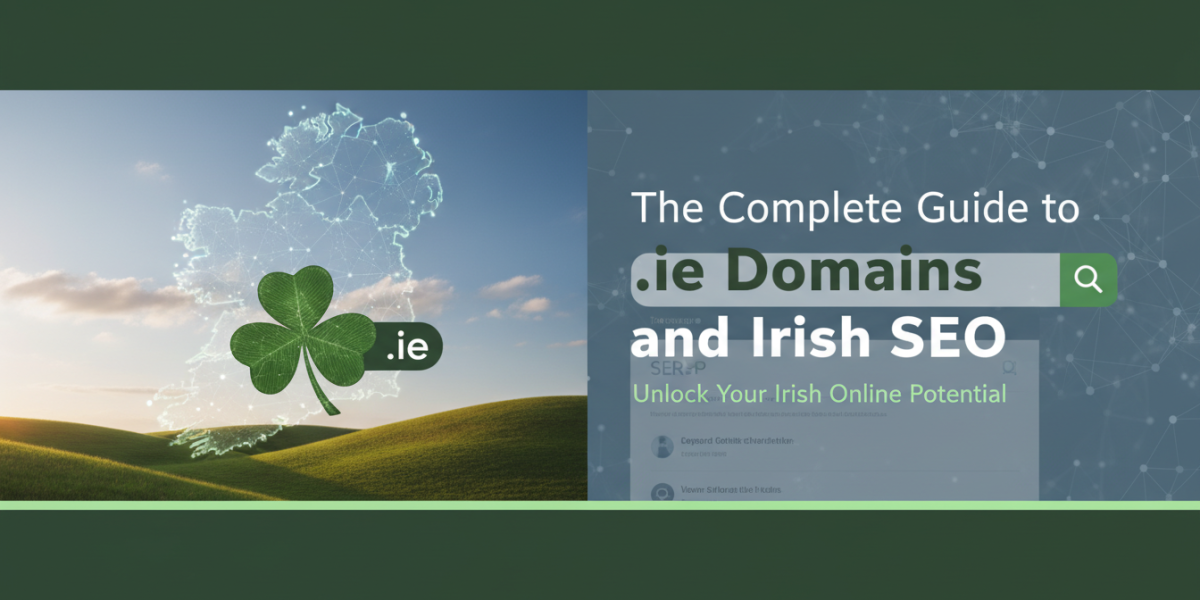
If you’re running a business in Ireland — or targeting Irish customers online — your choice of domain extension matters more than you might think. A .ie domain is far more than a digital address. It’s a trust signal, a local SEO asset, and in many cases, the single clearest way to tell both Google and your customers that your business is firmly rooted in Ireland. This guide covers everything you need to know about .ie domains and Irish SEO, from registration requirements to practical optimisation strategies that actually move the needle.
What Is a .ie Domain and Why Does It Matter for Irish SEO?
A .ie domain is Ireland’s country-code top-level domain (ccTLD), managed by the IE Domain Registry (IEDR). It was established to give Irish individuals and organisations a clearly identifiable online presence, and today it’s one of the strongest signals you can send to both users and search engines that your business operates within Ireland.
From a pure SEO perspective, Google treats ccTLDs as strong geographic signals. When someone in Dublin searches for a local service, Google’s algorithm weighs the domain extension as part of its relevance assessment. A .ie domain tells Google: this site is for Ireland. That alone can give you a meaningful edge over a .com or .co.uk competitor targeting the same audience.
Beyond the algorithm, there’s a human element. Irish consumers tend to trust .ie domains more than generic alternatives. A 2021 IEDR survey found that 73% of Irish internet users considered a .ie domain more trustworthy for businesses operating in Ireland. That trust translates into higher click-through rates and lower bounce rates — both of which feed back into your SEO performance.
Understanding .ie Domain Registration Requirements
Who Can Register a .ie Domain?
Unlike .com or .net domains, which anyone worldwide can register, .ie domains have eligibility criteria. To register one, you need to demonstrate a real and substantive connection to Ireland. This can be established through:
- Irish citizenship or residency
- A registered Irish business (companies registered with the Companies Registration Office qualify automatically)
- An Irish trademark corresponding to the domain name
- An association or organisation with a presence in Ireland
The IEDR has tightened these requirements over time to protect the integrity of the namespace. This is actually a good thing — it means a .ie domain carries genuine credibility that a .com never can.
How Long Does Registration Take?
Standard .ie domain registration through an accredited registrar typically completes within 24 to 72 hours, once your eligibility documentation is verified. Some registrars offer faster processing for straightforward applications. Renewals are annual or multi-year, and it’s worth setting calendar reminders — a lapsed .ie domain can be snapped up quickly, and recovering it can be costly or impossible.
.ie Domains vs. .com for Irish Businesses
This is one of the most common questions businesses ask when setting up online, and the answer isn’t always black and white.
If your entire customer base is in Ireland, a .ie domain is almost always the stronger choice. It signals local intent, builds trust with Irish consumers, and gives you a structural SEO advantage in geo-targeted search results. For a local solicitor’s firm in Cork, a physiotherapy clinic in Galway, or an Irish e-commerce store, the .ie extension is a no-brainer.
If you’re an Irish company with significant international ambitions — say, a SaaS startup targeting the US and EU markets — a .com might serve your global positioning better, with a .ie as a secondary domain redirecting to it. Many Irish companies use both: the .com for global presence, the .ie for the Irish market specifically.
The key mistake to avoid is registering a .com simply because it feels more "professional." That perception is fading fast. Irish audiences increasingly see .ie as the mark of a legitimate local business, while .com can feel anonymous or generic by comparison.
Irish SEO: How to Optimise Your .ie Website for Local Search
Google Search Console and Geo-Targeting
If you’re using a .ie domain, Google automatically interprets your site as relevant to Ireland — you don’t need to manually set a target country in Google Search Console. This is one of the practical advantages ccTLDs have over generic extensions, where you’d need to configure geographic targeting explicitly.
That said, it’s still worth verifying your site in Search Console and monitoring your performance data by country. You want to confirm that your Irish traffic is healthy and growing, and spot any indexing issues early.
On-Page SEO for the Irish Market
Writing for Irish audiences means more than dropping in the occasional "Dublin" or "Ireland" reference. It means understanding how Irish users actually search.
A few practical considerations:
- Use Irish spellings and terminology where relevant (e.g., "solicitor" not "attorney," "estate agent" not "realtor").
- Include location-specific pages if you serve multiple counties or cities — a dedicated page for Cork, Limerick, or Waterford services is far more effective than a generic "we serve all of Ireland" statement.
- Reference local landmarks, events, or context where it makes sense. A blog post mentioning planning permission processes under Irish law, for example, is far more useful to an Irish reader than a generic post about construction.
Local Citations and Irish Directories
Consistent NAP (Name, Address, Phone number) data across Irish directories is a cornerstone of local SEO. Priority listings to pursue include:
- Golden Pages (goldenpages.ie)
- Yelp Ireland
- Bing Places (still relevant for a meaningful slice of Irish search traffic)
- Google Business Profile — arguably the most important of all
Your Google Business Profile is especially powerful. A fully optimised profile — with accurate hours, recent photos, a keyword-rich description, and genuine customer reviews — can push you into the Google Local Pack for relevant searches. That three-pack of map results captures a disproportionate share of clicks for local intent queries.
Building Irish Backlinks
Link building in an Irish SEO context means earning links from Irish-relevant sources. These carry more weight for your local rankings than a generic link from an unrelated international site.
Practical approaches include:
- Getting listed in Irish trade association directories (e.g., ISME, Ibec, Construction Industry Federation)
- Earning coverage in Irish media — regional outlets like the Irish Examiner, RTE, or local papers are gold
- Partnering with complementary Irish businesses for genuine cross-links
- Sponsoring local events or charities — these often come with a web mention
Quality matters far more than quantity. A single link from a well-regarded Irish news site will do more for your rankings than fifty links from irrelevant international directories.
Technical SEO Considerations for .ie Websites
Site Speed and Core Web Vitals
Google’s Core Web Vitals — Largest Contentful Paint (LCP), Interaction to Next Paint (INP), and Cumulative Layout Shift (CLS) — are now confirmed ranking factors. Irish websites often lag behind UK and US counterparts here, partly because smaller development budgets lead to bloated WordPress installs or unoptimised images.
Run your site through Google PageSpeed Insights regularly. Target an LCP under 2.5 seconds, and compress images using modern formats like WebP. If your hosting server is based outside Ireland or the EU, consider switching — server proximity affects load times, and a Dublin-based server will typically deliver faster response times to Irish users.
HTTPS and Security
Every .ie site should be running HTTPS. This has been a Google ranking factor since 2014, and browsers now actively flag HTTP sites as "not secure" — a trust killer, especially for e-commerce or professional services. Most reputable Irish hosting providers include free SSL certificates through Let’s Encrypt.
Mobile Optimisation
Over 60% of web traffic in Ireland now comes from mobile devices, consistent with global trends. Google indexes mobile-first, meaning your mobile site performance directly affects your rankings. Test your site with Google’s Mobile-Friendly Test tool, and prioritise responsive design over separate mobile URLs.
Frequently Asked Questions
What is the cost of registering a .ie domain?
The cost varies by registrar, but typically ranges from €10 to €30 per year for a standard .ie domain. Premium or previously registered domains may cost significantly more. Shop around among IEDR-accredited registrars, as pricing and support quality vary.
Do I need a .ie domain to rank well in Irish search results?
Not strictly — a well-optimised .com with strong Irish SEO signals can rank in Ireland. However, a .ie domain gives you a structural advantage, particularly for local and geo-targeted searches. For businesses primarily serving the Irish market, it’s strongly recommended.
How do I transfer my existing website to a .ie domain without losing SEO rankings?
The key steps are: set up 301 redirects from all old URLs to the new .ie equivalents, update your Google Search Console property, resubmit your sitemap, and update your NAP information across all directories. Done properly, most sites recover their rankings within four to eight weeks.
Is it worth having both a .com and a .ie domain?
Often, yes — especially for established businesses. You can register both and redirect the .com to the .ie (or vice versa), protecting your brand across both extensions. Just ensure only one version is indexed by Google to avoid duplicate content issues.
How important are Google reviews for Irish local SEO?
Extremely important. Google reviews directly influence your Local Pack rankings and click-through rates. Aim to build a steady stream of genuine reviews over time rather than seeking a sudden surge, which can trigger Google’s spam filters.
Conclusion
A .ie domain is one of the most cost-effective investments an Irish business can make in its online presence. When combined with a solid Irish SEO strategy — covering on-page optimisation, local citations, quality backlinks, and technical health — it creates a compounding advantage that generic domain extensions simply can’t replicate.
The businesses that win in Irish search results aren’t necessarily the ones with the biggest budgets. They’re the ones that understand their local audience, speak to them authentically, and give Google every structural reason to rank them first. A .ie domain, used strategically, is your foundation for doing exactly that.
Ready to Improve Your Irish Online Presence?
Whether you’re just getting started with a .ie domain or you want to sharpen your existing Irish SEO strategy, our team is here to help. We work with Irish businesses of all sizes — from sole traders to established companies — and we’d be happy to talk through your specific situation.
Get in touch today:
📧 Email us at moc.ssobebolg@ofni
📞 Call us on +353 1 868 2345
We’ll walk you through your options, answer your questions, and help you figure out the best path forward — no pressure, no jargon.
Related Posts
 Googleʼs Query Fan-Out R4T-Diffusion: Impact On Irish SEO Tactics
 Is Your Irish Business Website Inside Google AI Retrieval Pipeline? Check Now
 Find Sources Shaping AI Answers: Guide For Irish Digital Marketers
 Agentic Commerce Hype Versus Reality: Irish E-Commerce Brand Guide
 Creating Professional AI Videos with Gemini Omni: A Guide for Irish Marketers
 Frequently Asked SEO Questions: A Complete Guide by Globe Boss SEO Agency Dublin
 Performance Max Campaigns: A Guide for Irish Advertisers
 Local SEO for Dublin 2 Businesses: A Complete Guide